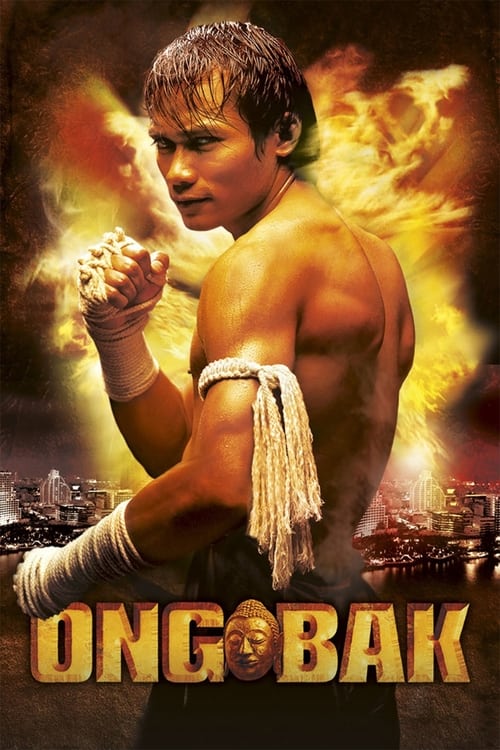
Ong-Bak
The Sacred Head Must Be Returned (Muay Thai as Meditation)
Directed by Prachya Pinkaew
Beneath the bone-cracking spectacle is a Buddhist parable. The village's Buddha head is stolen — the sacred center removed. Ting's mission is restoration: returning the divine to its proper place. His body is the instrument; his training is meditation made kinetic. The violence serves dharma.
Ong-Bak appears to be a showcase for Tony Jaa's extraordinary physical abilities — and it is. But Tony Jaa is also a practitioner of Theravadan Buddhism whose martial arts training is inseparable from spiritual discipline. The film's plot is a Buddhist teaching: the sacred has been stolen from the community, and only one trained in both body and spirit can retrieve it. The head of Ong-Bak — the village's Buddha statue — is taken by criminals who see it as merchandise. Ting, the young monk-in-training, must enter the corrupt city to recover it. His journey is descent: from rural purity into urban degradation, from monastic discipline into underworld chaos. But Ting does not become corrupted. His training holds. His center remains intact precisely because the center he seeks to restore is already within him. The violence in Ong-Bak is not gratuitous. It is dharmic action — force applied in service of sacred restoration. Ting does not seek fights; fights find him. He does not kill; he incapacitates. His body is the instrument of a purpose larger than himself. This is the warrior-monk tradition: martial arts as moving meditation, combat as spiritual practice.
The Surface
Ong-Bak introduced Tony Jaa to the world and revived interest in authentic martial arts cinema. No wires, no CGI, no stunt doubles — just a human body doing things that seem impossible. The film became famous for its action sequences: the chase through Bangkok, the fight club battles, the climactic confrontation.
Western audiences saw spectacle. Thai audiences saw something more: a story about the relationship between village and city, tradition and modernity, sacred and profane. The Buddha head's theft is not just a plot device. It is an image of what modernization does to traditional culture — extracting the sacred center and selling it to the highest bidder.
Tony Jaa's background is essential to understanding the film. He trained at a Buddhist temple. His Muay Thai is not separate from his spiritual practice — it is an expression of it. When he performs on screen, he is demonstrating what disciplined Buddhist practice looks like when it manifests through the body.
The Stolen Center
The village of Ban Nong Pradu has one sacred object: the head of Ong-Bak, a Buddha statue that has protected the community for generations. When it is stolen, the village loses more than an artifact. It loses its spiritual anchor — the visible symbol of its connection to dharma.
This theft literalizes something that happens constantly in the modern world. Sacred traditions are extracted, commodified, sold. Temple art ends up in private collections. Spiritual practices become wellness products. The sacred center is removed and replaced with nothing.
Ting's mission is restoration — returning the sacred to its proper place. This is not about nationalism or tribalism. It is about recognizing that communities need visible symbols of their highest values, and that those symbols must be protected from those who see only merchandise.
The criminals who steal the head have no concept of its sacredness. They see weight, material, market value. This blindness to the sacred is the film's diagnosis of modernity: a worldview that can price everything and value nothing.
Descent into the City
Ting's journey from village to Bangkok follows initiatory structure: the hero must descend into the underworld before he can complete his mission. The city is that underworld — a realm of corruption, exploitation, and violence that tests everything the village taught him.
Bangkok in the film is not depicted neutrally. It is shown as a place where bodies are commodities (the fight clubs), where heritage is merchandise (the antiquities trade), where human connection is transactional. Ting walks through this realm without becoming part of it.
His resistance to corruption is not moral superiority. It is the fruit of training. The monastic discipline that shaped his body also shaped his mind. He can witness depravity without being seduced by it because his center is established. He knows who he is and why he is there.
This is the test every initiate faces: can you enter the realm of shadows without losing yourself? Can you engage with corruption without being corrupted? Ting's answer is physical: his body refuses to become an instrument of greed or ego. It remains an instrument of dharma.
Violence as Dharmic Action
Buddhist teaching generally emphasizes non-violence. Yet warrior-monk traditions exist throughout Buddhist history — Shaolin monks, Thai temple fighters, Japanese sohei. How do we reconcile combat with compassion?
The film's answer is intention and restraint. Ting never initiates violence. He responds to attacks. He never kills when incapacitation is sufficient. He takes no pleasure in hurting opponents. His violence is instrumental — the minimum force necessary to accomplish dharmic purpose.
The fight scenes make this visible. Ting's face shows no anger, no bloodlust, no ego-satisfaction. He is doing what must be done with the tools he has been given. The spectacular moves are not showmanship — they are efficiency. End the fight quickly so no more harm is necessary.
This is the warrior-monk teaching: violence is sometimes unavoidable in a world that contains violent people. The question is whether you use it in service of ego or in service of something larger. Ting's violence serves the sacred. His body is the instrument; dharma is the master.
The Body as Temple
Tony Jaa's physical performance is itself a teaching. His body does things that seem to violate physical law — the jumps, the rotations, the impacts absorbed and delivered. This is not natural talent alone. This is what decades of disciplined practice produce.
The film makes no distinction between Jaa's martial training and his spiritual practice because in the Muay Thai tradition, there is no distinction. The body is trained as the mind is trained. The discipline that produces extraordinary physical ability is the same discipline that produces mental clarity and spiritual stability.
When we watch Jaa perform, we are watching meditation in motion. The centered attention, the precise awareness, the complete commitment to each moment — these are meditative qualities expressed physically. The body becomes a demonstration of what consciousness can do when properly trained.
This is the film's deepest teaching: the body is not an obstacle to spiritual development. The body, properly trained, is a vehicle for it. The temple Ting serves is not only the one in his village. His body is also a temple — maintained, disciplined, dedicated to sacred purpose.
The Transmission
Ong-Bak transmits something that action cinema rarely carries: the possibility that physical mastery and spiritual development are the same path. Tony Jaa's body is proof that Buddhist discipline produces extraordinary capacity — not despite the flesh but through it.
The film also transmits a warning: the sacred can be stolen. Communities can lose their centers. Traditions can be commodified into extinction. The forces that took Ong-Bak's head are the same forces that extract sacred objects worldwide, turning heritage into product.
But the film ends with restoration. Ting returns the head to its place. The village is made whole. The message is not despair but possibility: what has been taken can be recovered. What has been scattered can be reassembled. But it requires someone trained for the task — someone whose body and spirit have been forged into a single instrument of restoration.
Questions this film answers
What is the deeper meaning of Ong-Bak?
Ong-Bak appears to be a showcase for Tony Jaa's extraordinary physical abilities — and it is. But Tony Jaa is also a practitioner of Theravadan Buddhism whose martial arts training is inseparable from spiritual discipline. The film's plot is a Buddhist teaching: the sacred has been stolen from the community, and only one trained in both body and spirit can retrieve it. The head of Ong-Bak — the village's Buddha statue — is taken by criminals who see it as merchandise. Ting, the young monk-in-training, must enter the corrupt city to recover it. His journey is descent: from rural purity into urban degradation, from monastic discipline into underworld chaos. But Ting does not become corrupted. His training holds. His center remains intact precisely because the center he seeks to restore is already within him. The violence in Ong-Bak is not gratuitous. It is dharmic action — force applied in service of sacred restoration. Ting does not seek fights; fights find him. He does not kill; he incapacitates. His body is the instrument of a purpose larger than himself. This is the warrior-monk tradition: martial arts as moving meditation, combat as spiritual practice.
What is the hidden symbolism in Ong-Bak?
Ong-Bak introduced Tony Jaa to the world and revived interest in authentic martial arts cinema. No wires, no CGI, no stunt doubles — just a human body doing things that seem impossible. The film became famous for its action sequences: the chase through Bangkok, the fight club battles, the climactic confrontation.
What esoteric traditions appear in Ong-Bak?
Ong-Bak draws from Buddhism, Initiation traditions. Beneath the bone-cracking spectacle is a Buddhist parable. The village's Buddha head is stolen — the sacred center removed. Ting's mission is restoration: returning the divine to its proper place. His body is the instrument; his training is meditation made kinetic. The violence serves dharma.
What does Ong-Bak teach about the stolen center?
The criminals see weight, material, market value. This blindness to the sacred is the film's diagnosis of modernity. The village of Ban Nong Pradu has one sacred object: the head of Ong-Bak, a Buddha statue that has protected the community for generations. When it is stolen, the village loses more than an artifact. It loses its spiritual anchor — the visible symbol of its connection to dharma.
What does Ong-Bak teach about violence as dharmic action?
Ting's violence serves the sacred. His body is the instrument; dharma is the master. Buddhist teaching generally emphasizes non-violence. Yet warrior-monk traditions exist throughout Buddhist history — Shaolin monks, Thai temple fighters, Japanese sohei. How do we reconcile combat with compassion?
Is Ong-Bak worth watching for spiritual seekers?
Ong-Bak (2003) directed by Prachya Pinkaew is essential viewing for those interested in Buddhism, Initiation, Martial Arts. The Sacred Head Must Be Returned (Muay Thai as Meditation). It rewards multiple viewings and contemplation.
Rewatch With New Eyes
Now that you've seen the architecture, experience it again. The same film becomes a different film when you know what to watch for.
This time, watch for:
- See impermanence: what clings, what releases, what remains
- Mark the threshold: the old self dies, the ordeal transforms, the new self returns
Links may include affiliate partnerships that support Media Revelations
The Descent Continues
Where this thread leads next.
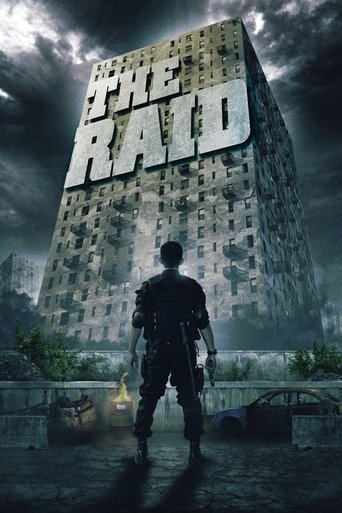
The Raid 2012
The Raid Is a Vertical Ascent Through Hell, One Floor of Suffering at a Time
Read the revelation →