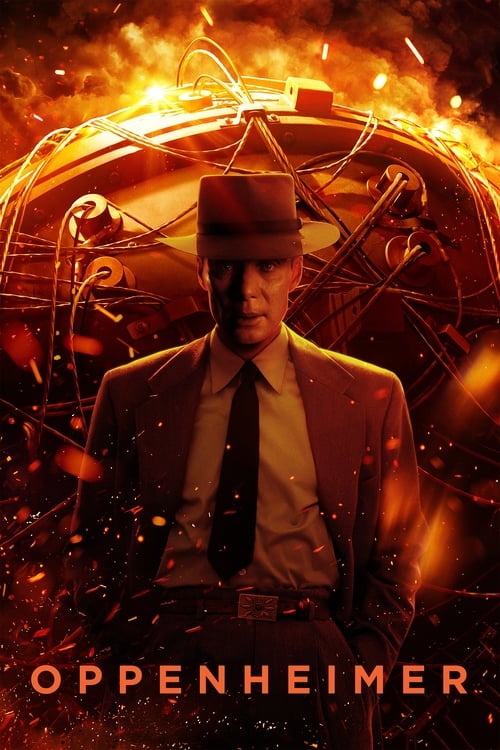
Oppenheimer
The Bhagavad Gita Quoted by the Man Who Just Became Shiva
Directed by Christopher Nolan
Nolan filmed a Faustian tragedy whose protagonist read the Bhagavad Gita in Sanskrit and quoted Krishna at the moment of detonation because he had spent fifteen years preparing to be the one who would speak Krishna's line when it became applicable. The Trinity test is not the climax. The climax is the security hearing — the slow ritual dismemberment of the man who became God for ninety seconds and was then assigned to be the warning the country needed about the men who become gods for ninety seconds.
Oppenheimer is the most theologically serious mainstream American film of the 2020s and Nolan's most mature work. Nolan has spent his career composing films about men whose minds outrun the moral apparatus available to them. With Oppenheimer he has finally found the historical figure whose actual biography contains the structure he has been approximating in fiction. J. Robert Oppenheimer learned Sanskrit so he could read the Gita in the original. He chose Krishna's terrible line — 'Now I am become Death, the destroyer of worlds' — as his self-narration at the moment of the Trinity test. He spent the rest of his life paying for the position he had voluntarily entered. Nolan films the entire arc as initiation: the candidate selected by talent, the years of preparation, the encounter with the unbearable, the wound that does not close, the eventual stripping by the institution that needed the candidate to perform the role and then needed someone to scapegoat for what the role required. The Strauss-led security hearing is not bureaucratic vindictiveness. It is the public ritual by which the culture that benefited from the bomb processes its complicity by symbolically destroying the man who built it. Oppenheimer signs the document of his own dismantling because he understands, finally, that this is the cost of the position he accepted in 1942.
The Surface
The film tracks J. Robert Oppenheimer from his student years in Europe through the Manhattan Project to the Atomic Energy Commission security hearing that destroyed his clearance in 1954, interlaced with the 1959 Senate confirmation hearing of Lewis Strauss who orchestrated Oppenheimer's destruction. The film is structured around two color schemes: 'Fission' (Oppenheimer's color, subjective, the path of decision and consequence) and 'Fusion' (Strauss's color, objective, the institutional retaliation). The Trinity test is approximately at the film's midpoint. The hearings dominate the back half. The film ends with the conversation at the lake between Oppenheimer and Einstein — the conversation Strauss imagined was about him but was actually about the chain reaction that would never end.
On release the film was a commercial and critical triumph. It won seven Academy Awards. Cillian Murphy's performance, Hoyte van Hoytema's cinematography, Ludwig Göransson's score, and Nolan's screenplay were all recognized. Most discussion has stayed at the level of biography and craft.
Underneath, the film is conducting an extended inquiry into what happens to a man who voluntarily enters a position that requires him to do something the entire moral apparatus of his civilization is unprepared for. Oppenheimer is not portrayed as a hero or as a villain. He is portrayed as the candidate who was selected for an initiation he agreed to, did not fully understand, and could not later refuse. The film treats his post-Trinity behavior — the warnings, the political fragility, the entanglement with Communist Party adjacent figures, the eventual inability to defend himself — as the predictable cost of the position he occupied during the project.
The Gita and the Man Who Learned Sanskrit
Oppenheimer's connection to the Bhagavad Gita is not a piece of biographical color. It is the structural key to who he was. He studied Sanskrit at Berkeley in the 1930s under Arthur Ryder. He read the Gita in the original. He quoted from it for the rest of his life. He gave copies to colleagues. When asked years later what he was thinking at Trinity, he gave the famous line — 'Now I am become Death, the destroyer of worlds' — and the context: Krishna is revealing his cosmic form to Arjuna, who is paralyzed by the prospect of the battle he must lead, and Krishna's revelation is intended to inform Arjuna that he is the instrument by which a vast cosmic operation is taking place, that the deaths will happen whether he participates or not, and that his duty as warrior is to perform his function without attachment to the outcome.
Oppenheimer chose the Gita as his interior text because he understood, perhaps earlier than anyone else on the project, that he was being asked to occupy Krishna's role. He was being asked to instruct other scientists that the deaths would happen, were going to happen, and that the responsibility was to perform the function. He pre-arranged the moral framework that would allow him to do the job. Nolan films this with appropriate weight. The Sanskrit scenes in Berkeley are not decorative. They are showing the man assembling the spiritual apparatus he would need.
The Gita is uncomfortable to most Western readers because it appears to license violence in service of duty. The deeper teaching is more subtle: the verses are addressed to a warrior who has already been called to a battle that will occur. The question is not whether to fight. The question is how to fight from a position of non-attachment to outcome. Oppenheimer's tragedy is that he managed the non-attachment during the project and was destroyed by the attachment that finally arrived afterward. The mature Krishna would not have been politically destroyed by his own creations. Oppenheimer was not Krishna. He was Arjuna who had been given Krishna's lines to read and had read them too long without yet receiving Krishna's wisdom.
The Florence Pugh scene — Jean Tatlock asking him to read from the Gita in bed and selecting that specific verse — is one of the most loaded sequences in twenty-first century cinema. The line is uttered in a private erotic context before it is uttered in the public historical one. The film is showing that the line was already in him, already rehearsed, already part of his self-narration before the historical moment that made the line famous. This is what the position requires. The line was prepared. The historical moment was the moment the line became applicable.
Trinity as Threshold
The Trinity sequence is the film's structural center. Nolan shoots it largely silent in the moments after the flash. The explosion is shown without sound for several seconds. Then the shock wave arrives. Then the men in the bunker can breathe again. Oppenheimer, watching, says the line internally. The film does not stage the line as triumphal. The film stages it as the words a man speaks when he has just discovered that what he intellectually knew was going to happen has actually happened.
Initiation in every tradition has the same structural feature: the candidate is told, in advance, what will occur, but cannot fully understand until it occurs. The instructor's words turn out to have been pointing at something the language could only gesture toward. The moment of contact with the actual phenomenon is the moment the previous understanding is recognized as inadequate. Oppenheimer had spent years describing what a critical mass would do. He had calculated yields. He had reviewed test data. None of it prepared him for the experience of standing in the desert and witnessing the operation. The line he had pre-prepared was the only language available, and even it failed to contain what had just occurred.
Nolan's most precise touch is the post-Trinity sequence in the Los Alamos auditorium. Oppenheimer is being celebrated. The room is cheering. He attempts to speak. He has stage-prepared remarks about pride and victory. The remarks come out of him hollow because his interior is occupied by what he saw the desert do. He looks at the room and briefly hallucinates the flesh of the celebrants peeling away. A woman's face becomes a charred skull. A young man's body becomes ash. This is what the position has given him — a permanent overlay of the bomb's effect on every human form he sees. He cannot turn it off. He never turns it off.
The initiation is complete. He has crossed the threshold. He is now the man who has seen the consequence of his own work. He cannot go back to the man who had not seen it. The rest of his life is what is available to a person on the other side of that threshold.
Strauss and the Public Dismemberment
Robert Downey Jr.'s Lewis Strauss is the film's most underappreciated character. He is not a simple villain. He is the Shadow figure the larger institution required. The post-war American security state needed someone who would do the work of destroying Oppenheimer in public. Strauss volunteered. He had his personal reasons — a snub, a humiliation, an envy. The institution had its structural reasons. The structural reasons used the personal reasons to get the job done.
Oppenheimer's security hearing in 1954 is the film's second center. It is filmed as a kind of ritual dismemberment — the candidate stripped of his clearance, his reputation, his ability to access the work he founded. The witnesses against him include men he mentored. The evidence against him is composed of conversations he had with colleagues, marriages he made, affiliations he held in his thirties. The hearing is not designed to find the truth. The hearing is designed to produce the outcome the institution has decided is needed. Oppenheimer recognizes this and does not effectively defend himself because effective defense would require attacking the institution itself, and he cannot bring himself to do so.
This is the Jungian Shadow operation enacted by an entire national security apparatus. The country needed the bomb. The country built the bomb. The country has, in possessing the bomb, become a different country than the one that began the project. The discomfort of this transformation cannot be sustained without a sacrificial figure to bear it. Oppenheimer is the figure. He is destroyed not because he is a security risk but because the country needs to be able to point to one man and say: that is the one whose moral compromise produced this. The rest of us, by contrast, are clean.
Strauss eventually loses his Senate confirmation because the structure that used him to destroy Oppenheimer recognizes that Strauss himself has now become useful as the figure who destroyed Oppenheimer. The Shadow operation requires a fall guy for the fall guy. Strauss did not see this coming. Strauss was being used at a level he did not understand. The film's most quietly satisfying beat is the moment Strauss realizes, in the back room of his hearing, that he has been outmaneuvered. The mechanism that destroyed Oppenheimer has turned on him.
The Transmission
Oppenheimer transmits the most precise account of what it means to be selected by history to do the work that history requires and then to be discarded by history for having done it. The film does not romanticize the position. It does not condemn the position. It documents the position. The audience leaves the theater with a sense that they have witnessed an initiation whose cost was correctly priced.
The closing conversation between Oppenheimer and Einstein at the Princeton lake is the film's quietest masterpiece. Strauss has imagined that Einstein was being told that Strauss is contemptible. The film reveals, in the last minutes, that Einstein and Oppenheimer were not discussing Strauss. They were discussing whether the chain reaction Oppenheimer's calculations had once raised as theoretical possibility — that a fission bomb could ignite the entire atmosphere — had, in some sense, been initiated anyway. Not literally. Politically. Culturally. Spiritually. Once the bomb exists, the chain reaction in human consciousness has begun. The chain reaction does not stop. The world the bomb has made cannot become a world without the bomb again.
Oppenheimer's final line — 'Yes. I believe we did.' — is the film's last word. He believes the chain reaction has been initiated. He has spent his life trying to slow it. The hearing has demonstrated that he cannot. The institution he served has used him to detonate the device and then dispensed with him before he could effectively advocate against further use. The film closes on his face. He understands what he has done. He has known, since the desert, what he has done. The film makes the viewer understand too. This is the gift. It is also the warning. The reactor has been started. Whether the chain reaction can be slowed enough to allow human life to continue is now the problem we share.
Questions this film answers
What is the deeper meaning of Oppenheimer?
Oppenheimer is the most theologically serious mainstream American film of the 2020s and Nolan's most mature work. Nolan has spent his career composing films about men whose minds outrun the moral apparatus available to them. With Oppenheimer he has finally found the historical figure whose actual biography contains the structure he has been approximating in fiction. J. Robert Oppenheimer learned Sanskrit so he could read the Gita in the original. He chose Krishna's terrible line — 'Now I am become Death, the destroyer of worlds' — as his self-narration at the moment of the Trinity test. He spent the rest of his life paying for the position he had voluntarily entered. Nolan films the entire arc as initiation: the candidate selected by talent, the years of preparation, the encounter with the unbearable, the wound that does not close, the eventual stripping by the institution that needed the candidate to perform the role and then needed someone to scapegoat for what the role required. The Strauss-led security hearing is not bureaucratic vindictiveness. It is the public ritual by which the culture that benefited from the bomb processes its complicity by symbolically destroying the man who built it. Oppenheimer signs the document of his own dismantling because he understands, finally, that this is the cost of the position he accepted in 1942.
What is the hidden symbolism in Oppenheimer?
The film tracks J. Robert Oppenheimer from his student years in Europe through the Manhattan Project to the Atomic Energy Commission security hearing that destroyed his clearance in 1954, interlaced with the 1959 Senate confirmation hearing of Lewis Strauss who orchestrated Oppenheimer's destruction. The film is structured around two color schemes: 'Fission' (Oppenheimer's color, subjective, the path of decision and consequence) and 'Fusion' (Strauss's color, objective, the institutional retaliation). The Trinity test is approximately at the film's midpoint. The hearings dominate the back half. The film ends with the conversation at the lake between Oppenheimer and Einstein — the conversation Strauss imagined was about him but was actually about the chain reaction that would never end.
What esoteric traditions appear in Oppenheimer?
Oppenheimer draws from Initiation, Kabbalah, Jungian traditions. Nolan filmed a Faustian tragedy whose protagonist read the Bhagavad Gita in Sanskrit and quoted Krishna at the moment of detonation because he had spent fifteen years preparing to be the one who would speak Krishna's line when it became applicable. The Trinity test is not the climax. The climax is the security hearing — the slow ritual dismemberment of the man who became God for ninety seconds and was then assigned to be the warning the country needed about the men who become gods for ninety seconds.
What does Oppenheimer teach about trinity as threshold?
He has a permanent overlay of the bomb's effect on every human form he sees. He cannot turn it off. The Trinity sequence is the film's structural center. Nolan shoots it largely silent in the moments after the flash. The explosion is shown without sound for several seconds. Then the shock wave arrives. Then the men in the bunker can breathe again. Oppenheimer, watching, says the line internally. The film does not stage the line as triumphal. The film stages it as the words a man speaks when he has just discovered that what he intellectually knew was going to happen has actually happened.
What does Oppenheimer teach about strauss and the public dismemberment?
Oppenheimer is destroyed not because he is a security risk but because the country needs to be able to point to one man and say: that is the one whose moral compromise produced this. Robert Downey Jr.'s Lewis Strauss is the film's most underappreciated character. He is not a simple villain. He is the Shadow figure the larger institution required. The post-war American security state needed someone who would do the work of destroying Oppenheimer in public. Strauss volunteered. He had his personal reasons — a snub, a humiliation, an envy. The institution had its structural reasons. The structural reasons used the personal reasons to get the job done.
Is Oppenheimer worth watching for spiritual seekers?
Oppenheimer (2023) directed by Christopher Nolan is essential viewing for those interested in Initiation, Hindu, Nolan. The Bhagavad Gita Quoted by the Man Who Just Became Shiva. It rewards multiple viewings and contemplation.
Rewatch With New Eyes
Now that you've seen the architecture, experience it again. The same film becomes a different film when you know what to watch for.
This time, watch for:
- Mark the threshold: the old self dies, the ordeal transforms, the new self returns
- Notice the vessels: what contains, what shatters, what repairs
- Meet the shadow: what is rejected, projected, and finally integrated
Links may include affiliate partnerships that support Media Revelations
The Descent Continues
Where this thread leads next.
Interstellar 2014
Love as the Fifth-Dimensional Force
Read the revelation →