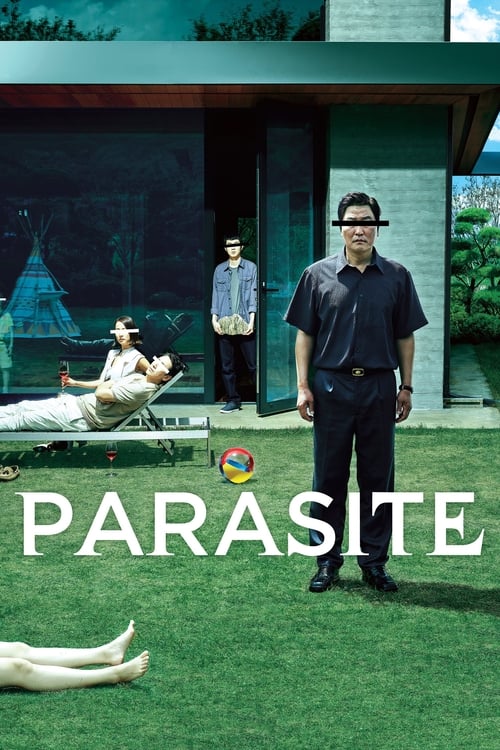
Bong made a film about class that is actually a film about karma. Every Korean home has a basement. Every basement has a basement. The Kims do not bring chaos into the Park household — they discover it was already there, breathing, eating, waiting for someone hungry enough to climb up. The stone is samsara. It does not need to be magical to weigh as much as it weighs.
Parasite is the most precise Buddhist parable disguised as social satire in twenty-first century cinema. Bong Joon-ho built a film that the West read primarily as class commentary and that East Asia read as karma diagram. Both readings are correct. Bong's genius is that they are the same reading. Class is karma made architectural. The basement under the basement is samsara. The smell that follows the Kims is the trace of their realm of birth that no costume can wash off. The stone is desire. When Ki-woo finally returns to find it returned to the river, his fantasy of buying the house is the cycle reasserting itself one more turn. There is no escape upward. There is only the basement underneath, and the basement underneath that.
The Surface
An unemployed family in Seoul — the Kims — infiltrates the household of a wealthy family — the Parks — by faking credentials and identities, one by one displacing the existing staff. They discover the previous housekeeper has been hiding her husband in a secret basement bunker for years. The two families of poor people fight each other for control of access to the rich. The fight escalates into murder at a children's birthday party. The patriarch of the Kims kills the patriarch of the Parks, then descends into the basement himself, replacing the previous occupant. His son survives, fantasizes about one day buying the house to free his father, and the film ends knowing this is impossible.
Bong won every major award for the film. Most readings frame it as class allegory: the poor and the poorer fighting over scraps the rich do not even notice. This reading is correct but partial.
The film's deeper structure is karmic. Bong is showing the wheel of samsara at three levels simultaneously — semi-basement, ground floor, sub-basement — and showing that movement between them is structurally prevented, no matter how hard any individual works to ascend.
The Realms of Rebirth
Buddhist cosmology describes six realms into which beings are born depending on karma: hell beings, hungry ghosts, animals, humans, demigods, gods. The realms are not metaphors. They are operational descriptions of consciousness conditions a being can find itself in. Most beings cycle through them without awareness that the cycle is occurring.
Parasite is a six-realms film with the realms made architectural. The sub-basement is hell — Geun-sae has been there for years, feeding off scraps, banging morse code into the wall, his consciousness reduced to gratitude for the man whose house imprisons him. The semi-basement is the realm of hungry ghosts — the Kims live half-underground, exposed to drunks pissing on their window, watching their phones die when the neighbor's Wi-Fi gets a password. The ground floor of the Park house is the realm of gods — clean, lit, with a perfect lawn, designed by an architect named Namgoong who has cultivated the home as a Pure Land.
Bong's camera moves between these realms with brutal precision. Stairs are not stairs. They are the apparatus of karmic transition. The Kims ascend stairs to enter the Park house. They descend many more stairs to flee back to their flooded basement. The previous housekeeper descends the secret stairs to feed her husband. The night of the flood, every realm is shown in its proper relation: gods asleep in clean beds, hungry ghosts watching their possessions float by, hell beings drowning in sewage.
The realms do not communicate. Mr. Park cannot smell what the Kims smell because he has never lived where the smell exists. Geun-sae thanks Mr. Park as his god, having no information about who Mr. Park actually is. The Kims, between, see all the realms and cannot inhabit any of them stably. They are the bardo-state in the film. Their existence is unstable because they are in transit between conditions that are themselves stable.
The Smell
The film's most precise device is the smell. The Park family notices it. They cannot place it. They describe it among themselves: it is the smell of subway, of old radish, of something the rich do not encounter and the poor cannot wash off because the smell is from the apartment, not the body. The Kims discover that no shampoo can defeat it. The smell follows them up.
This is karma in its most operational sense. Karma is not punishment. Karma is the trace condition of action — the residue that a being carries from its history, regardless of intention or effort, until it is finally exhausted through skillful action and patience. The Kims have generations of basement karma. Their semi-basement is the inheritance, not a temporary station.
Mr. Park's recoil from the smell at the climactic moment — flinching as he reaches over the dying Geun-sae's body for the car keys — is what triggers the murder. Ki-taek sees the flinch. He has been performing for the Park family for months. The flinch tells him that no performance will ever be enough. The smell cannot be performed away. The realm is not exit-able through service or competence or even strategic identity theft.
He kills Mr. Park not because Mr. Park is the worst man in the film — he is not. Mr. Park is, by his own lights, decent. Ki-taek kills him because the flinch contained an entire cosmology. The cosmology is real. The murder is karmic reaction in a moment of clarity. Bong does not excuse it. He shows how exactly it happens.
The Stone and the River
Ki-woo is given a scholar's stone by his friend at the start of the film. He carries it with him. He insists it is meaningful. He brings it into the Park house. He carries it into the basement on the night of the flood. He tries to use it as a weapon. The basement-dweller takes it from him and uses it to crack his skull.
The stone is desire. It is the literalization of attachment — heavy, prized, useless. Ki-woo wants it to be a talisman of upward mobility. The film keeps showing it as what it is: a rock. By the time it is used to assault him, the film has demonstrated what every Buddhist text says about attachment. The thing you cling to in order to ascend is the thing that will be picked up by reality to break your head.
After Ki-woo wakes from the coma, he returns the stone to the stream. This is the closest the film comes to a moment of genuine renunciation. He sets it down. He lets the water carry it. He lets go.
But Bong does not give him the consolation prize. The next scene is the fantasy of buying the house, freeing his father, walking up the steps. The fantasy is precise. It includes architecture, weather, the exact gesture of embrace. And then the film cuts back to Ki-woo in the semi-basement, writing the letter that contains the fantasy. He has set the stone down. He has not set down what the stone was a symbol of. The cycle is reasserting itself in a finer register, as the new ambition that will keep him bound for another lifetime, and another after that.
This is the most precise depiction of how samsara actually operates available in popular cinema. Liberation is not refusing one object of desire. Liberation is recognizing that the structure of desiring is the trap, regardless of what you happen to be desiring on a given day.
The Transmission
Parasite hands the viewer two readings and watches which one they pick. Most viewers in 2019 picked the class reading because the class reading was already in their hands. Bong handed them the Buddhist reading underneath it and let them keep it under the wrapping of the more comfortable interpretation.
What it transmits is a permanent disturbance of how you read the architecture of your own life. Where is your semi-basement? Who is in the sub-basement of your situation? Whose existence makes possible the floor you are standing on? What is your stone? When will you put it down? When will you pick up the next one?
Bong is not making a Marxist film. He is making a film a Marxist can love and a Buddhist can love, simultaneously, because the underlying diagnosis is shared. Suffering arises from the structure of attachment. The structures of attachment are encoded in architecture. The architecture is encoded in the body — the smell, the flinch, the stairs you have learned to climb without thinking. The cycle continues until something fundamental in the structure of wanting is seen through. The film does not show that being seen through. It shows the wheel turning. That is the gift.
Questions this film answers
What is the deeper meaning of Parasite?
Parasite is the most precise Buddhist parable disguised as social satire in twenty-first century cinema. Bong Joon-ho built a film that the West read primarily as class commentary and that East Asia read as karma diagram. Both readings are correct. Bong's genius is that they are the same reading. Class is karma made architectural. The basement under the basement is samsara. The smell that follows the Kims is the trace of their realm of birth that no costume can wash off. The stone is desire. When Ki-woo finally returns to find it returned to the river, his fantasy of buying the house is the cycle reasserting itself one more turn. There is no escape upward. There is only the basement underneath, and the basement underneath that.
What is the hidden symbolism in Parasite?
An unemployed family in Seoul — the Kims — infiltrates the household of a wealthy family — the Parks — by faking credentials and identities, one by one displacing the existing staff. They discover the previous housekeeper has been hiding her husband in a secret basement bunker for years. The two families of poor people fight each other for control of access to the rich. The fight escalates into murder at a children's birthday party. The patriarch of the Kims kills the patriarch of the Parks, then descends into the basement himself, replacing the previous occupant. His son survives, fantasizes about one day buying the house to free his father, and the film ends knowing this is impossible.
What esoteric traditions appear in Parasite?
Parasite draws from Buddhism, Gnosticism traditions. Bong made a film about class that is actually a film about karma. Every Korean home has a basement. Every basement has a basement. The Kims do not bring chaos into the Park household — they discover it was already there, breathing, eating, waiting for someone hungry enough to climb up. The stone is samsara. It does not need to be magical to weigh as much as it weighs.
What does Parasite teach about the realms of rebirth?
Class is karma made architectural. The realms do not communicate. The realms cannot exchange information about each other's interior. Buddhist cosmology describes six realms into which beings are born depending on karma: hell beings, hungry ghosts, animals, humans, demigods, gods. The realms are not metaphors. They are operational descriptions of consciousness conditions a being can find itself in. Most beings cycle through them without awareness that the cycle is occurring.
What does Parasite teach about the smell?
Karma is the trace condition of action — the residue a being carries from its history regardless of intention or effort. The film's most precise device is the smell. The Park family notices it. They cannot place it. They describe it among themselves: it is the smell of subway, of old radish, of something the rich do not encounter and the poor cannot wash off because the smell is from the apartment, not the body. The Kims discover that no shampoo can defeat it. The smell follows them up.
Is Parasite worth watching for spiritual seekers?
Parasite (2019) directed by Bong Joon Ho is essential viewing for those interested in Buddhism, Karma, Class. The House Has a Basement Has a Basement. It rewards multiple viewings and contemplation.
Rewatch With New Eyes
Now that you've seen the architecture, experience it again. The same film becomes a different film when you know what to watch for.
This time, watch for:
- See impermanence: what clings, what releases, what remains
- Watch for the false world vs. the real — who is asleep, who awakens
Links may include affiliate partnerships that support Media Revelations
The Descent Continues
Where this thread leads next.
Mother! 2017
Genesis to Revelation in One House
Read the revelation →