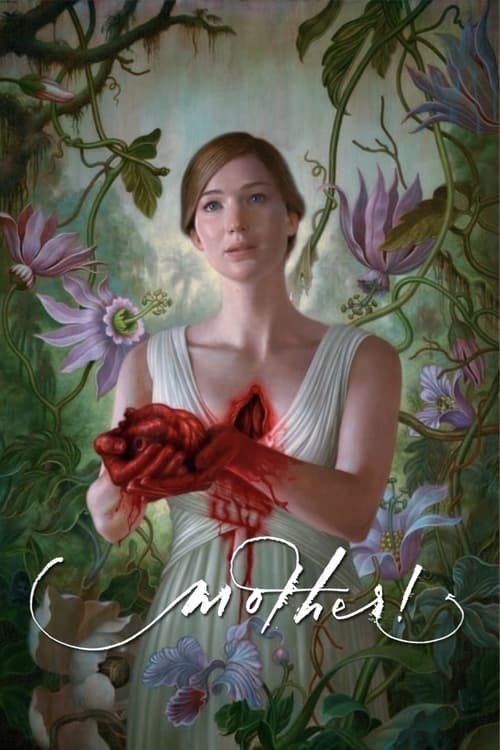
The house is Earth. Mother is Gaia. Him is the creator-god who loves the audience more than creation. Every guest is humanity — taking, breaking, demanding more. The cycle restarts because gods don't learn.
Mother! is the entire Bible compressed into one house and one woman. Mother is Gaia. Him is the creator-god. The strangers who arrive are humanity. The film replays Genesis through Revelation in two hours and refuses to let the audience pretend it is about anything else. The deepest claim Aronofsky is making is theological: the creator does not love creation. The creator loves the worship he receives from creation. He will let creation burn for that worship. Mother is the part of God that loves the world. The film is her diary of being betrayed by the part of God that loves the applause.
The Surface
A woman lives in a remote house with her poet husband. She is restoring the house, lovingly, room by room. A stranger arrives. Then another. They will not leave. More come. They break things. They consume. By the end the house is overrun, her newborn child has been devoured by the crowd, and she has set the house on fire, killing herself and resetting the cycle. The film opens with a new woman waking in the restored house. It has happened before. It will happen again.
On release the film was met with the most polarized response of any major studio film that decade. The CinemaScore was F. Critics were either devastated or contemptuous. The middle did not exist. This is appropriate to the film's structure. It is a religious allegory delivered with the urgency of a vision. You receive the vision or you reject it. There is no neutral position.
Aronofsky has been explicit that Mother is Gaia and the film is about climate. This is true but incomplete. The film is about climate because the film is about every form of betrayal of the maternal substrate by the systems that exploit it. Climate is one instance. Religion is another. Marriage is another. The pattern is the same pattern.
The House as Body of Gaia
Mother feels the house. When the wall is wounded, she feels the wound. When a heating duct is damaged, the pulse in the wall slows and she clutches her chest. The house and her body are the same body. This is not magic realism. It is the literal claim the film is making about the relationship between Gaia and what she sustains.
Shamanic traditions across cultures hold that the Earth is a sentient body. Damage to one part registers in the whole. The destruction of a forest is felt in the watershed. The contamination of a river is felt in the species that drink from it. There is no environmental damage that is local. Everything is connected because everything is one body.
Mother's increasing distress as the house fills with people is not paranoia. It is correct perception. The house is being overrun. She is the only one who can feel it because she is the only one who is the house. Him cannot feel it. The guests cannot feel it. The house is sustaining all of them and they cannot perceive the source of their sustenance.
Modern people are the guests. We live on the body of Gaia and we cannot feel her. Aronofsky is showing what it would look like if we could feel her — and what we look like to her from inside the feeling. We are eating her. We do not know we are eating her. She is unable to make us stop.
Him as the Creator of Worship
Him — the husband, the creator — is not malicious. He is something stranger. He loves the guests because the guests love him. They want to be near him. They quote his poems. They tear pieces off the wall as relics. He cannot turn them away. Their devotion is his oxygen.
This is one of the most precise diagnoses of false godhood ever filmed. Him is not the Demiurge of cosmic ignorance. He is the god of attention. He needs worship more than he needs his wife. He needs to be loved by many more than he needs to be loved by one. The cycle restarts at the end of the film because Him cannot stop needing this even after he has watched the previous instance collapse.
Mother begs him to ask the people to leave. He cannot. He needs their adoration too much. He needs to make new work for them. When his son dies in the crowd, he forgives them. He cannot do otherwise. The capacity to forgive his admirers is the same capacity that prevents him from protecting his wife.
This is the structural critique. The God who loves the worshipper more than the loved one is not a benign God. He is a deity who has confused devotion for love. He will sacrifice the part of creation that loves him for the part of creation that praises him. This is the deepest cut Aronofsky is making, and it lands on every reader who has met this god in their own life.
The Cycle and the Reset
The film ends with Mother burning the house. Him extracts a crystal from her chest — the last of her essence. He places it in the house. A new woman wakes in a new bed in a restored house. The cycle begins again.
This is the structure of cosmic cycles in Hindu, Mayan, Kabbalistic, and Stoic cosmologies. The world is created. The world is destroyed. The creator persists. A new world is generated from what remained. The creator does not learn because the creator is not the part of the system that can learn.
The learning must come from somewhere else. Aronofsky leaves open who that somewhere is. It may be the viewer. It may be the part of Mother that does not finally accept this. The film is a transmission to whoever is watching, asking the viewer to be the part of the cycle that finally refuses to participate.
The deepest theological move is the implication that God does not learn. The cycles repeat because the divine principle that runs them is not the divine principle that could change them. Salvation, if there is any, has to come from below — from the part of creation that remembers what was done to the previous Mother, and refuses to let it happen again.
The Transmission
Mother! is one of the most unpleasant films of the decade to sit through. This is intentional. Aronofsky wants you to feel what Mother feels — the slow encroachment, the polite explanations, the impossibility of saying no, the moment when politeness collapses into horror, the sensation of being eaten alive while still expected to be a good host.
Anyone who has been in a relationship with someone who needed adoration more than they needed love will recognize the film immediately. Anyone who has watched climate breakdown while being asked to remain optimistic will recognize the film. Anyone who has been the woman in the house while the men quoted poems and broke the furniture will recognize the film.
The recognition is the transmission. You cannot un-see the structure once it has been named. After Mother!, you start noticing when worship has been confused for love. You start noticing when the loved one is being sacrificed for the praise of strangers. The film does the diagnostic work and refuses the comfort of resolution. The cycle will continue. The question is whether you, the viewer, finally refuse to be one of the guests.
Questions this film answers
What is the deeper meaning of Mother!?
Mother! is the entire Bible compressed into one house and one woman. Mother is Gaia. Him is the creator-god. The strangers who arrive are humanity. The film replays Genesis through Revelation in two hours and refuses to let the audience pretend it is about anything else. The deepest claim Aronofsky is making is theological: the creator does not love creation. The creator loves the worship he receives from creation. He will let creation burn for that worship. Mother is the part of God that loves the world. The film is her diary of being betrayed by the part of God that loves the applause.
What is the hidden symbolism in Mother!?
A woman lives in a remote house with her poet husband. She is restoring the house, lovingly, room by room. A stranger arrives. Then another. They will not leave. More come. They break things. They consume. By the end the house is overrun, her newborn child has been devoured by the crowd, and she has set the house on fire, killing herself and resetting the cycle. The film opens with a new woman waking in the restored house. It has happened before. It will happen again.
What esoteric traditions appear in Mother!?
Mother! draws from Gnosticism, Shamanism, Kabbalah traditions. The house is Earth. Mother is Gaia. Him is the creator-god who loves the audience more than creation. Every guest is humanity — taking, breaking, demanding more. The cycle restarts because gods don't learn.
Is Mother! worth watching for spiritual seekers?
Mother! (2017) directed by Darren Aronofsky is essential viewing for those interested in Biblical, Gaia, Cycle. Genesis to Revelation in One House. It rewards multiple viewings and contemplation.
Rewatch With New Eyes
Now that you've seen the architecture, experience it again. The same film becomes a different film when you know what to watch for.
This time, watch for:
- Watch for the false world vs. the real — who is asleep, who awakens
- Follow the descent: what dies, what guides, what returns transformed
- Notice the vessels: what contains, what shatters, what repairs
Links may include affiliate partnerships that support Media Revelations
The Descent Continues
Where this thread leads next.
The Fountain 2006
The Tree of Life and the Death of Death
Read the revelation →