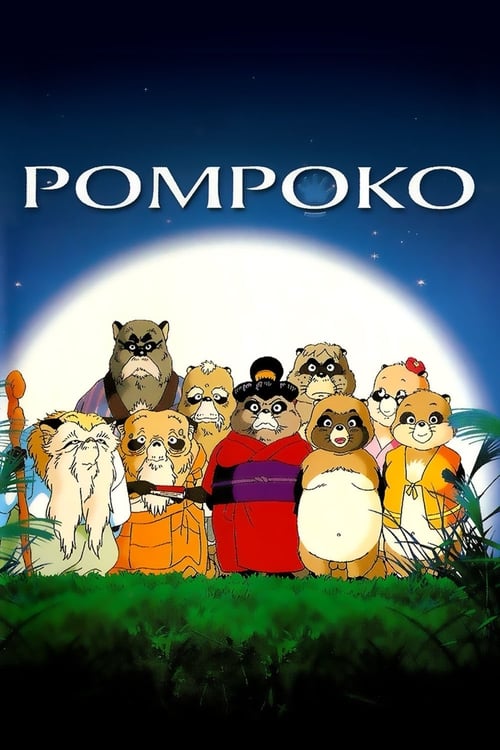
Pom Poko
Pom Poko Is a Shamanic Culture Watching Its Gods Lose the War for the Land
Directed by Isao Takahata
Takahata made a cartoon about testicle-shape-shifting raccoons and buried inside it the exact moment an animist world stops working.
The tanuki of the Tama Hills are not animals with cute powers. In Japanese folk belief they are henge, shape-shifters, minor kami of the wild who can transform reality itself. Takahata takes that belief literally and then films what happens when it collides with bulldozers. The raccoons train, remember the old transformation arts, and mount a supernatural counterattack against a Tokyo suburb being carved out of their forest. And they lose. Not because their magic fails, but because the humans no longer live in a world where magic means anything. That is the film's real subject: the death of an enchanted cosmos, watched from inside by the spirits it is killing. The famous ghost parade is not a set piece. It is a religion's last public rite, performed to an audience that claps and then goes back to shopping.
Shamanic Reading: The Spirit Parade That Fails Because No One Believes
The tanuki's greatest weapon is the transformation art itself, the shamanic power to make the unseen world visible. Their masters stage the Operation Specter: a full spectral procession of yokai, dragons, and old gods marching through the new development at night. In an animist cosmos this is overwhelming, a direct manifestation of the sacred into ordinary space. It is exactly what a shaman does, opening the membrane so the community sees what is always there.
The humans watch it as entertainment. Worse, a nearby amusement park owner takes credit, claiming the parade was his own publicity stunt. This is the shamanic catastrophe rendered exactly. The sacred manifests and the culture has no category left to receive it, so it files the miracle under marketing. The spirits pour out everything they are and the response is a press release. When the old tanuki masters realize this, some of them transform one final time into a ship and sail off into the sunset, choosing to vanish rather than live in a world that cannot see them. The membrane closes from the human side, not the spirit side: the tanuki keep offering the vision, and the eyes to receive it have simply gone dark.
Buddhist Reading: The Ones Who Shape-Shift Into Human, and the Ones Who Cannot
The film's quiet devastation is in its ending. Unable to win, many surviving tanuki use their transformation power to permanently become human, putting on suits, taking jobs, riding the trains they once fought. They have not been defeated. They have been absorbed. This is samsara shown as assimilation: to survive in the new world they must forget what they were, and forgetting is the price of the ticket.
But Takahata refuses the clean erasure. The tanuki who could never learn to transform, the ordinary ones, still live in the shrinking green margins. In a late scene they briefly restore an entire vanished landscape by memory alone, conjuring the old hills back into being for a single aching minute before it fades. That is the Buddhist teaching underneath the whole picture: impermanence is not an idea here, it is a homeland being demolished in real time, and clinging to it produces exactly the suffering the sutras describe. The film ends by breaking the fourth wall, a tanuki asking the audience directly to remember that the animals are still there. It is a plea against forgetting, delivered by a creature that survived only by learning to forget itself.
Other Takahata and Ghibli films where a world quietly ends: Grave of the Fireflies (Takahata's other unflinching elegy), Princess Mononoke (the same war, fought by gods who still frighten us), Only Yesterday (the vanished countryside remembered from inside the city).
Questions this film answers
What is the deeper meaning of Pom Poko?
The tanuki of the Tama Hills are not animals with cute powers. In Japanese folk belief they are henge, shape-shifters, minor kami of the wild who can transform reality itself. Takahata takes that belief literally and then films what happens when it collides with bulldozers. The raccoons train, remember the old transformation arts, and mount a supernatural counterattack against a Tokyo suburb being carved out of their forest. And they lose. Not because their magic fails, but because the humans no longer live in a world where magic means anything. That is the film's real subject: the death of an enchanted cosmos, watched from inside by the spirits it is killing. The famous ghost parade is not a set piece. It is a religion's last public rite, performed to an audience that claps and then goes back to shopping.
What is the hidden symbolism in Pom Poko?
The tanuki's greatest weapon is the transformation art itself, the shamanic power to make the unseen world visible. Their masters stage the Operation Specter: a full spectral procession of yokai, dragons, and old gods marching through the new development at night. In an animist cosmos this is overwhelming, a direct manifestation of the sacred into ordinary space. It is exactly what a shaman does, opening the membrane so the community sees what is always there.
What esoteric traditions appear in Pom Poko?
Pom Poko draws from Shamanism, Buddhism traditions. Takahata made a cartoon about testicle-shape-shifting raccoons and buried inside it the exact moment an animist world stops working.
Is Pom Poko worth watching for spiritual seekers?
Pom Poko (1994) directed by Isao Takahata is essential viewing for those interested in Shamanism, Buddhism. Pom Poko Is a Shamanic Culture Watching Its Gods Lose the War for the Land. It rewards multiple viewings and contemplation.
Rewatch With New Eyes
Now that you've seen the architecture, experience it again. The same film becomes a different film when you know what to watch for.
This time, watch for:
- Follow the descent: what dies, what guides, what returns transformed
- See impermanence: what clings, what releases, what remains
Links may include affiliate partnerships that support Media Revelations