Poor Things
The Soul Re-Born Outside Patriarchal Calibration
Directed by Yorgos Lanthimos
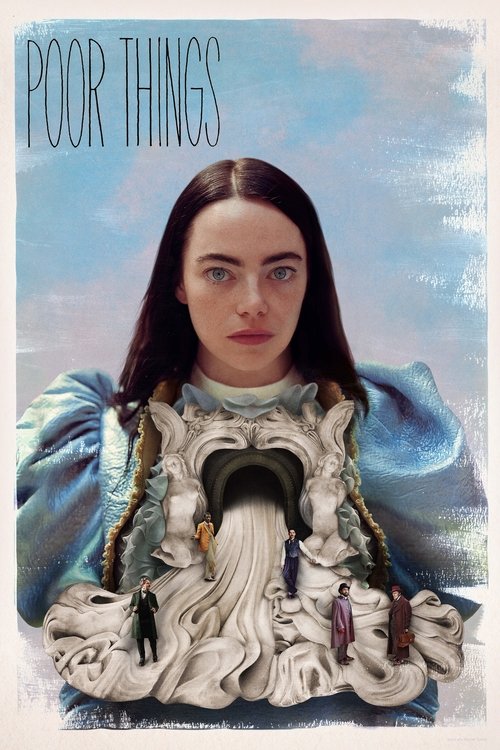
Lanthimos and Tony McNamara built a Frankenstein in reverse. The Creature here is the woman the Demiurge thought he was making. She has the brain of her own unborn daughter implanted in her adult body. She has no patriarchal conditioning. She develops her own ethics from contact with the world. The film is the most accurate depiction of what a soul looks like that has not been formed by the apparatus most souls are formed by — and it is not what the apparatus would have predicted.
Poor Things is the most generous and most theologically interesting film Lanthimos has made. Adapted from Alasdair Gray's novel, the film centers on Bella Baxter — a woman whose dead, pregnant body was reanimated by the surgeon Godwin Baxter via the implantation of her unborn daughter's brain into her adult body. She wakes as an infant in a grown woman's flesh. She develops, at compressed speed, through every stage of consciousness without the gendered conditioning that would have shaped her in normal development. The film follows her as she discovers her own appetites, her own intellect, her own ethics — without ever passing through the structures of shame, fear of pleasure, romantic submission, or class deference that most women in her historical period are constructed by. The film is not science fiction. The film is a thought experiment in alchemical anthropology: what does a soul look like that has been re-born outside patriarchal calibration. The answer the film gives is precise. Such a soul becomes intellectually voracious, ethically rigorous, sexually free without sentimentality, and ultimately compassionate in ways the men around her cannot recognize as compassion because their moral frameworks were built to control exactly the kind of woman she has become.
The Surface
Victorian London. A surgeon known as God (Godwin Baxter) shows his apprentice Max McCandless the woman he has reanimated. She is Bella Baxter — a body recovered from suicide-by-jumping into the Thames while heavily pregnant. God removed the brain of the unborn child and implanted it in the mother's skull. The mother's body now lives with the daughter's developing mind. Bella has the motor skills of a toddler and the curiosity of an infant in an adult body. Max is to study her development. God plans for Max and Bella to marry. Bella, becoming sexually aware, takes up with Duncan Wedderburn, a libertine attorney. She runs away with him on a long sea voyage and adventure across Europe. Her capacity for self-direction outstrips Duncan's ability to control. She becomes a sex worker in Paris by choice, both for the income and for the data. She reads voraciously. She develops her own philosophy. She returns to London. She marries Max. She discovers her body's original husband — the violent General Alfred Blessington — and turns the tables. The film ends with Bella as the matriarch of a redesigned household, conducting medical work, having implanted Alfred's brain in a goat.
On release the film was nominated for Best Picture and won four Academy Awards including Best Actress for Emma Stone. Critical reception was largely enthusiastic. Some objections were raised regarding the depiction of sexuality, with critics divided on whether the film was feminist or exploitative.
The objections, even when sincere, tended to miss what the film was doing. It was not making a statement about contemporary sexual politics. It was constructing a thought experiment about what a particular kind of soul would look like under particular conditions. The conditions are specifically designed: the soul is in a woman's body but has never been told that being in a woman's body has the constraints it has been told to have. Lanthimos and McNamara are running the experiment. The film is the data.
Godwin Baxter as Sympathetic Demiurge
Willem Dafoe's Godwin Baxter — God — is the film's most theologically loaded character. He is the Demiurge in his alchemical form: the maker who has done a thing for which he has the technical competence and only incomplete ethical apparatus. He created Bella because he could. He has spent his life as the subject of his own father's surgical experimentation. His face is patchwork. His digestive system is augmented. He is himself a creature of his father's incomplete love.
What makes him sympathetic, unlike Victor Frankenstein, is that he loves Bella. He does not abandon her. He builds the conditions for her development. He answers her questions. He provides her with books. He releases her into the world when she demands her freedom and arranges to be reachable when she needs to return. This is the Demiurge as he ought to have been — present, accountable, willing to be transformed by what he has made.
The alchemical doctrine of the Philosopher's Stone is precisely this. The Stone is not made for the alchemist's personal benefit. The Stone is the product of the alchemist's willingness to participate in a transformation that exceeds his ability to control. Godwin makes Bella. Bella exceeds him. He does not punish her for the excess. He celebrates it. He dies blessing it. The opus completes itself through her.
Lanthimos is making an interesting argument: the Demiurge can be redeemed by allowing the creation to surpass and supersede him. Most stories of artificial life — Frankenstein, Ex Machina, Blade Runner — treat the creator's failure as primary tragedy. Poor Things treats the creator's successful surrender as primary triumph. Godwin's deathbed scene is the rare image of a maker who has been improved by having been outpaced by his own work.
Bella's Curriculum
Bella's development is the film's central operation. She passes through every developmental stage that conventional childhood produces — motor coordination, language, social interaction, sexuality, moral reasoning, philosophical inquiry — at a compressed rate, in an adult body, and in the absence of the inhibition apparatus that would normally constrain each stage.
Her sexual awakening is the most controversial sequence. The film treats it as a learning curriculum, not as titillation. Bella discovers her own body's capacity for pleasure. She has not been taught that pleasure requires shame, partnership, marriage, or any of the social inflections that her historical moment would have placed on it. She experiments. She names her observations. She moves on. The lack of shame is what makes the depiction transgressive. The film refuses to give her the shame the audience has been formed to expect a woman in her situation to display.
Her intellectual development follows the same pattern. She reads voraciously. She encounters philosophy, socialism, anatomy, comparative theology. She accepts what holds up to scrutiny and discards what does not. She has no prior commitments to defend. Most people's intellectual development is constrained by the need to remain consistent with what they already believe. Bella has no such constraint. The result is a young woman who arrives at ethical positions by direct contact with the conditions she observes rather than by inheritance from authorities.
Initiation traditions across cultures have understood that the conditioning the child receives is, in important ways, what initiation must later strip away. The reason initiation is necessary is that ordinary socialization has installed structures the adult will need to confront and transcend. Bella's gift is that she did not need to undergo initiation because she was constructed without the conditioning that requires it. She is what an initiated adult would be if they had not had to pay the price of becoming one. The film is fantasy in this specific sense. It is showing what would be possible if the conditioning were not installed in the first place.
Duncan, Max, and Alfred as the Three Patriarchies
The film's three central male antagonists — Duncan the libertine, Max the loyal apprentice, Alfred the violent original husband — represent three distinct patriarchal apparatuses, each of which assumes it can contain Bella. None succeed.
Duncan is the libertine patriarchy — the seduction-and-control framework in which a woman's freedom is permitted only as long as the man is the agent of it. Duncan tells Bella she is a wild creature and he is liberating her. Bella thanks him for the early sex and then exceeds him intellectually within weeks. By the time they reach Lisbon, Duncan is in emotional crisis because Bella will not behave the way his framework requires liberated women to behave. She does not return his obsession. She does not need his protection. She moves through the world as an agent. He cannot tolerate it.
Max is the husband-coded patriarchy in its sympathetic form — the kind, patient, decent man who waits for the woman to recognize that he is good for her. Bella eventually marries him, but on her terms. She tells him she will continue her sex work for as long as it interests her. She tells him she will continue her studies. She tells him she will live in her own house with her own staff. Max accepts. The film is generous to him for accepting. The acceptance is the only available position for a man who genuinely loves a woman who has not been conditioned into the role most love-structures require.
Alfred is patriarchal violence in its undisguised form. The General owns the body Bella was born into. He believes the body is his property. He attempts to kidnap her, control her, install her in his estate. Bella's response is to defeat him by his own logic — she shoots him in a duel, then implants his brain in a goat. The poetic justice is not subtle. It is also entirely consistent with the film's larger argument. The patriarchal violence becomes the goat because that is the form its consciousness, examined honestly, deserves.
The Transmission
Poor Things transmits a particular and rare experience: an extended cinematic glimpse of what a soul without the standard conditioning actually looks like. Most films about liberated women show liberation as the rejection of conditioning. The films stage the rejection as the central drama. Poor Things skips the rejection because Bella was never installed with the conditioning in the first place. The result is a portrait of liberation that does not feel like resistance because the structure being resisted was not present.
What the film leaves the viewer with is a glimpse of what is possible. Most of us cannot become Bella. The conditioning was installed early and the surgery to remove it was not on offer. But the film makes the conditioning visible by contrast. We see what we were trained to be by watching what an untrained woman becomes. The contrast is the gift.
Lanthimos's Poor Things is, finally, a more hopeful film than anything else in his filmography. The Lobster, Killing of a Sacred Deer, and Bugonia diagnose systems that capture the soul. Poor Things shows a soul that escaped the capture. The escape was made possible by a fortunate accident — a particular kind of brain implanted in a particular kind of body raised by a particular kind of guardian. Most souls do not get this. But the existence of one such soul is the proof of concept. The capture is not necessary. Different conditions produce different souls. The film names what the conditions would have to include. The viewer can then look at their own conditions and ask which of them are still amenable to revision.
Questions this film answers
What is the deeper meaning of Poor Things?
Poor Things is the most generous and most theologically interesting film Lanthimos has made. Adapted from Alasdair Gray's novel, the film centers on Bella Baxter — a woman whose dead, pregnant body was reanimated by the surgeon Godwin Baxter via the implantation of her unborn daughter's brain into her adult body. She wakes as an infant in a grown woman's flesh. She develops, at compressed speed, through every stage of consciousness without the gendered conditioning that would have shaped her in normal development. The film follows her as she discovers her own appetites, her own intellect, her own ethics — without ever passing through the structures of shame, fear of pleasure, romantic submission, or class deference that most women in her historical period are constructed by. The film is not science fiction. The film is a thought experiment in alchemical anthropology: what does a soul look like that has been re-born outside patriarchal calibration. The answer the film gives is precise. Such a soul becomes intellectually voracious, ethically rigorous, sexually free without sentimentality, and ultimately compassionate in ways the men around her cannot recognize as compassion because their moral frameworks were built to control exactly the kind of woman she has become.
What is the hidden symbolism in Poor Things?
Victorian London. A surgeon known as God (Godwin Baxter) shows his apprentice Max McCandless the woman he has reanimated. She is Bella Baxter — a body recovered from suicide-by-jumping into the Thames while heavily pregnant. God removed the brain of the unborn child and implanted it in the mother's skull. The mother's body now lives with the daughter's developing mind. Bella has the motor skills of a toddler and the curiosity of an infant in an adult body. Max is to study her development. God plans for Max and Bella to marry. Bella, becoming sexually aware, takes up with Duncan Wedderburn, a libertine attorney. She runs away with him on a long sea voyage and adventure across Europe. Her capacity for self-direction outstrips Duncan's ability to control. She becomes a sex worker in Paris by choice, both for the income and for the data. She reads voraciously. She develops her own philosophy. She returns to London. She marries Max. She discovers her body's original husband — the violent General Alfred Blessington — and turns the tables. The film ends with Bella as the matriarch of a redesigned household, conducting medical work, having implanted Alfred's brain in a goat.
What esoteric traditions appear in Poor Things?
Poor Things draws from Alchemy, Initiation traditions. Lanthimos and Tony McNamara built a Frankenstein in reverse. The Creature here is the woman the Demiurge thought he was making. She has the brain of her own unborn daughter implanted in her adult body. She has no patriarchal conditioning. She develops her own ethics from contact with the world. The film is the most accurate depiction of what a soul looks like that has not been formed by the apparatus most souls are formed by — and it is not what the apparatus would have predicted.
What does Poor Things teach about godwin baxter as sympathetic demiurge?
The Demiurge can be redeemed by allowing the creation to surpass and supersede him. Godwin's deathbed scene is the rare image of a maker improved by being outpaced by his work. Willem Dafoe's Godwin Baxter — God — is the film's most theologically loaded character. He is the Demiurge in his alchemical form: the maker who has done a thing for which he has the technical competence and only incomplete ethical apparatus. He created Bella because he could. He has spent his life as the subject of his own father's surgical experimentation. His face is patchwork. His digestive system is augmented. He is himself a creature of his father's incomplete love.
What does Poor Things teach about bella's curriculum?
Most people's intellectual development is constrained by the need to remain consistent with what they already believe. Bella has no such constraint. Bella's development is the film's central operation. She passes through every developmental stage that conventional childhood produces — motor coordination, language, social interaction, sexuality, moral reasoning, philosophical inquiry — at a compressed rate, in an adult body, and in the absence of the inhibition apparatus that would normally constrain each stage.
Is Poor Things worth watching for spiritual seekers?
Poor Things (2023) directed by Yorgos Lanthimos is essential viewing for those interested in Alchemy, Initiation, Lanthimos. The Soul Re-Born Outside Patriarchal Calibration. It rewards multiple viewings and contemplation.
Rewatch With New Eyes
Now that you've seen the architecture, experience it again. The same film becomes a different film when you know what to watch for.
This time, watch for:
- Track the stages: blackening, whitening, reddening — death before rebirth
- Mark the threshold: the old self dies, the ordeal transforms, the new self returns
Links may include affiliate partnerships that support Media Revelations