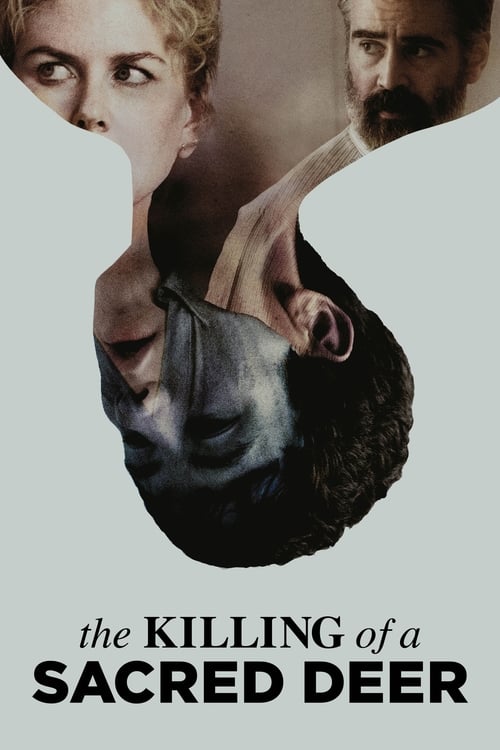
The Killing of a Sacred Deer
The Older Justice Comes to the Surgeon's House
Directed by Yorgos Lanthimos
Lanthimos updated the Iphigenia myth without softening it. A surgeon kills a patient through negligence. The patient's son arrives. The son explains, calmly, the terms: the surgeon must sacrifice one of his own family or all of them will die. The film does not ask whether the demand is fair. The film documents what the surgeon does once he recognizes that the demand is operational, mandatory, and not negotiable.
The Killing of a Sacred Deer is Lanthimos's most precise and most upsetting film. It transposes the Iphigenia myth — Agamemnon, having killed a sacred deer of Artemis, must sacrifice his own daughter to release the winds that will allow the Greek fleet to sail — into a contemporary American hospital. The surgeon Steven Murphy operated drunk on Martin's father. Martin's father died. Martin, the son, arrives in Steven's life. He introduces himself politely. He explains the rules. Members of the surgeon's family will be visited by a four-stage curse — paralysis, refusal of food, bleeding from the eyes, death — unless the surgeon selects one of them to kill. The curse begins. The family deteriorates exactly as Martin promised. Steven attempts every form of avoidance, denial, and counter-action. None work. The film ends with Steven blindfolded in his living room, firing a rifle in a circle until he kills one of his children at random. The surviving family then encounters Martin in a diner. Nobody speaks. They eat. The Greek tragic ratio has been satisfied. The older justice has been served. Lanthimos has filmed the recognition that pre-Christian moral physics did not require fairness — it required equivalence — and that the architecture is still operating beneath the medical-professional gloss of contemporary life.
The Surface
A cardiothoracic surgeon named Steven, his ophthalmologist wife Anna, and their two children Kim and Bob live in a clean suburban home. Steven has been quietly meeting with a sixteen-year-old named Martin, whose father died on Steven's operating table. Their relationship is presented as a quasi-mentorship Steven feels he owes the boy. Martin's calm escalations — meeting Steven's family, inserting himself into their schedule — eventually culminate in his announcement that the family will experience four-stage symptoms culminating in death unless Steven kills one of them. Bob is paralyzed first. Then he refuses food. Kim follows. Steven attempts violence on Martin, attempts to bargain, attempts to flee. Martin remains calm and patient. Steven eventually ties up Martin in his basement and beats him. The curse continues. Steven, blindfolded, fires a rifle in a circle in the living room until he kills Bob. The bleeding stops. The family is permanently destroyed but alive. The final scene is Steven, Anna, and Kim eating in a diner where Martin sits at another table. Nobody acknowledges anyone.
On release, the film was praised by some as a brilliant Greek-tragedy update and dismissed by others as cold. Lanthimos's signature affect — flat delivery, geometric framing, deliberate stiltedness — alienates many viewers. The film was the most precise application of his method to ancient material.
What the film is doing, structurally, is reintroducing pre-Christian moral physics to an audience that has been formed by a moral framework that does not include them. The Greeks did not believe that the gods were always fair. They believed that the cosmos was ordered by ratios that had to be maintained. A killing required a counter-killing. The counter-killing did not have to be the same person who did the killing. The counter-killing had to balance the books. Christianity introduced the idea that the books could be balanced by one sacrifice once for all. The Greeks did not have that consolation. The Killing of a Sacred Deer takes the consolation away and shows the audience what the older arithmetic actually looks like when applied to a modern family that has not been prepared for it.
Martin as Nemesis
Barry Keoghan's Martin is one of the most precisely calibrated antagonists in twenty-first century cinema. He is not menacing. He is polite. He explains things clearly. He has no obvious supernatural apparatus. He simply states what will happen and then it happens. The lack of menace is the menace.
Martin is Nemesis in the Greek sense — the agent of retribution, not driven by personal hatred but by the older requirement that imbalances be corrected. The Greeks believed that humans whose actions broke the cosmic ratios would attract figures whose function was to restore the ratio. The figures did not arrive with announcement. They arrived disguised. They were patient. They were inevitable.
Lanthimos films Martin with the unsettling steadiness of a being who is doing a job. He eats spaghetti with care. He explains the rules with the affect of a teacher whose student is slow but capable. He is not pleased by the suffering he is causing. He is not displeased either. He is performing the function. The function is restoring the equivalence. Steven killed Martin's father. The system requires that Steven kill someone equally close to him. Martin is the mechanism of delivery.
The film's most precise structural choice is to keep Martin's actual supernatural status ambiguous. Is he literally cursing the family. Is he poisoning them and constructing the appearance of supernatural intervention. The film refuses to clarify. The clarification would be a Western consolation. Greek tragedy did not provide it. The figure of Nemesis arrives. The figure has the result the figure says they will have. The mechanism is unimportant. The result is the point.
Steven and the Refusal to Recognize the Ratio
Steven spends most of the film refusing to take Martin's announcement seriously. He attempts second medical opinions. He attempts violence. He attempts to bribe Martin's mother. He attempts to convince himself that the symptoms are coincidental or psychosomatic. None of the attempts produce results because the situation is not the situation he is treating it as. He is treating it as a problem to be solved. It is not a problem to be solved. It is a sentence to be served.
This is the Jungian Shadow making itself visible at the level of moral physics. Steven killed Martin's father through negligence. He did not face the killing. He filed it as a regrettable incident, performed minor compensations, and continued his career. The killing remained. The Shadow material was not integrated. It returned, exactly as Jung promised it always does, in a form Steven could not control — a quiet teenage boy who happened to know what his father's surgeon had been drinking that morning.
Steven's wife Anna eventually understands what is happening before Steven does. Her line at the dinner table — 'It is the most logical thing to do' — when she calmly proposes which of the children should be sacrificed, is the film's most chilling moment. Anna has recognized that the cosmos has presented a bill and that the bill is going to be paid one way or another. Her interest is now in minimizing additional damage by selecting carefully.
Steven's final action — the blindfold, the rifle, the spinning, the random firing — is the moment he finally accepts the structure but refuses to take responsibility for the selection. He outsources the selection to chance because he cannot bear to choose. This is not a redemption. This is the final cowardice. The Greeks would have required him to choose. He found a way to avoid choosing while still doing the action. The film does not absolve him. The film documents the maneuver.
The Diner and the Restored Order
The film's final scene is set in a diner where the surviving family — Steven, Anna, Kim — encounters Martin at another table. None of them speak. Steven and Anna order something. Kim watches Martin. Martin eats fries calmly. The family pays. They leave. The film cuts to black.
This is the restored order in its most concrete form. The ratio has been balanced. Steven killed Martin's father. Steven has now killed his own son. The books are even. The encounter at the diner is the cosmos confirming that the case is closed. Martin does not pursue them further. They do not pursue him. The system has done what the system required. Daily life will continue.
The diner scene's quiet is the film's most devastating note. There is no catharsis. There is no apology. There is no recognition that the surviving family has been irrevocably damaged. There is only the resumption of eating. This is what the Greeks understood about tragedy. The action is required. The action is performed. Life continues afterward, transformed, but continues. The tragedy is not that the heroes die. The tragedy is that the surviving live with what was required.
Lanthimos's discipline in refusing to editorialize is what makes this ending land. A lesser director would have closed on Steven's face crumpling, or Anna's grief, or Kim's silent accusation. Lanthimos closes on the family eating. The eating is the diagnosis. They will continue. They will continue having paid this price. They will continue indefinitely. The continuing is what the ratio bought.
The Transmission
The Killing of a Sacred Deer transmits a particular and uncomfortable recognition: that the older moral physics — equivalence, balance, the eye for the eye — has not been replaced by Christian or therapeutic frameworks. It has been covered over. The covering allows daily life to proceed without the operations being visible. The covering does not stop the operations. When the bill comes due, the older arithmetic asserts itself with full force, and the modern subject discovers that the spiritual technologies they thought protected them from such arithmetic are not in fact engaged.
What the film leaves the viewer with is a permanent suspicion that one's own incomplete reckonings are still on the ledger. The unaddressed harms one has done. The accountabilities one has avoided. The killings, large or small, that one filed as regrettable incidents and moved past. The film names what daily consciousness denies — that these incidents accumulate, and that they may eventually find their Martin.
Lanthimos is not advocating revenge ethics. He is documenting the structural feature that Greek tragedy already documented two and a half thousand years ago. The feature has not disappeared because Western culture stopped looking at it. The film is the act of looking. The looking is uncomfortable because the feature is uncomfortable. Few directors are willing to perform this act with this much precision. Lanthimos is. The film is the result.
Questions this film answers
What is the deeper meaning of The Killing of a Sacred Deer?
The Killing of a Sacred Deer is Lanthimos's most precise and most upsetting film. It transposes the Iphigenia myth — Agamemnon, having killed a sacred deer of Artemis, must sacrifice his own daughter to release the winds that will allow the Greek fleet to sail — into a contemporary American hospital. The surgeon Steven Murphy operated drunk on Martin's father. Martin's father died. Martin, the son, arrives in Steven's life. He introduces himself politely. He explains the rules. Members of the surgeon's family will be visited by a four-stage curse — paralysis, refusal of food, bleeding from the eyes, death — unless the surgeon selects one of them to kill. The curse begins. The family deteriorates exactly as Martin promised. Steven attempts every form of avoidance, denial, and counter-action. None work. The film ends with Steven blindfolded in his living room, firing a rifle in a circle until he kills one of his children at random. The surviving family then encounters Martin in a diner. Nobody speaks. They eat. The Greek tragic ratio has been satisfied. The older justice has been served. Lanthimos has filmed the recognition that pre-Christian moral physics did not require fairness — it required equivalence — and that the architecture is still operating beneath the medical-professional gloss of contemporary life.
What is the hidden symbolism in The Killing of a Sacred Deer?
A cardiothoracic surgeon named Steven, his ophthalmologist wife Anna, and their two children Kim and Bob live in a clean suburban home. Steven has been quietly meeting with a sixteen-year-old named Martin, whose father died on Steven's operating table. Their relationship is presented as a quasi-mentorship Steven feels he owes the boy. Martin's calm escalations — meeting Steven's family, inserting himself into their schedule — eventually culminate in his announcement that the family will experience four-stage symptoms culminating in death unless Steven kills one of them. Bob is paralyzed first. Then he refuses food. Kim follows. Steven attempts violence on Martin, attempts to bargain, attempts to flee. Martin remains calm and patient. Steven eventually ties up Martin in his basement and beats him. The curse continues. Steven, blindfolded, fires a rifle in a circle in the living room until he kills Bob. The bleeding stops. The family is permanently destroyed but alive. The final scene is Steven, Anna, and Kim eating in a diner where Martin sits at another table. Nobody acknowledges anyone.
What esoteric traditions appear in The Killing of a Sacred Deer?
The Killing of a Sacred Deer draws from Initiation, Jungian traditions. Lanthimos updated the Iphigenia myth without softening it. A surgeon kills a patient through negligence. The patient's son arrives. The son explains, calmly, the terms: the surgeon must sacrifice one of his own family or all of them will die. The film does not ask whether the demand is fair. The film documents what the surgeon does once he recognizes that the demand is operational, mandatory, and not negotiable.
What does The Killing of a Sacred Deer teach about martin as nemesis?
The Greeks did not believe the gods were fair. They believed the cosmos was ordered by ratios that had to be maintained. Barry Keoghan's Martin is one of the most precisely calibrated antagonists in twenty-first century cinema. He is not menacing. He is polite. He explains things clearly. He has no obvious supernatural apparatus. He simply states what will happen and then it happens. The lack of menace is the menace.
Is The Killing of a Sacred Deer worth watching for spiritual seekers?
The Killing of a Sacred Deer (2017) directed by Yorgos Lanthimos is essential viewing for those interested in Initiation, Sacrifice, Lanthimos. The Older Justice Comes to the Surgeon's House. It rewards multiple viewings and contemplation.
Rewatch With New Eyes
Now that you've seen the architecture, experience it again. The same film becomes a different film when you know what to watch for.
This time, watch for:
- Mark the threshold: the old self dies, the ordeal transforms, the new self returns
- Meet the shadow: what is rejected, projected, and finally integrated
Links may include affiliate partnerships that support Media Revelations
The Descent Continues
Where this thread leads next.
The Lobster 2015
The Pair-Bond as Authoritarian Apparatus
Read the revelation →