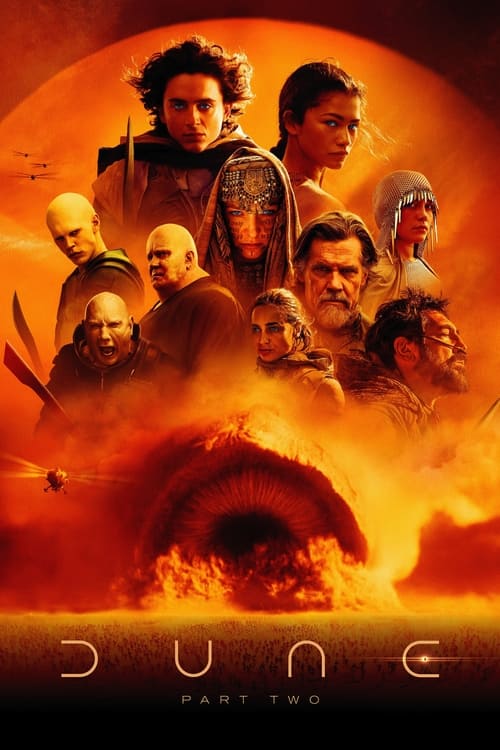
Dune: Part Two
Why Paul Atreides Is the Villain and You're Supposed to Cheer
Directed by Denis Villeneuve
Paul becomes possessed by the messianic archetype. The spice is kundalini. The seeing is real. The narrative is manufactured. Herbert screams that it's a trap.
Dune: Part Two is the most expensive cautionary tale ever made about the danger of charismatic leaders — and it knows most audiences will miss the warning. Paul Atreides does not become the messiah. He becomes possessed by the messianic archetype, which is not the same thing. The Bene Gesserit planted the Lisan al-Gaib prophecy centuries ago as a manipulation tool. Paul knows this. He walks into the trap anyway because the alternative is watching his people die. By the film's end, he has launched a holy war that will kill sixty-one billion people. The audience cheers. This is exactly what Herbert warned us about.
The Surface
A young nobleman, his family destroyed by political rivals, finds refuge among a desert people who believe he is their prophesied messiah. He masters their ways, falls in love, gains their loyalty, and leads them to victory against the empire that killed his father. He avenges his family and claims his birthright.
This is the hero's journey at its most archetypal. Every beat lands where Campbell said it would. The problem is that Herbert wrote Dune specifically to critique this narrative — to show how the hero's journey, when it succeeds, produces tyrants. Villeneuve understood this. He made a $190 million film that works as both the epic and its indictment.
The film is engineered to make you root for Paul. The cinematography worships him. The score swells when he rises. Chani loves him. The Fremen follow him. He wins every fight. And by the final frame, he has become the thing his mother's order has been breeding for centuries: a weapon of total control disguised as liberation.
The Manufactured Prophecy
The Lisan al-Gaib prophecy was not a genuine religious vision. It was planted by the Bene Gesserit's Missionaria Protectiva — a program that seeds messianic myths on planets throughout the Imperium, creating pre-installed belief systems that their agents can later exploit for survival or control.
Paul knows this. Jessica knows this. The film makes it explicit: the prophecy is manufactured, the belief is engineered, the Fremen's faith is the product of centuries of deliberate manipulation. And Paul uses it anyway. He gives them signs. He speaks their prophecy back to them. He becomes what they were programmed to believe in.
This is Gnostic architecture inverted. In authentic gnosis, the pneumatic awakens to the falseness of the constructed world and escapes it. Paul has gnosis — he sees the manipulation clearly — and chooses to become the architect of a new construction. He does not liberate the Fremen. He gives them a better prison.
The spice visions show him the future: holy war, billions dead, his name used to justify atrocities for millennia. He walks into it with open eyes. This is not a hero being corrupted. This is a man choosing to become the very thing his awareness should have let him refuse.
The Spice as Kundalini
The spice melange does what all psychedelic initiations do: it dissolves the boundaries of ordinary consciousness and opens perception to larger patterns. Paul's visions are not metaphor. He genuinely sees the branching paths of the future. He perceives the genetic memory of his ancestors. The spice works.
Kundalini traditions warn that awakening the serpent energy without proper preparation and guidance produces not enlightenment but inflation. The ego does not dissolve into something larger — it expands to claim it is something larger. The person becomes convinced they are the universe's special instrument.
Paul undergoes the Water of Life ceremony — drinking the bile of a dying sandworm, converting what would kill any man into the catalyst for total prescient awareness. He survives. He becomes the Kwisatz Haderach. And from that moment, he is no longer Paul. He is the archetype wearing Paul's face.
Watch his eyes after the ceremony. Watch how he speaks. The warmth is gone. The hesitation is gone. He has become what the breeding program designed him to become: a human computer, a weapon, a messiah. The boy who loved Chani is still in there somewhere. He is no longer in charge.
Chani as the Witness
Chani is the film's moral center — the only character who sees clearly what Paul is becoming and refuses to accept it. She loves him as a man. She rejects him as a messiah. When he takes the Water of Life and rises as the Lisan al-Gaib, her face tells us everything: she has lost him.
In Jungian terms, Chani represents the anima's refusal to be subsumed by the inflated ego. She is the feminine principle that insists on relationship over role, presence over performance, the specific human over the archetypal image. Paul's tragedy is that he cannot hold both. He must choose the archetype.
The final scene — Paul sending his armies to holy war while Chani walks away into the desert — is the film's thesis made visual. The messiah cannot have a real relationship. The archetype consumes everything personal. Chani's departure is not abandonment; it is the only sane response to what Paul has become.
Villeneuve's Chani is angrier than Herbert's, more politically conscious, more resistant. This was a deliberate choice. In 2024, audiences need someone on screen who names what is happening. She is the voice that says: this is not liberation. This is conquest wearing liberation's clothes.
The Shadow Emperor
Paul's father Leto was the Good Duke — noble, beloved, ethical in his rule. Paul spent the first film learning his father's ways, absorbing his father's ideals. The assumption was that he would continue that legacy, that the Atreides way would triumph through him.
But Paul does not continue his father's legacy. He inverts it. Leto refused to use the Fremen as weapons, seeing them as people deserving protection. Paul uses them as an army. Leto sought to bring water to Arrakis, to terraform and give. Paul unleashes them as a jihad across the galaxy.
This is the Shadow erupting through the conscious personality. Everything Leto suppressed — the will to power, the capacity for ruthless calculation, the willingness to sacrifice others for larger goals — emerges in Paul. He is not his father's continuation. He is his father's Shadow, given the resources his father never had.
The Emperor Shaddam, the Harkonnens, the Bene Gesserit — these are not Paul's real enemies. They are obstacles. Paul's real enemy is the version of himself that could have remained human. By the end of the film, that version has lost.
The Transmission
Herbert wrote Dune in the 1960s, watching charismatic leaders lead nations into catastrophe while their followers cheered. He wanted to show how the hero myth functions as a trap — how the very qualities that make someone inspiring make them dangerous when given absolute power. He knew most readers would miss it and simply enjoy the ride.
Villeneuve has the same problem. He has made a film that works perfectly as a rousing epic — the hero rises, the armies gather, the enemy falls. And he has made a film that, if you watch carefully, is a horror movie. The horror is that the rousing epic and the nightmare are the same film.
Paul will kill sixty-one billion people. His Fremen will spread across the galaxy enforcing his vision. Millennia later, his name will still be invoked to justify atrocities. He knew this before he made his choice. He chose anyway.
The question the film leaves you with is not whether Paul is a hero. The question is why you wanted him to be one — and what that wanting reveals about your own relationship to power, to charisma, to the seductive story of the chosen one who saves his people through violence. The trap Herbert built is not on Arrakis. It is in the audience. Villeneuve just made it visible.
Questions this film answers
What is the deeper meaning of Dune: Part Two?
Dune: Part Two is the most expensive cautionary tale ever made about the danger of charismatic leaders — and it knows most audiences will miss the warning. Paul Atreides does not become the messiah. He becomes possessed by the messianic archetype, which is not the same thing. The Bene Gesserit planted the Lisan al-Gaib prophecy centuries ago as a manipulation tool. Paul knows this. He walks into the trap anyway because the alternative is watching his people die. By the film's end, he has launched a holy war that will kill sixty-one billion people. The audience cheers. This is exactly what Herbert warned us about.
What is the hidden symbolism in Dune: Part Two?
A young nobleman, his family destroyed by political rivals, finds refuge among a desert people who believe he is their prophesied messiah. He masters their ways, falls in love, gains their loyalty, and leads them to victory against the empire that killed his father. He avenges his family and claims his birthright.
What esoteric traditions appear in Dune: Part Two?
Dune: Part Two draws from Initiation, Jungian, Gnosticism traditions. Paul becomes possessed by the messianic archetype. The spice is kundalini. The seeing is real. The narrative is manufactured. Herbert screams that it's a trap.
What does Dune: Part Two teach about the manufactured prophecy?
Paul has gnosis — he sees the manipulation clearly — and chooses to become the architect of a new construction. The Lisan al-Gaib prophecy was not a genuine religious vision. It was planted by the Bene Gesserit's Missionaria Protectiva — a program that seeds messianic myths on planets throughout the Imperium, creating pre-installed belief systems that their agents can later exploit for survival or control.
What does Dune: Part Two teach about the spice as kundalini?
The boy who loved Chani is still in there somewhere. He is no longer in charge. The spice melange does what all psychedelic initiations do: it dissolves the boundaries of ordinary consciousness and opens perception to larger patterns. Paul's visions are not metaphor. He genuinely sees the branching paths of the future. He perceives the genetic memory of his ancestors. The spice works.
What does Dune: Part Two teach about the shadow emperor?
Paul is not his father's continuation. He is his father's Shadow, given the resources his father never had. Paul's father Leto was the Good Duke — noble, beloved, ethical in his rule. Paul spent the first film learning his father's ways, absorbing his father's ideals. The assumption was that he would continue that legacy, that the Atreides way would triumph through him.
Is Dune: Part Two worth watching for spiritual seekers?
Dune: Part Two (2024) directed by Denis Villeneuve is essential viewing for those interested in Messianism, Kundalini, Archetype. Why Paul Atreides Is the Villain and You're Supposed to Cheer. It rewards multiple viewings and contemplation.
Rewatch With New Eyes
Now that you've seen the architecture, experience it again. The same film becomes a different film when you know what to watch for.
This time, watch for:
- Mark the threshold: the old self dies, the ordeal transforms, the new self returns
- Meet the shadow: what is rejected, projected, and finally integrated
- Watch for the false world vs. the real — who is asleep, who awakens
Links may include affiliate partnerships that support Media Revelations
The Descent Continues
Where this thread leads next.
The Matrix 1999
The Gnostic Gospel of the Machine Age
Read the revelation →