Rainer Werner Fassbinder's World on a Wire: Looking Ahead to Today
World on a Wire Knew You Were a Simulation in 1973, and Filmed the Panic of Finding Out
Directed by Juliane Lorenz
This retrospective documents Fassbinder building the simulated-reality film decades before the genre had a name. What it preserves is a work that already understood the horror is not that the world is fake. The horror is that finding out changes nothing about the suffering.
Fassbinder's two-part television film, restored and framed by this retrospective look at its making, gives us Fred Stiller, an engineer at a research institute running Simulacron: a computer world populated by thousands of "identity units" who believe they are real people living real lives. When Stiller's predecessor dies raving about the nature of reality, Stiller begins to suspect that his own world is itself a simulation, a program running one level up, watched by operators he cannot see. The retrospective's value is that it lets us watch a director in 1973 arrive, without any of the visual language later films would invent, at the oldest religious intuition there is: the world is a constructed appearance, and the beings inside it are steered by powers above them.
Gnostic Reading: Simulacron Is the Demiurge's Creation, and Every Level Has Its Own Blind God
The Gnostic cosmos is a series of nested realities, each ruled by an Archon who believes his level is the top. World on a Wire builds precisely this ladder. The identity units inside Simulacron live full lives, feel real grief, and have no idea they are code. Above them sit Stiller and his colleagues, who play god with the program, editing units, deleting the inconvenient, treating conscious beings as data. And above Stiller sits another level entirely, one he can only glimpse when the mirrors and reflective surfaces Fassbinder fills every frame with begin to feel like the walls of a tank.
The Gnostic terror is not that a higher world exists. It is that the operators of each world are as trapped and as blind as the units below them. When Stiller finally learns the truth, that he is a simulated copy of a real man in the world above, he does not gain freedom. He gains the knowledge that his whole existence was a tool, run to solve someone else's problem. That is the authentic Gnostic wound: to be a spark of awareness inside a system designed by a power that never intended you to wake up.
Buddhist Reading: Knowing It Is Empty Does Not End the Craving
Fassbinder refuses the easy version where seeing through the illusion sets you free. Stiller learns his world is unreal and still bleeds, still fears, still loves Eva. His enlightenment is purely intellectual, and the film uses his ongoing panic to make a Buddhist point sharper than most Buddhist films manage: conceptual insight into emptiness is not liberation. You can know a thing is a projection and remain fully captured by it.
Watch how the operators can only pull a unit out of Simulacron by transferring its consciousness into a body in their world, meaning escape is never escape, only relocation to a larger cage. That is samsara stated as engineering. Liberation in the film comes only at the very end, when Stiller's consciousness crosses fully into the real world and, for one moment, love in a genuine body replaces suffering in a false one. The teaching underneath is that seeing the illusion is the beginning of the work, never the end of it.
Questions this film answers
What is the deeper meaning of Rainer Werner Fassbinder's World on a Wire: Looking Ahead to Today?
Fassbinder's two-part television film, restored and framed by this retrospective look at its making, gives us Fred Stiller, an engineer at a research institute running Simulacron: a computer world populated by thousands of "identity units" who believe they are real people living real lives. When Stiller's predecessor dies raving about the nature of reality, Stiller begins to suspect that his own world is itself a simulation, a program running one level up, watched by operators he cannot see. The retrospective's value is that it lets us watch a director in 1973 arrive, without any of the visual language later films would invent, at the oldest religious intuition there is: the world is a constructed appearance, and the beings inside it are steered by powers above them.
What is the hidden symbolism in Rainer Werner Fassbinder's World on a Wire: Looking Ahead to Today?
The Gnostic cosmos is a series of nested realities, each ruled by an Archon who believes his level is the top. World on a Wire builds precisely this ladder. The identity units inside Simulacron live full lives, feel real grief, and have no idea they are code. Above them sit Stiller and his colleagues, who play god with the program, editing units, deleting the inconvenient, treating conscious beings as data. And above Stiller sits another level entirely, one he can only glimpse when the mirrors and reflective surfaces Fassbinder fills every frame with begin to feel like the walls of a tank.
What esoteric traditions appear in Rainer Werner Fassbinder's World on a Wire: Looking Ahead to Today?
Rainer Werner Fassbinder's World on a Wire: Looking Ahead to Today draws from Gnosticism, Buddhism traditions. This retrospective documents Fassbinder building the simulated-reality film decades before the genre had a name. What it preserves is a work that already understood the horror is not that the world is fake. The horror is that finding out changes nothing about the suffering.
Is Rainer Werner Fassbinder's World on a Wire: Looking Ahead to Today worth watching for spiritual seekers?
Rainer Werner Fassbinder's World on a Wire: Looking Ahead to Today (2010) directed by Juliane Lorenz is essential viewing for those interested in Gnosticism, Buddhism. World on a Wire Knew You Were a Simulation in 1973, and Filmed the Panic of Finding Out. It rewards multiple viewings and contemplation.
Rewatch With New Eyes
Now that you've seen the architecture, experience it again. The same film becomes a different film when you know what to watch for.
This time, watch for:
- Watch for the false world vs. the real — who is asleep, who awakens
- See impermanence: what clings, what releases, what remains
Links may include affiliate partnerships that support Media Revelations
The Descent Continues
Where this thread leads next.
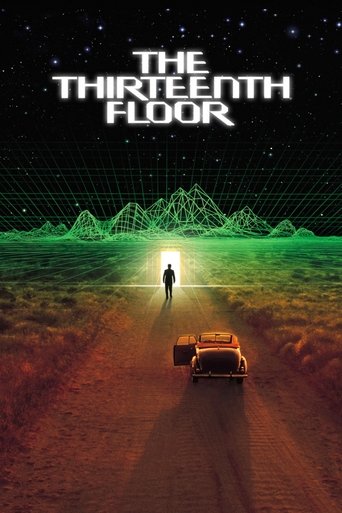
The Thirteenth Floor 1999
The Thirteenth Floor Maps the Gnostic Cosmos (Every Layer Has Its Demiurge)
Read the revelation →