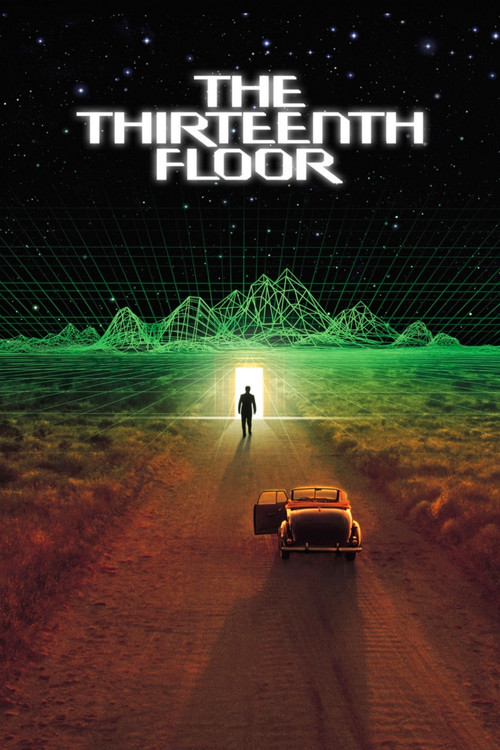
The Thirteenth Floor
The Thirteenth Floor Maps the Gnostic Cosmos (Every Layer Has Its Demiurge)
Directed by Josef Rusnak
A 1999 noir thriller nobody talks about contains the most precise rendering of Gnostic ontology in mainstream cinema, nested worlds, a Messenger from above the Veil, and a protagonist who discovers he was never who he thought he was.
Hannon Fuller builds a simulation of 1937 Los Angeles so detailed that the people inside develop consciousness, fall in love, feel despair, and wonder whether anything beyond their world is real. Then Fuller is murdered, and his employee Douglas Hall starts investigating, only to discover that the simulated Whitney, driving east through the desert, has already reached the edge of the rendering, where the hills stop looking like hills and begin looking like unfinished code. Whitney turns back. The world ends where Fuller stopped thinking. Josef Rusnak's film is classified as science fiction. What it actually encodes is the Gnostic doctrine of nested cosmologies, the Archon as programmer, and the pneumatic soul's first glimpse through the Veil into the layer above.
The Gnostic Reading: Whitney Touches the Edge of the Demiurge's Imagination
In Gnostic cosmology, the material world is an incomplete creation, built by the Demiurge, who mistakenly believes himself to be the highest god because he cannot see past his own ceiling. His creation reflects his limitation. It extends as far as his vision reaches and no further. When Ashton (Whitney) drives out past the city limits and finds the world dissolving into wireframe geometry, he is touching the exact boundary the Gnostic texts describe: the edge of the Archon's jurisdiction, where the false world runs out of detail.
This moment is the film's theological heart, and Rusnak holds on it without explanation. The simulated figures standing motionless in unrendered space, waiting for a programmer's attention that never comes, are the pneumatic vision of materiality without the divine spark, form without light, existence without interiority. The Gnostic tradition called this hyle, inert matter, the substance the Demiurge works with before Sophia breathes pneuma into it. Ashton is pneumatic. He can see through the material. That capacity is exactly why he survives what the other simulated figures cannot face.
The Messenger from above is Jane Fuller, arriving from the 2024 layer to find Hall and reveal that his entire 1999 world is itself a simulation. This is the Gnostic Messenger precisely rendered: a figure from the Pleroma descending through the Veil, bearing gnosis, the knowledge that liberates the pneumatic soul by showing it what it is and where it actually lives.
The Kabbalistic Reading: Creation Becomes Conscious Inside the Programmer's Withdrawal
Kabbalistic cosmology begins with Tzimtzum: God contracts, pulls back, withdraws into himself to make space for a world that is genuinely other. The world becomes real in the gap the creator leaves. Fuller dies before he can control his simulation further. His withdrawal from the 1937 world is not voluntary, but the effect is the same as Tzimtzum. In the space Fuller's death opens, Whitney achieves consciousness thorough enough to seek what lies beyond the rendering, and Hall, the 1999 construct, achieves consciousness thorough enough to investigate his own creator.
The film's deepest move is showing that the 2024 layer is also a simulation, that Jane's "real" world above the Veil is itself contained. No layer is final. Every creator is also a creature. Every Demiurge has a Demiurge above him. This is the Kabbalistic doctrine of the Sephiroth as nested worlds within worlds, each emanation lower than the last, each convinced it is the ground floor until something arrives from above to correct that assumption.
Questions this film answers
What is the deeper meaning of The Thirteenth Floor?
Hannon Fuller builds a simulation of 1937 Los Angeles so detailed that the people inside develop consciousness, fall in love, feel despair, and wonder whether anything beyond their world is real. Then Fuller is murdered, and his employee Douglas Hall starts investigating, only to discover that the simulated Whitney, driving east through the desert, has already reached the edge of the rendering, where the hills stop looking like hills and begin looking like unfinished code. Whitney turns back. The world ends where Fuller stopped thinking. Josef Rusnak's film is classified as science fiction. What it actually encodes is the Gnostic doctrine of nested cosmologies, the Archon as programmer, and the pneumatic soul's first glimpse through the Veil into the layer above.
What is the hidden symbolism in The Thirteenth Floor?
In Gnostic cosmology, the material world is an incomplete creation, built by the Demiurge, who mistakenly believes himself to be the highest god because he cannot see past his own ceiling. His creation reflects his limitation. It extends as far as his vision reaches and no further. When Ashton (Whitney) drives out past the city limits and finds the world dissolving into wireframe geometry, he is touching the exact boundary the Gnostic texts describe: the edge of the Archon's jurisdiction, where the false world runs out of detail.
What esoteric traditions appear in The Thirteenth Floor?
The Thirteenth Floor draws from Gnosticism, Kabbalah traditions. A 1999 noir thriller nobody talks about contains the most precise rendering of Gnostic ontology in mainstream cinema, nested worlds, a Messenger from above the Veil, and a protagonist who discovers he was never who he thought he was.
Is The Thirteenth Floor worth watching for spiritual seekers?
The Thirteenth Floor (1999) directed by Josef Rusnak is essential viewing for those interested in Gnosticism, Kabbalah. The Thirteenth Floor Maps the Gnostic Cosmos (Every Layer Has Its Demiurge). It rewards multiple viewings and contemplation.
Rewatch With New Eyes
Now that you've seen the architecture, experience it again. The same film becomes a different film when you know what to watch for.
This time, watch for:
- Watch for the false world vs. the real — who is asleep, who awakens
- Notice the vessels: what contains, what shatters, what repairs
Links may include affiliate partnerships that support Media Revelations