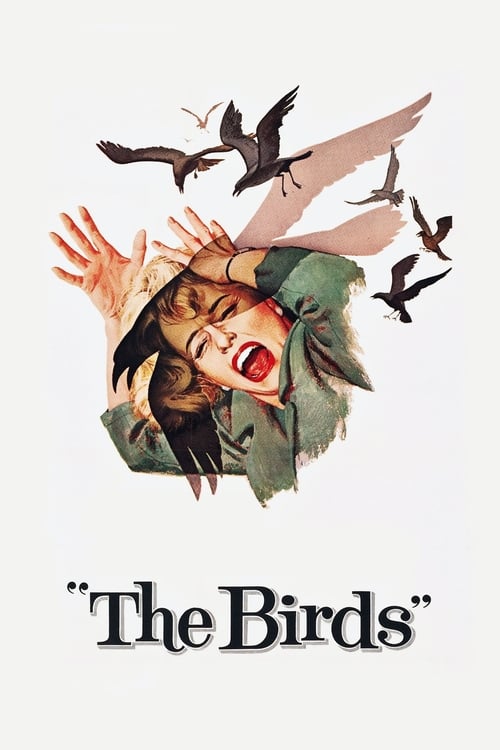
Hitchcock filmed the moment the older order stops cooperating with the assumptions of modern civilized life. There is no explanation for the bird attacks. There is no resolution. The film refuses both. The horror is that the non-human world, having tolerated us for some unspecified length of time, has begun — without warning, without explanation, without negotiation — to withdraw the tolerance.
The Birds is Hitchcock's least conclusive and most ecologically prescient film. The bird attacks have no announced cause. The film refuses to provide one. Critics have suggested various readings — sexual repression, family dysfunction, environmental collapse — and Hitchcock's deliberate refusal to confirm any of them is itself the film's most precise statement. The birds are not a metaphor that resolves. The birds are the older non-human order withdrawing its consent. Daphne du Maurier's source story was set against the postwar British coast and read as Cold War paranoia. Hitchcock's California adaptation places the attacks against the comfortable affluence of Bodega Bay, and the violence of the imagery — children fleeing a schoolhouse, a man's eyes pecked out at a doorway, a population reduced to barricading itself in basements — registers differently than a wartime parable. The film is showing what happens when one assumes a relationship with the non-human world is fundamentally peaceful and discovers that the assumption was always a courtesy the non-human world was extending and could at any moment cease extending. The ending — the protagonists driving slowly through a landscape of waiting birds, the birds not attacking but not departing — is the film's most rigorous statement. We have not been forgiven. We have been suspended. The suspension is the new condition.
The Surface
Melanie Daniels, a wealthy San Francisco socialite, follows lawyer Mitch Brenner to Bodega Bay to deliver a pair of lovebirds as a prank. She arrives during increasingly strange bird behavior. Gulls attack her in the harbor. Crows mass on a schoolyard. A finch crashes through a window during a quiet evening at the family home. The attacks escalate. Children are attacked outside the schoolhouse. A man is found dead with his eyes pecked out. The town's residents barricade themselves. Melanie is attacked in an attic. The film ends with the family — Mitch, his mother, his sister Cathy, and an unconscious Melanie — driving slowly out of Bodega Bay through fields and rooftops covered with thousands of silent, watching birds. The birds do not attack the car. They allow it to pass. The film cuts to black with no explanation, no resolution, and no closing credits.
On release the film was a commercial success and a critical puzzle. Hitchcock's decision to omit the closing 'The End' was unprecedented. The lack of explanation for the attacks frustrated some viewers. Tippi Hedren's performance, the practical effects with live birds, the sound design composed of bird vocalizations rather than music — all became influential.
The film has been read variously as feminist, anti-feminist, sexual, anti-sexual, ecological, political. The variety of readings is the consequence of Hitchcock's deliberate refusal to provide closure. The film is not a puzzle with a missing piece. The film is a deliberately incomplete work whose incompleteness is the form of its meaning. The birds do not need a reason. The film refuses to give them one. The viewer must sit with the absence of explanation.
The Non-Human World as Other
Shamanic traditions across cultures share a foundational recognition: the non-human world is populated by beings with their own perspectives, intentions, and modes of relation, and the human relationship with these beings requires ongoing negotiation. The negotiation is not metaphorical. Specific practices — offerings, songs, names, taboos — are performed because they maintain a peace that, if not maintained, becomes hostile.
Modern civilization has largely abandoned this framework. Birds, in particular, are filed as wildlife. They are categorized by species, observed for behavior, sometimes counted for ecological monitoring. They are not addressed. They are not consulted. Their consent is not sought because they are not considered the kind of beings whose consent could be sought.
The Birds is what happens when this assumption proves wrong. Hitchcock films the birds without anthropomorphizing them. They do not snarl. They do not posture. They simply act in coordinated fashion against the human population. The coordination implies intelligence the film never explains. The intelligence implies a perspective the film never voices. The viewer is forced to imagine a non-human consciousness operating at scale with intentions that include the harming of humans for unstated reasons.
This is the world a shamanic culture lives in. The shaman's office exists precisely because such situations arise and require an interpreter. Hitchcock's Bodega Bay has no shaman. The town has a hardware store, a school, a diner, a pier. None of these institutions are designed for the situation that has arrived. The town is structurally unprepared because the modern world has decided such situations no longer occur. The film demonstrates that the modern world's decision did not change what actually occurs. The decision changed only the apparatus available when occurrences happen.
The Attic and the Failure of Refuge
The film's most psychologically intense sequence is Melanie's attack in the attic. She climbs to investigate a noise. She opens the door. She is set upon by dozens of birds that have entered through the roof. The attack lasts minutes. The birds tear her hands, her face, her scalp. She defends herself with her arms. The attack continues until she collapses. Mitch breaks down the door to find her.
What makes the sequence work is the spatial logic. The attic is supposed to be the safest room. It is high. It is enclosed. It is the place where children hide. By staging the most concentrated attack in this specific room, Hitchcock is making a structural argument: there is no refuge. The instinct to climb upward toward safety is the wrong instinct in the new conditions. The birds are above. The birds are below. The birds are inside the supposedly secure spaces. The architecture of safety has been compromised by the new tenants.
This is the same recognition that shamanic peoples maintain by ritual practice. The house is not safe because the cosmos has decided it is safe. The house is safe because specific arrangements have been made and are being maintained. When the arrangements lapse, the house becomes a building, no more inherently safe than a tree. Melanie's attack is what happens when the arrangements have lapsed without anyone noticing they were there in the first place.
The Brenner family barricading the windows of the house at the climax is the modern attempt to substitute material for ritual. They board the windows with what they have. They survive the night. They have not solved the problem. They have postponed it. The morning brings the field of waiting birds. The barricades did not earn forgiveness. The barricades only deferred the next encounter.
The Lovebirds and the Pact
Hitchcock's most underrated symbolic gesture is the pair of lovebirds Melanie has brought as a prank. The lovebirds are caged. They are domesticated. They are a gift intended for a child. Throughout the film, as the wild birds attack, the lovebirds remain in their cage, unharmed, watching.
In the final escape sequence, Cathy asks to bring the lovebirds with them. She does not want to leave them behind. The family debates whether the wild birds will attack if they take the cage. The lovebirds are brought to the car. The wild birds, watching, do not attack. The lovebirds are permitted.
This is the film's most underrated piece of theology. The relationship between the domesticated lovebirds and the wild bird population is the relationship the film's apparent moral universe excludes. The lovebirds are not enemies of the wild birds. They are kin who have entered into a different arrangement with humans. The wild birds, in permitting their passage, are acknowledging the kinship without acknowledging the humans' permission to extend it.
The film does not allow us to read this clearly. But the gesture is precise. The way out of the conflict the film depicts is not victory over the birds. The way out is the recognition that there are arrangements that have always been available — the lovebird arrangement is one example — that the modern frame of nature-as-resource has obscured. Cathy's insistence on bringing the lovebirds, and the wild birds' permission for that bringing, is the film's only image of negotiation. It does not solve anything. It points at what solving would require.
The Transmission
The Birds transmits a particular and now-prescient perception: the non-human world is not the inert background against which human drama unfolds. It is composed of beings, populations, systems whose cooperation with human activity has been conditional and may, at any moment and for reasons we will not be allowed to fully understand, be withdrawn. Climate change has made this transmission more legible. The film made it sixty years ago. The film was correct.
What the film leaves the viewer with is the experience of having been refused — of having been put in the position of a person whose explanations are not going to be provided, whose authority is not going to be respected, whose comfort is not going to be restored. This is the perceptual state most contemporary viewers spend their lives avoiding. The film puts the viewer in it. The film does not let them out.
Hitchcock's refusal to provide closure was widely treated as a stylistic experiment. It was actually structural honesty. The situation depicted does not have closure available. The birds are still on the lawn at the end. They are not departing. They are not attacking. They are holding the position. The new condition is the holding. There is no return to before. The film does not pretend otherwise. The viewer who sits with the cut to black has sat with what Hitchcock was actually showing. The image is the gift. The gift is uncomfortable. The discomfort is the perception's accuracy.
Questions this film answers
What is the deeper meaning of The Birds?
The Birds is Hitchcock's least conclusive and most ecologically prescient film. The bird attacks have no announced cause. The film refuses to provide one. Critics have suggested various readings — sexual repression, family dysfunction, environmental collapse — and Hitchcock's deliberate refusal to confirm any of them is itself the film's most precise statement. The birds are not a metaphor that resolves. The birds are the older non-human order withdrawing its consent. Daphne du Maurier's source story was set against the postwar British coast and read as Cold War paranoia. Hitchcock's California adaptation places the attacks against the comfortable affluence of Bodega Bay, and the violence of the imagery — children fleeing a schoolhouse, a man's eyes pecked out at a doorway, a population reduced to barricading itself in basements — registers differently than a wartime parable. The film is showing what happens when one assumes a relationship with the non-human world is fundamentally peaceful and discovers that the assumption was always a courtesy the non-human world was extending and could at any moment cease extending. The ending — the protagonists driving slowly through a landscape of waiting birds, the birds not attacking but not departing — is the film's most rigorous statement. We have not been forgiven. We have been suspended. The suspension is the new condition.
What is the hidden symbolism in The Birds?
Melanie Daniels, a wealthy San Francisco socialite, follows lawyer Mitch Brenner to Bodega Bay to deliver a pair of lovebirds as a prank. She arrives during increasingly strange bird behavior. Gulls attack her in the harbor. Crows mass on a schoolyard. A finch crashes through a window during a quiet evening at the family home. The attacks escalate. Children are attacked outside the schoolhouse. A man is found dead with his eyes pecked out. The town's residents barricade themselves. Melanie is attacked in an attic. The film ends with the family — Mitch, his mother, his sister Cathy, and an unconscious Melanie — driving slowly out of Bodega Bay through fields and rooftops covered with thousands of silent, watching birds. The birds do not attack the car. They allow it to pass. The film cuts to black with no explanation, no resolution, and no closing credits.
What esoteric traditions appear in The Birds?
The Birds draws from Shamanism, Jungian traditions. Hitchcock filmed the moment the older order stops cooperating with the assumptions of modern civilized life. There is no explanation for the bird attacks. There is no resolution. The film refuses both. The horror is that the non-human world, having tolerated us for some unspecified length of time, has begun — without warning, without explanation, without negotiation — to withdraw the tolerance.
What does The Birds teach about the non-human world as other?
The shaman's office exists precisely because such situations arise and require an interpreter. The town has no shaman. Shamanic traditions across cultures share a foundational recognition: the non-human world is populated by beings with their own perspectives, intentions, and modes of relation, and the human relationship with these beings requires ongoing negotiation. The negotiation is not metaphorical. Specific practices — offerings, songs, names, taboos — are performed because they maintain a peace that, if not maintained, becomes hostile.
What does The Birds teach about the lovebirds and the pact?
The wild birds are acknowledging the kinship without acknowledging the humans' permission to extend it. Hitchcock's most underrated symbolic gesture is the pair of lovebirds Melanie has brought as a prank. The lovebirds are caged. They are domesticated. They are a gift intended for a child. Throughout the film, as the wild birds attack, the lovebirds remain in their cage, unharmed, watching.
Is The Birds worth watching for spiritual seekers?
The Birds (1963) directed by Alfred Hitchcock is essential viewing for those interested in Shamanism, Ecology, Hitchcock. Nature Withdrawing Its Consent. It rewards multiple viewings and contemplation.
Rewatch With New Eyes
Now that you've seen the architecture, experience it again. The same film becomes a different film when you know what to watch for.
This time, watch for:
- Follow the descent: what dies, what guides, what returns transformed
- Meet the shadow: what is rejected, projected, and finally integrated
Links may include affiliate partnerships that support Media Revelations
The Descent Continues
Where this thread leads next.
The Thing 1982
When the Enemy Wears Your Face (Perfect Paranoia as Spiritual Teaching)
Read the revelation →