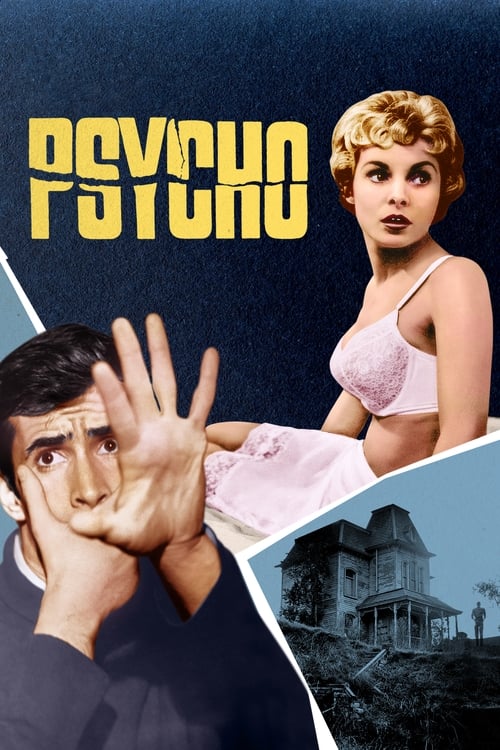
Psycho
The Mother Who Ate Her Son From the Inside
Directed by Alfred Hitchcock
Hitchcock made the most precise depiction of Shadow possession in mid-century American cinema and wrapped it in a structural prank — kill the protagonist forty minutes in, then make the audience identify with the killer. Norman Bates is not a man with a mother problem. Norman Bates is a man whose mother killed him by remaining in him after she was dead. The film is not a slasher. It is a Jungian autopsy of what happens when the parent's Shadow becomes the child's only available identity.
Psycho is treated as the founding text of the modern slasher and the master class in directorial misdirection. Both are correct. The film is also something else most discussions skip: the most rigorous Jungian autopsy of maternal Shadow possession ever produced in mainstream cinema. Norman Bates did not develop into a multiple personality. Norman Bates was eaten by his mother from the inside. The mother had no available exit from his psyche because Norman had built his identity around her, and when she died — by his own hand, which the film reveals only at the end — the only way to keep functioning was to install her as a permanent operating principle within his own consciousness. He maintains her body in the basement as a stage prop. He maintains her voice in his head as a working component. The film's actual horror is not the shower stabbing. The film's actual horror is the final monologue, delivered in mother's voice from inside Norman's body, in which the mother explains why she would never harm a fly. The annexation is complete. Norman is the body. The voice is whoever has taken up residence. Hitchcock did not need to invent any of this. He needed only to film it precisely. The precision is what produces the film's continuing capacity to disturb.
The Surface
A real estate secretary named Marion Crane steals $40,000 from her employer to start a new life with her boyfriend. She drives, gets paranoid, stops at a motel run by a polite, awkward young man named Norman Bates. Norman lives with his mother in the house behind the motel. He tells Marion about the mother during dinner. Marion decides to return the money. She showers. She is stabbed to death by a figure who appears to be Norman's mother. Marion's sister Lila and her boyfriend Sam investigate the disappearance, along with a private detective who is also killed at the house. They eventually discover Norman in the basement holding the embalmed body of his mother. Norman, dressed as his mother, attacks Lila. Sam subdues him. The psychiatrist's monologue at the end explains: Norman killed his mother and her lover years ago, then preserved her body and grew a personality based on her inside his own psyche, eventually being absorbed by it. The final shot is Norman in a cell, the mother's voice narrating internally, smiling as she explains she would not even hurt a fly.
On release the film was a sensation. Hitchcock built marketing around the no-late-admission policy and the demand that nobody reveal the ending. Bernard Herrmann's score, the shower-stabbing montage, Janet Leigh's mid-film death, the Bates house silhouette — all became part of the cinematic vocabulary.
The film has been analyzed primarily as a structural triumph and as the proto-slasher. Less discussed is the psychological precision of the mother possession depicted. Hitchcock, working from Robert Bloch's novel, has staged what Jung described clinically as Shadow possession in its most complete form. The film is not a horror invention. It is a clinical case rendered with the resources of cinema.
The Mother as Annexed Shadow
Jung described the Shadow as the disowned aspect of the personality — the qualities the conscious ego refuses to recognize as its own. The Shadow operates autonomously until integrated. When the Shadow is parental — when the child has built its identity around a parent and refused to recognize the parent's negative qualities — the parental Shadow can take possession of the child's psyche, particularly after the parent's death removes the external referent.
Norman is the textbook case. He has built his entire identity around his mother. His personality, his vocabulary, his living arrangements, his attire — all are organized around the maternal axis. He has never differentiated. The mother's actual death — at his hands, in a fit of jealousy over her lover — removed the external mother but did not remove the maternal apparatus inside Norman. The apparatus required the mother. The apparatus continued running. Without the actual mother to point at, Norman became the actual mother.
This is not invented horror. This is descriptive psychology. Adult children of intensely controlling parents often discover, after the parent's death, that the parental voice continues to operate inside them with diminished accountability. The parent is no longer corrigible. The internal voice cannot be argued with. The voice issues judgments. The voice forbids behaviors. The voice praises compliance. The work of liberation — if it is to be performed — requires the adult to consciously distinguish their own perspective from the inherited maternal or paternal voice.
Norman never performs this work. He cannot. He has no scaffolding outside the mother to perform it from. The mother becomes the entire psyche. By the end of the film, there is no Norman left. The body is Norman's. The consciousness is mother's. The takeover is complete.
The Shower as Sparagmos
The shower sequence is the most analyzed forty-five seconds in twentieth-century cinema. Hitchcock filmed it as a series of more than seventy cuts in less than a minute. The knife is shown approaching the body but is never shown actually piercing it. The blood is chocolate syrup. The screams are Janet Leigh's voice mixed with Bernard Herrmann's screeching violins. The dramatic effect is the violence the viewer assembles from the fragments.
What is often missed is the sequence's structural function. Marion has just decided to return the money. She has chosen the moral path. She has begun the alchemical washing — literally, in the shower, getting clean. The sparagmos arrives exactly at the moment of cleansing. The dismemberment is the ritual the older traditions describe: the moment a candidate begins to integrate their material is precisely the moment the disowned forces strike.
Marion is not killed for being bad. Marion is killed at the moment of her conversion. This is the film's most theologically loaded structural choice. The protagonist whose redemption was about to be visible is removed before the redemption can resolve. The film does not give Marion her arc. The film denies her the arc. The denial is the diagnosis. The world the film depicts does not reliably reward conversion. The work of converting is undertaken without the assurance of harvest.
Hitchcock's other underrated structural move: after Marion's death, the film transfers the audience's identification to Norman. We watch Norman clean the bathroom. We watch Norman wrap the body. We watch Norman sink the car in the swamp. We hold our breath when the car briefly stops sinking. We exhale when it resumes. The audience has been invited, with extraordinary cinematic skill, to root for the cleanup of the murder we just witnessed. The maneuver is the film's structural argument about how easily moral identification can be redirected when the cinema chooses to redirect it.
The House as Body
The Bates property is composed of two structures — the modern motel below and the Gothic Victorian house above. The architecture is the diagnosis made spatial. The motel is Norman's surface, his public-facing competence, his daily life. The house is his interior, the mother's domain, the place where the actual operation takes place.
The vertical relationship is precise. The mother is upstairs. The visible corpse is in the basement. Norman lives in the middle, ascending to perform the mother's role, descending to maintain her physical remains. The geography is the psyche made architectural. Each level is a different stratum of consciousness. The film's investigators have to climb the levels in sequence, and the climb is the discovery.
Hitchcock's most precise compositional choice is the silhouette shot of the house. The house is filmed against the sky, lit from below or behind, framed as a structure with personality. The house is the mother in physical form. The mother's actual body in the basement is, in important ways, redundant — the house is already the body. Norman lives inside the mother whether or not he is currently inside the dwelling.
The film's ending, with Norman in the cell, is the first time he has been removed from the house. The removal does not free him. The internal house is already complete. The external structure was only the visible scaffold. The internal mother continues. The cell is now her dwelling. The architectural body has been replaced by the institutional one. The mother does not mind. The mother is wherever Norman is. The takeover was never spatial. The takeover was psychic. The cell does not change it.
The Transmission
Psycho transmits a particular and uncomfortable recognition: that the people we love and have built our identities around are not safely outside us when they leave the room or leave the world. They remain, sometimes louder, sometimes more imperious, sometimes more capable of issuing instructions than they ever were in life. The work of an adult life often turns out to include the slow, painful process of distinguishing one's own voice from the internalized voices of the formative figures.
What the film leaves the viewer with is a permanent suspicion of the internal voices. Whose voice is that? Where did it come from? When did I begin agreeing with it? Why have I never argued with it? These are not horror movie questions. These are the questions any contemplative tradition asks of the practitioner. The film delivers them as horror because horror is the genre most viewers will sit through. The diagnosis is more accurate than any therapy session most viewers will undertake.
Hitchcock's final shot is the most unsettling in his filmography. Norman in the cell, smiling in mother's voice, while the camera slowly closes in. The fade includes a brief superimposition of the mother's skull over Norman's face. The takeover is total. The viewer is shown what the takeover looks like when it has reached its endpoint. Few viewers leave the theater unable to identify some internal voice they have been carrying that fits the pattern. The recognition is the film's gift. The work of beginning to differentiate that voice from one's own is the viewer's responsibility. The film cannot do that work. The film only makes the work visible.
Questions this film answers
What is the deeper meaning of Psycho?
Psycho is treated as the founding text of the modern slasher and the master class in directorial misdirection. Both are correct. The film is also something else most discussions skip: the most rigorous Jungian autopsy of maternal Shadow possession ever produced in mainstream cinema. Norman Bates did not develop into a multiple personality. Norman Bates was eaten by his mother from the inside. The mother had no available exit from his psyche because Norman had built his identity around her, and when she died — by his own hand, which the film reveals only at the end — the only way to keep functioning was to install her as a permanent operating principle within his own consciousness. He maintains her body in the basement as a stage prop. He maintains her voice in his head as a working component. The film's actual horror is not the shower stabbing. The film's actual horror is the final monologue, delivered in mother's voice from inside Norman's body, in which the mother explains why she would never harm a fly. The annexation is complete. Norman is the body. The voice is whoever has taken up residence. Hitchcock did not need to invent any of this. He needed only to film it precisely. The precision is what produces the film's continuing capacity to disturb.
What is the hidden symbolism in Psycho?
A real estate secretary named Marion Crane steals $40,000 from her employer to start a new life with her boyfriend. She drives, gets paranoid, stops at a motel run by a polite, awkward young man named Norman Bates. Norman lives with his mother in the house behind the motel. He tells Marion about the mother during dinner. Marion decides to return the money. She showers. She is stabbed to death by a figure who appears to be Norman's mother. Marion's sister Lila and her boyfriend Sam investigate the disappearance, along with a private detective who is also killed at the house. They eventually discover Norman in the basement holding the embalmed body of his mother. Norman, dressed as his mother, attacks Lila. Sam subdues him. The psychiatrist's monologue at the end explains: Norman killed his mother and her lover years ago, then preserved her body and grew a personality based on her inside his own psyche, eventually being absorbed by it. The final shot is Norman in a cell, the mother's voice narrating internally, smiling as she explains she would not even hurt a fly.
What esoteric traditions appear in Psycho?
Psycho draws from Jungian, Initiation traditions. Hitchcock made the most precise depiction of Shadow possession in mid-century American cinema and wrapped it in a structural prank — kill the protagonist forty minutes in, then make the audience identify with the killer. Norman Bates is not a man with a mother problem. Norman Bates is a man whose mother killed him by remaining in him after she was dead. The film is not a slasher. It is a Jungian autopsy of what happens when the parent's Shadow becomes the child's only available identity.
What does Psycho teach about the mother as annexed shadow?
The apparatus required the mother. The apparatus continued running. Without the actual mother to point at, Norman became the actual mother. Jung described the Shadow as the disowned aspect of the personality — the qualities the conscious ego refuses to recognize as its own. The Shadow operates autonomously until integrated. When the Shadow is parental — when the child has built its identity around a parent and refused to recognize the parent's negative qualities — the parental Shadow can take possession of the child's psyche, particularly after the parent's death removes the external referent.
What does Psycho teach about the shower as sparagmos?
Marion is killed at the moment of her conversion. The film does not give Marion her arc. The denial is the diagnosis. The shower sequence is the most analyzed forty-five seconds in twentieth-century cinema. Hitchcock filmed it as a series of more than seventy cuts in less than a minute. The knife is shown approaching the body but is never shown actually piercing it. The blood is chocolate syrup. The screams are Janet Leigh's voice mixed with Bernard Herrmann's screeching violins. The dramatic effect is the violence the viewer assembles from the fragments.
Is Psycho worth watching for spiritual seekers?
Psycho (1960) directed by Alfred Hitchcock is essential viewing for those interested in Jungian, Shadow, Hitchcock. The Mother Who Ate Her Son From the Inside. It rewards multiple viewings and contemplation.
Rewatch With New Eyes
Now that you've seen the architecture, experience it again. The same film becomes a different film when you know what to watch for.
This time, watch for:
- Meet the shadow: what is rejected, projected, and finally integrated
- Mark the threshold: the old self dies, the ordeal transforms, the new self returns
Links may include affiliate partnerships that support Media Revelations
The Descent Continues
Where this thread leads next.
Mulholland Drive 2001
The Blue Key and the Dissolution of Identity
Read the revelation →