The Cabinet of Dr. Caligari
Caligari Is the First Film to Show You That the Whole World Is Someone Else's Cabinet
Directed by Robert Wiene
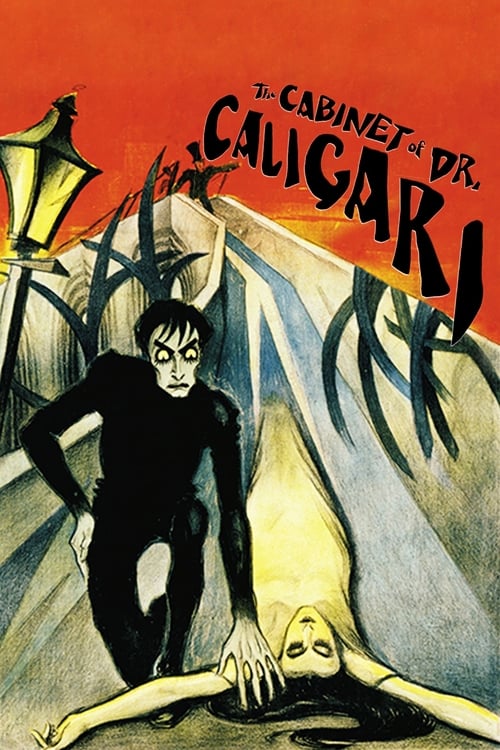
Painted shadows, buildings that lean like teeth, a town with no straight line in it. Then the last scene reveals whose mind you have been standing inside the entire time.
The Cabinet of Dr. Caligari is usually filed under horror, or under the birth of Expressionism, and both are true and both miss the machine underneath. Francis tells a story: a fairground doctor exhibits a sleepwalker, Cesare, who wakes from his coffin only to predict a man's death and then, that night, commits it. The doctor is the murderer working through the hand of his hypnotized instrument. Francis chases the truth, exposes Caligari as the director of an asylum, and wins. Then the frame collapses. Francis is himself an inmate. Caligari is his doctor. The world with the crooked walls, the leaning windows, the streets that fold like paper, all of it was the architecture of Francis's own delusion. The film is not about a killer. It is about the moment you realize the shape of reality was drawn by the one who has power over you.
Gnosticism Reading: The Demiurge Runs the Asylum
Gnostic cosmology holds that the world you take for reality was built by a lesser god, the Demiurge, an authority who mistakes himself for the source and keeps souls asleep inside his fabrication. Caligari is that figure rendered in greasepaint and shadow. He does not simply lie. He constructs the entire perceptual world: the sets themselves, painted with impossible angles and light that is brushed onto the walls rather than cast, are not scenery but theology. Nothing in this town is level because nothing in it is real, and the being who bent every line is the same being who runs the institution that names Francis mad.
Watch the horror on Francis's face in the final scene, when Caligari, now the benevolent director, straightens his coat and says he knows how to cure him. This is the Gnostic terror precisely. The one who imprisons you is the same one who offers to heal you, and he will heal you into deeper sleep. The exhibit, the cabinet where Cesare stands upright in his box waiting to be woken, is the whole cosmos in miniature: a sleeper in a coffin, displayed by an authority, roused only to serve another's will. Gnosis in this film would be Francis's brief lucidity, the story he tells, in which he at least perceived the doctor as the enemy. The system answers that lucidity by calling it insanity.
Jungian Reading: Cesare Is the Shadow, and Someone Else Holds His Leash
Cesare the somnambulist is the unlived self, the Shadow, the part of Francis that acts in darkness while the conscious man sleeps. He is dressed in black, moves against black, emerges only at night, and kills without memory or will. In Jung's terms he is autonomous complex made flesh: the disowned drive that, unintegrated, gets commanded by whatever hand takes hold of it. Francis cannot own his own violence, so the story splits it off into a sleepwalker directed by a father figure.
The tenderness of the film is in Cesare's one refusal. Sent to murder Jane, he raises the knife over the sleeping woman and cannot bring it down. Beauty stays the Shadow's hand. He carries her across the rooftops instead, and dies of exhaustion in flight. Even the disowned self, met directly, would rather love than obey. The tragedy is that no one in the cabinet is awake enough to receive that.
Questions this film answers
What is the deeper meaning of The Cabinet of Dr. Caligari?
The Cabinet of Dr. Caligari is usually filed under horror, or under the birth of Expressionism, and both are true and both miss the machine underneath. Francis tells a story: a fairground doctor exhibits a sleepwalker, Cesare, who wakes from his coffin only to predict a man's death and then, that night, commits it. The doctor is the murderer working through the hand of his hypnotized instrument. Francis chases the truth, exposes Caligari as the director of an asylum, and wins. Then the frame collapses. Francis is himself an inmate. Caligari is his doctor. The world with the crooked walls, the leaning windows, the streets that fold like paper, all of it was the architecture of Francis's own delusion. The film is not about a killer. It is about the moment you realize the shape of reality was drawn by the one who has power over you.
What is the hidden symbolism in The Cabinet of Dr. Caligari?
Gnostic cosmology holds that the world you take for reality was built by a lesser god, the Demiurge, an authority who mistakes himself for the source and keeps souls asleep inside his fabrication. Caligari is that figure rendered in greasepaint and shadow. He does not simply lie. He constructs the entire perceptual world: the sets themselves, painted with impossible angles and light that is brushed onto the walls rather than cast, are not scenery but theology. Nothing in this town is level because nothing in it is real, and the being who bent every line is the same being who runs the institution that names Francis mad.
What esoteric traditions appear in The Cabinet of Dr. Caligari?
The Cabinet of Dr. Caligari draws from Gnosticism, Jungian traditions. Painted shadows, buildings that lean like teeth, a town with no straight line in it. Then the last scene reveals whose mind you have been standing inside the entire time.
Is The Cabinet of Dr. Caligari worth watching for spiritual seekers?
The Cabinet of Dr. Caligari (1920) directed by Robert Wiene is essential viewing for those interested in Gnosticism, Jungian. Caligari Is the First Film to Show You That the Whole World Is Someone Else's Cabinet. It rewards multiple viewings and contemplation.
Rewatch With New Eyes
Now that you've seen the architecture, experience it again. The same film becomes a different film when you know what to watch for.
This time, watch for:
- Watch for the false world vs. the real — who is asleep, who awakens
- Meet the shadow: what is rejected, projected, and finally integrated
Links may include affiliate partnerships that support Media Revelations