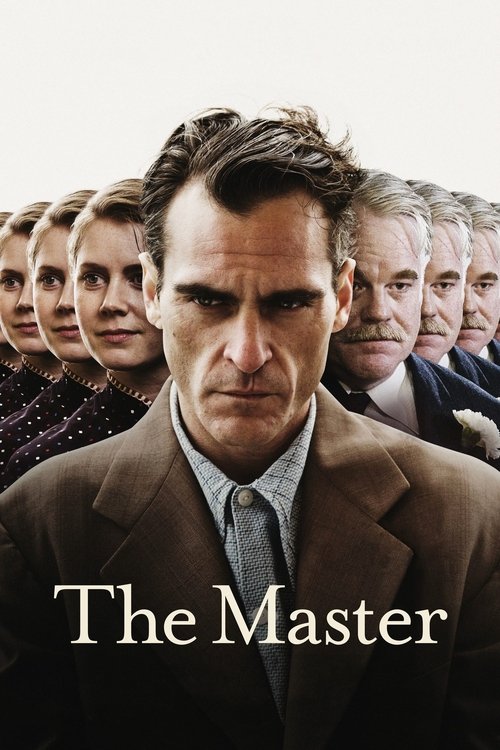
The Master
The Animal Who Found a Man Who Found a Method
Directed by Paul Thomas Anderson
Freddie Quell is a human animal — pure id, uncontained, dangerous. Lancaster Dodd is a man who has built a system to contain such animals. Their relationship is the oldest story: the beast who needs a master, the master who needs a beast to prove his methods work.
The Master is not primarily about Scientology, though the parallels to L. Ron Hubbard are obvious. It is about the oldest dynamic in human civilization: the wild man and the man who tames him, the id and the superego, the animal and the trainer. Freddie Quell and Lancaster Dodd need each other with a desperation neither fully understands. Freddie is pure chaos — sexually compulsive, violent, alcoholic, unable to function in post-war society. He poisons himself with paint thinner and torpedo fuel. He assaults strangers. He is what the human becomes when every civilizing restraint has been stripped away by trauma. Lancaster offers structure: a cosmology, a method, a father figure. The Cause promises to 'process' Freddie's animal nature into something manageable. But the film's devastating insight is that Lancaster needs Freddie as much as Freddie needs Lancaster. The Master requires proof that his methods work, and Freddie is the ultimate test case. If The Cause can civilize this animal, it can civilize anyone. Freddie's wildness validates Lancaster's system. Their mutual dependency is the film's true subject.
The Surface
Freddie Quell, a World War II veteran incapable of readjusting to civilian life, stumbles onto a yacht where Lancaster Dodd, known as 'The Master,' presides over a burgeoning spiritual movement called The Cause. Dodd is fascinated by Freddie's wildness and takes him on as a project. What follows is a complicated bond — part therapeutic, part paternal, part erotic — that neither can resolve or abandon.
Paul Thomas Anderson's film was expected to be an exposé of Scientology. Instead, it is something stranger and more intimate: a love story between two men who cannot love normally, mediated through the apparatus of a pseudo-religion that may or may not work.
The film is deliberately opaque, refusing the satisfactions of narrative resolution. Freddie does not 'get better.' Lancaster is not exposed as a fraud (though he clearly is one, at least partly). The Cause continues. The animal remains animal. The master remains master. What changed? The film leaves this as an open question.
Freddie as Id
Freddie is not a person so much as a collection of drives. He drinks compulsively, concocting poison cocktails from whatever intoxicants are available. He is sexually obsessive, humping sand-sculptures and assaulting department store customers. He is violent without purpose, explosive without warning.
This is what Freud called the id — the reservoir of primal urges that civilization exists to contain. Freddie is a man whose containing structures have been destroyed. War stripped him of whatever socialization he once possessed. He walks through post-war America as a figure from prehistory, pre-verbal in his impulses, dangerous and pitiful.
Phoenix's performance makes Freddie physically uncomfortable to watch. His body is twisted, cramped, asymmetrical. He speaks through clenched teeth. He holds tension like a bomb holds pressure. Every scene suggests imminent explosion. This is not acting a character — it is embodying a psychological condition.
The Cause offers what Freddie lacks: structure, belonging, meaning. Lancaster's methods — however dubious — give Freddie something to do with his chaos. The 'processing' sessions channel his energy into a framework. Even if the framework is nonsense, the channeling provides temporary containment.
Lancaster as Superego
Lancaster Dodd is everything Freddie is not: articulate, controlled, socially adept, intellectually pretentious. He has constructed an elaborate cosmology involving past lives, psychological 'processing,' and the perfectibility of human nature. He speaks like a father, commands like a king, seduces like a lover.
But Anderson is careful to show the cracks. Lancaster can be challenged by a skeptic at a party — his certainty wavers when questioned. He drinks too. He has a temper that emerges when his authority is questioned. His wife is the true power behind the throne, managing him as he manages his followers.
The Cause is real to Lancaster in the way that all self-constructed belief systems are real to their creators — real enough to believe, not real enough to survive external scrutiny. He is a con artist who has conned himself. This is perhaps the most dangerous kind of guru: the one who genuinely believes.
Lancaster needs Freddie because Freddie represents the ultimate validation. If these methods can tame this animal, they work. If Lancaster can father this unfatherable man, he is the father he claims to be. Freddie's resistance is not a problem — it is the proof that the victory, when it comes, will mean something.
The Processing Sessions
The 'processing' scenes between Lancaster and Freddie are the film's emotional center. Lancaster asks questions — 'Do your past failures bother you?' 'What is your name?' 'Do you linger at bus stations?' — and Freddie answers. The rules: no blinking, complete honesty, repetition until something breaks.
These sessions have the structure of initiatory ordeals. The questioner applies pressure. The subject resists. The resistance eventually cracks, and something authentic emerges from beneath the defensive structure. Whether what emerges is truth or trauma depends on your frame.
Phoenix plays these scenes with increasing vulnerability. Freddie begins armored, evasive, performing. As the questions continue — sometimes for hours — the armor falls away. We see beneath the animal to the wounded child. We see the moment of trauma. We see what Freddie has been running from.
The problem is what happens after. The sessions excavate trauma without providing healing. Freddie surfaces raw, exposed, more chaotic than before. The Cause has a method for opening but not for closing. Lancaster digs up the wound and calls it cure.
The Love That Cannot Speak
The relationship between Freddie and Lancaster is erotically charged without being sexual. Lancaster calls Freddie to his cabin at night. They gaze at each other with an intensity that exceeds any interaction Lancaster has with his wife. Their final scene is a declaration of love — 'If you leave, I don't ever want to see you again' — that could come from any romance.
Anderson leaves this ambiguous because the characters themselves cannot articulate it. This is not a hidden gay relationship. It is a bond that exceeds the categories available to describe it. Father-son. Master-disciple. Lover-beloved. Creator-creation. All of these and none of these.
Lancaster's wife recognizes the danger. Her famous scene — commanding Lancaster to 'stop' while she manipulates him to orgasm — is not just sexual control. It is an assertion of ownership against a rival. She sees what Freddie represents: a claim on her husband's attention that she cannot compete with because she cannot be what Freddie is.
The tragedy is that the relationship cannot go anywhere. Freddie cannot stay — he is too wild, too resistant to the container The Cause provides. Lancaster cannot let him go — he is too invested in the project, too in love with the challenge. They orbit each other, unable to join or separate.
The Transmission
The Master transmits something difficult: the recognition that even fraudulent systems meet genuine needs. The Cause is nonsense. Lancaster is a charlatan. But Freddie genuinely benefits — for a while — from belonging. The structure helps, even when the structure is built on nothing.
The film also transmits the warning embedded in every guru-disciple relationship: the master needs the disciple as much as the disciple needs the master. Lancaster's methods only work if they produce results. Freddie is the result he needs. Their relationship is symbiotic exploitation disguised as salvation.
In the final scene, Freddie repeats Lancaster's processing questions to a woman he has picked up. The method has been transmitted — but to what end? Freddie is still drunk, still chaotic, still alone. He has learned the technique without becoming the product the technique was supposed to produce.
The animal remains animal. The master remains master. Nothing is resolved. But something happened between them — something that both men will carry, something that defies the frameworks they tried to place it in. Call it love. Call it shadow-work. Call it the thing that makes us human, trying and failing to tame what cannot be tamed.
Questions this film answers
What is the deeper meaning of The Master?
The Master is not primarily about Scientology, though the parallels to L. Ron Hubbard are obvious. It is about the oldest dynamic in human civilization: the wild man and the man who tames him, the id and the superego, the animal and the trainer. Freddie Quell and Lancaster Dodd need each other with a desperation neither fully understands. Freddie is pure chaos — sexually compulsive, violent, alcoholic, unable to function in post-war society. He poisons himself with paint thinner and torpedo fuel. He assaults strangers. He is what the human becomes when every civilizing restraint has been stripped away by trauma. Lancaster offers structure: a cosmology, a method, a father figure. The Cause promises to 'process' Freddie's animal nature into something manageable. But the film's devastating insight is that Lancaster needs Freddie as much as Freddie needs Lancaster. The Master requires proof that his methods work, and Freddie is the ultimate test case. If The Cause can civilize this animal, it can civilize anyone. Freddie's wildness validates Lancaster's system. Their mutual dependency is the film's true subject.
What is the hidden symbolism in The Master?
Freddie Quell, a World War II veteran incapable of readjusting to civilian life, stumbles onto a yacht where Lancaster Dodd, known as 'The Master,' presides over a burgeoning spiritual movement called The Cause. Dodd is fascinated by Freddie's wildness and takes him on as a project. What follows is a complicated bond — part therapeutic, part paternal, part erotic — that neither can resolve or abandon.
What esoteric traditions appear in The Master?
The Master draws from Jungian, Initiation traditions. Freddie Quell is a human animal — pure id, uncontained, dangerous. Lancaster Dodd is a man who has built a system to contain such animals. Their relationship is the oldest story: the beast who needs a master, the master who needs a beast to prove his methods work.
What does The Master teach about freddie as id?
Freddie is a man whose containing structures have been destroyed. He walks through post-war America as a figure from prehistory. Freddie is not a person so much as a collection of drives. He drinks compulsively, concocting poison cocktails from whatever intoxicants are available. He is sexually obsessive, humping sand-sculptures and assaulting department store customers. He is violent without purpose, explosive without warning.
What does The Master teach about lancaster as superego?
Lancaster is a con artist who has conned himself. This is perhaps the most dangerous kind of guru: the one who genuinely believes. Lancaster Dodd is everything Freddie is not: articulate, controlled, socially adept, intellectually pretentious. He has constructed an elaborate cosmology involving past lives, psychological 'processing,' and the perfectibility of human nature. He speaks like a father, commands like a king, seduces like a lover.
What does The Master teach about the love that cannot speak?
Their bond exceeds the categories available to describe it. Father-son. Master-disciple. Lover-beloved. All of these and none of these. The relationship between Freddie and Lancaster is erotically charged without being sexual. Lancaster calls Freddie to his cabin at night. They gaze at each other with an intensity that exceeds any interaction Lancaster has with his wife. Their final scene is a declaration of love — 'If you leave, I don't ever want to see you again' — that could come from any romance.
Is The Master worth watching for spiritual seekers?
The Master (2012) directed by Paul Thomas Anderson is essential viewing for those interested in Jungian, Shadow, Cult. The Animal Who Found a Man Who Found a Method. It rewards multiple viewings and contemplation.
Rewatch With New Eyes
Now that you've seen the architecture, experience it again. The same film becomes a different film when you know what to watch for.
This time, watch for:
- Meet the shadow: what is rejected, projected, and finally integrated
- Mark the threshold: the old self dies, the ordeal transforms, the new self returns
Links may include affiliate partnerships that support Media Revelations
The Descent Continues
Where this thread leads next.
There Will Be Blood 2007
I Have a Competition in Me (The Gospel of American Avarice)
Read the revelation →