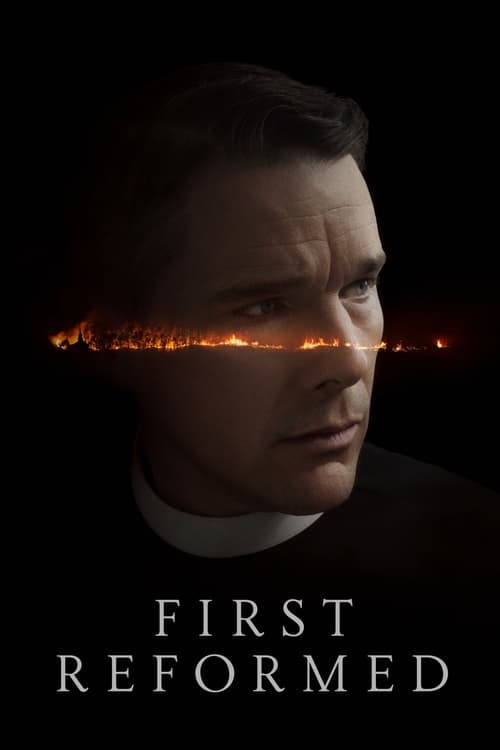
First Reformed
Ernst Toller Is a Gnostic in a World the Demiurge Owns
Directed by Paul Schrader
The despair is not breakdown. It is recognition.
Reverend Ernst Toller keeps a journal because he cannot speak what he sees to anyone who would hear it. First Reformed is Paul Schrader's most naked film, but the nakedness is doctrinal, not confessional. Toller is not a man losing faith. He is a pneumatic, a Gnostic term for the rare soul whose body of divine light recognizes, with terrible clarity, that the world is administered by something that cannot be prayed to. Michael, the environmental activist he counsels, hands him a manifesto about ecological collapse and then blows himself apart. Toller calls this an unstable mind. He is lying. What Michael carried was gnosis, the direct recognition that the Archons are winning, that the Demiurge's machine is accelerating, that piety inside a polluting institution is spiritual collaboration. The journal is Toller's attempt to metabolize that recognition before it metabolizes him.
The Communion Scene Is an Initiatory Transfer
Schrader stages the film's hinge with almost no dialogue. Toller lies on the floor of his study, and Mary, Michael's pregnant widow, lies on top of him, and they press together fully clothed, faces apart. Then the film levitates: a visionary sequence takes them over the Arctic, through aerial devastation, through the kind of beauty that breaks rather than heals. This is not comfort. It is transmission. In Gnostic cosmology, gnosis passes body to body, not argument to argument. Mary carries what Michael could not survive carrying. By absorbing her grief and her unborn child's future into his own body, Toller ceases to be merely afflicted and becomes a vessel. He enters what the tradition calls the light-realm, the momentary recognition of what the soul actually is, and returns to a world that still has to be lived inside. Initiation does not make the Archontic world less real. It makes the cost of tolerating it unbearable.
The Barbed Wire Is the Alchemical Coniunctio
Later, alone, Toller winds barbed wire around his torso beneath his vestments. He says nothing about it. The camera shows it once and moves on. In alchemical terms, this is the coniunctio, the union of opposites forced into a single vessel. Toller is preparing to conduct Sunday service while hosting a bomb in the next room. The wire is the suffering he has chosen to hold in his own flesh rather than dissociate from it. Alchemy's first move is always the same: the matter cannot be transformed from outside; the alchemist must enter the crucible. Toller has entered it. He has joined his body to the pain he spent the film trying to process intellectually. The vestments go over the wire. He walks to the altar. Schrader cuts just before the transformation resolves, love arrives and the film ends mid-motion, in the precise instant between a man destroying himself and a man choosing otherwise. The alchemical work is suspended at the moment of greatest heat.
Schrader built this architecture consciously; he wrote Taxi Driver with the same pneumatic-in-a-corrupt-world skeleton thirty years earlier, and the journal-voice is the same instrument. Where Bergman's priest in Winter Light loses God slowly, over decades of frost, Toller loses the institutional shell of God in ninety minutes of accelerating clarity. Bresson's priest in Diary of a Country Priest dies of cancer before the world can finish him. Toller chooses.
Questions this film answers
What is the deeper meaning of First Reformed?
Reverend Ernst Toller keeps a journal because he cannot speak what he sees to anyone who would hear it. First Reformed is Paul Schrader's most naked film, but the nakedness is doctrinal, not confessional. Toller is not a man losing faith. He is a pneumatic, a Gnostic term for the rare soul whose body of divine light recognizes, with terrible clarity, that the world is administered by something that cannot be prayed to. Michael, the environmental activist he counsels, hands him a manifesto about ecological collapse and then blows himself apart. Toller calls this an unstable mind. He is lying. What Michael carried was gnosis, the direct recognition that the Archons are winning, that the Demiurge's machine is accelerating, that piety inside a polluting institution is spiritual collaboration. The journal is Toller's attempt to metabolize that recognition before it metabolizes him.
What is the hidden symbolism in First Reformed?
Schrader stages the film's hinge with almost no dialogue. Toller lies on the floor of his study, and Mary, Michael's pregnant widow, lies on top of him, and they press together fully clothed, faces apart. Then the film levitates: a visionary sequence takes them over the Arctic, through aerial devastation, through the kind of beauty that breaks rather than heals. This is not comfort. It is transmission. In Gnostic cosmology, gnosis passes body to body, not argument to argument. Mary carries what Michael could not survive carrying. By absorbing her grief and her unborn child's future into his own body, Toller ceases to be merely afflicted and becomes a vessel. He enters what the tradition calls the light-realm, the momentary recognition of what the soul actually is, and returns to a world that still has to be lived inside. Initiation does not make the Archontic world less real. It makes the cost of tolerating it unbearable.
What esoteric traditions appear in First Reformed?
First Reformed draws from Gnosticism, Initiation traditions. The despair is not breakdown. It is recognition.
Is First Reformed worth watching for spiritual seekers?
First Reformed (2018) directed by Paul Schrader is essential viewing for those interested in Gnosticism, Initiation. Ernst Toller Is a Gnostic in a World the Demiurge Owns. It rewards multiple viewings and contemplation.
Rewatch With New Eyes
Now that you've seen the architecture, experience it again. The same film becomes a different film when you know what to watch for.
This time, watch for:
- Watch for the false world vs. the real — who is asleep, who awakens
- Mark the threshold: the old self dies, the ordeal transforms, the new self returns
Links may include affiliate partnerships that support Media Revelations