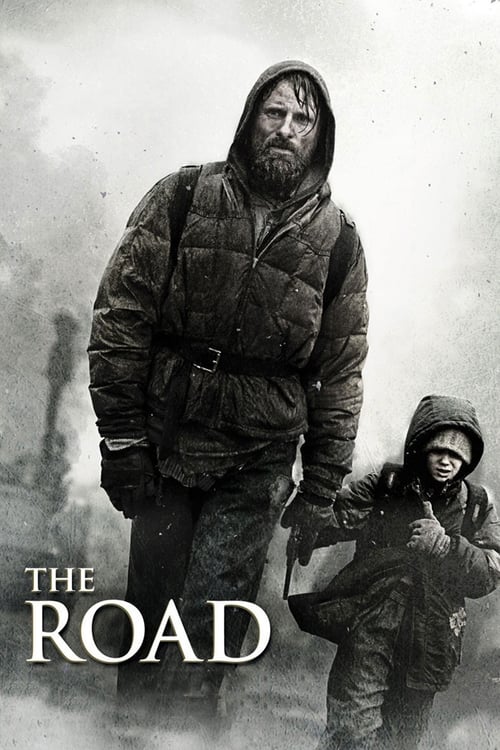
The Road
The Road Is a Father Teaching His Son the One Thing Worth Carrying Through the Dark
Directed by John Hillcoat
The ash-world is not the subject. The fire the man says they carry is the subject, and the whole film is about whether he can hand it over before he dies.
An unnamed man and his son walk south through a dead America, everything gray, every tree fallen or falling, no animals, no growth, only scavengers and the cannibal gangs the man dreads more than starving. The surface reading is that this is a grim survival story, endurance for its own sake. What the film is actually about is transmission. The father repeats a phrase to the boy: they are the good guys, they are "carrying the fire." There is no fire. It is a moral flame, an inner light, the single thing the man is trying to keep alive in his child while the outer world offers no evidence that goodness has any purpose left. The whole journey is a lesson the father is racing to complete before his lungs give out, and the film's real question is whether the fire is real enough to survive the man who carries it.
Gnostic Reading: The Divine Spark in a World the Light Has Abandoned
Gnosticism holds that a fragment of true light is trapped inside a material world that is dark, hostile, and not made by the good God. The Road builds that cosmology as landscape. The world is ash. The sun is gone behind permanent cloud. Whatever made this place, it was not benevolent, and the man never pretends otherwise; he curses the God who may or may not exist over a dead world.
Inside that darkness, the boy is the spark. The father says it plainly, that the child is the word of God, that if he is not then God never spoke. The "fire" they carry is the Gnostic pneuma, the divine remnant that does not belong to the ash and cannot be reduced to it. Every threat in the film is a threat to that spark: the cannibals who would consume it, the despair that would extinguish it, the father's own fear that would harden it into cruelty. The man's entire task is to keep the light burning long enough to pass it out of himself and into a vessel that can carry it further than he can go.
Initiation Reading: The Son Passes the Test the Father Sets
Beneath the survival lies a rite of passage, and the father is the initiator preparing the boy to live in the world alone. The lessons are relentless: how to hide, how to use the last bullet on himself if taken, how to know the good guys from the bad. But the deepest test is moral, not tactical. The boy keeps insisting they share, that they help the old man on the road, that they not become what the world has become. He is being initiated into a code, and he keeps enforcing it back onto his teacher.
The passage completes at the father's death. The man can go no further, and he tells the boy to keep carrying the fire, to keep going. Then the boy, alone, meets a stranger and must decide, without his father, whether to trust. He chooses to go with the family, extending the code his father drilled into him to a person his father never met. That is the mark of a completed initiation: the initiate applies the teaching in a situation the teacher never prepared, and does it right. The fire changed hands. It kept burning.
Questions this film answers
What is the deeper meaning of The Road?
An unnamed man and his son walk south through a dead America, everything gray, every tree fallen or falling, no animals, no growth, only scavengers and the cannibal gangs the man dreads more than starving. The surface reading is that this is a grim survival story, endurance for its own sake. What the film is actually about is transmission. The father repeats a phrase to the boy: they are the good guys, they are "carrying the fire." There is no fire. It is a moral flame, an inner light, the single thing the man is trying to keep alive in his child while the outer world offers no evidence that goodness has any purpose left. The whole journey is a lesson the father is racing to complete before his lungs give out, and the film's real question is whether the fire is real enough to survive the man who carries it.
What is the hidden symbolism in The Road?
Gnosticism holds that a fragment of true light is trapped inside a material world that is dark, hostile, and not made by the good God. The Road builds that cosmology as landscape. The world is ash. The sun is gone behind permanent cloud. Whatever made this place, it was not benevolent, and the man never pretends otherwise; he curses the God who may or may not exist over a dead world.
What esoteric traditions appear in The Road?
The Road draws from Gnosticism, Initiation traditions. The ash-world is not the subject. The fire the man says they carry is the subject, and the whole film is about whether he can hand it over before he dies.
Is The Road worth watching for spiritual seekers?
The Road (2009) directed by John Hillcoat is essential viewing for those interested in Gnosticism, Initiation. The Road Is a Father Teaching His Son the One Thing Worth Carrying Through the Dark. It rewards multiple viewings and contemplation.
Rewatch With New Eyes
Now that you've seen the architecture, experience it again. The same film becomes a different film when you know what to watch for.
This time, watch for:
- Watch for the false world vs. the real — who is asleep, who awakens
- Mark the threshold: the old self dies, the ordeal transforms, the new self returns
Links may include affiliate partnerships that support Media Revelations
The Descent Continues
Where this thread leads next.

Children of Men 2006
What Hope Looks Like When There Is No Future
Read the revelation →