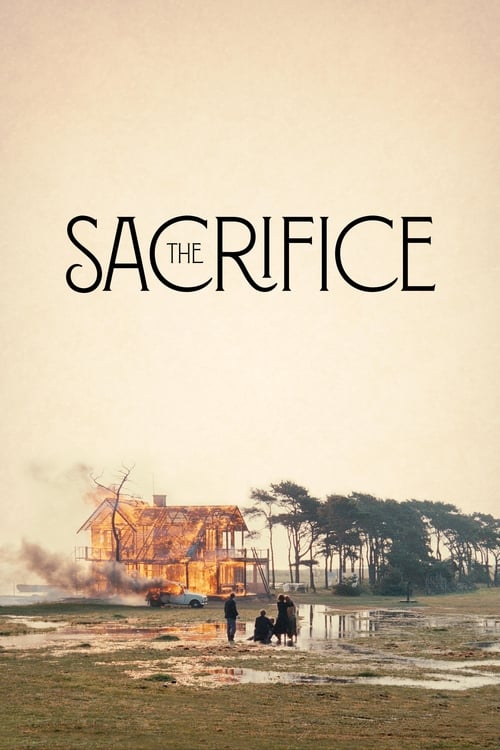
Tarkovsky's last film is a sustained meditation on the only spiritual gesture available when nothing in the world can be changed: give up the thing you love most as offering. Alexander burns his house because he made the vow. The film does not tell us whether the bomb fell or whether the vow worked. The point is that he gave the house. The fire is the only proof that he meant it.
The Sacrifice is the last film Tarkovsky made, completed while he was dying of the cancer that would kill him months after the premiere. He knew he was making a final statement. The statement is the most uncompromising offering ever filmed: a man learns that nuclear war has begun, makes a vow to God that he will surrender everything he loves if the catastrophe can be reversed, wakes in a morning where the catastrophe seems not to have happened, and performs the sacrifice anyway by burning his house to the ground. The film refuses to resolve whether the bomb actually fell or whether Alexander hallucinated it. The film refuses to resolve whether the sacrifice was efficacious or psychotic. What the film does not refuse is the gesture itself. Alexander made the vow. Alexander kept the vow. The fire that consumes the house at the end of the film is the only honest response to a world in which catastrophe is always present and individual action is always insufficient. The sacrifice is not strategic. The sacrifice is liturgical. The film is Tarkovsky's instruction to a viewer he knew would outlive him: when the world has gone past the point where any intervention can save it, the spiritual work that remains is to give up what you cannot keep so that what you give up was at least given.
The Surface
Alexander, a retired actor and intellectual, celebrates his birthday with family and friends at his remote Swedish island home. His son, called Little Man, is recovering from throat surgery and cannot speak. During the celebration, a series of low rumbles shakes the house. Fighter jets pass overhead. A radio broadcast announces that World War III has begun. The guests collapse into panic and despair. Alexander goes into a private room and prays — vowing to God that he will give up everything he owns, including his family, his speech, and his house, if the catastrophe can be undone. A neighbor, Otto, tells him that he must sleep with the maid Maria, who is rumored to be a witch, in order for the prayer to be efficacious. He does. He sleeps. He wakes to a morning in which the war seems not to have happened. He performs the sacrifice: while his family is away on a walk, he sets fire to his house. The family returns to see the house in flames. An ambulance takes Alexander away. The final shot is Little Man, watering the dead tree that he and his father planted at the start of the film, asking, after his long silence, his first words: 'In the beginning was the Word. Why is that, Papa?'
The film was made in Sweden with Sven Nykvist as cinematographer and several of Bergman's regular collaborators. Tarkovsky knew during production that he was terminally ill. He has said the film was made under the certainty that it would be his last. The famous final eight-minute single-take shot of the burning house had to be done twice — the camera failed during the first attempt and the house, half-destroyed, had to be rebuilt to allow the take to be repeated. The dedication card reads: 'To my son Andriosha, with hope and consolation.'
Most readings struggle with the film because most readings approach it as drama. It is not drama. It is liturgy. The sacrifice is not what Alexander does to solve a plot problem. The sacrifice is the film's whole content. Everything else is the necessary setup for the gesture the film is preparing to perform.
The Vow as Prayer
Alexander's vow in the locked room is one of the most theologically precise sequences Tarkovsky ever filmed. He does not bargain. He does not propose conditions. He offers everything in advance, with no guarantee that the offering will be accepted. This is the structure of authentic vow as the contemplative traditions understand it. The vow is not a contract. The vow is a permanent change in the structure of the self that the speaker is willing to undergo on the chance that the change might matter to something larger than himself.
He vows to give up his house. He vows to give up his family. He vows to give up his speech — to never speak another word. He vows to give up his son, the child he loves most. He asks only that the catastrophe be reversed. He does not ask to know whether the vow was accepted. He does not ask to be told whether his speech is required as part of the cost or whether the cost can be reduced. He puts the entirety of his life on the table and accepts whatever the response will be.
This is the initiation that Western culture has largely lost. Traditional societies understood that there are situations in which only this kind of vow is appropriate — where the magnitude of the threat exceeds the magnitude of any practical action, and where the only register of response that remains is the spiritual register of total offering. Alexander is doing this in a contemporary house in 1985. Tarkovsky is filming it as if the action were as native to modern existence as it would have been to a fifteenth-century pilgrim.
The vow is not psychological. The vow is operational. The viewer is asked to consider that the structure of reality may include a register in which such offerings have efficacy that physical action could not have. Tarkovsky is not naive about this. He knows the viewer will resist. The film does not argue. The film performs the gesture and leaves the viewer to consider whether the gesture made any difference.
The Burning House
Alexander wakes to a morning in which the war seems not to have happened. The household is normal. The radio plays music. The family is preparing for a walk. He could, at this point, decide that the war was nightmare, that the vow was hallucination, that no offering is required. Most people, faced with this configuration, would so decide. The relief at having been spared is the natural human response. The vow, in retrospect, could be quietly rescinded.
Alexander does not rescind the vow. He waits until the family has left the house. He puts on his cleanest clothes. He moves with quiet method through every room. He starts the fire. The house — which is also his identity, his accumulated life, his entire material biography — begins to burn.
This is the alchemical solve performed without expectation of the coagula. The standard alchemical formula moves from dissolution to recombination, from prima materia to the philosopher's stone. The dissolution is performed in service of what will be made next. Alexander's dissolution is performed without any guarantee that anything will be made next. The fire is the offering, not the means to a transformation that he will be allowed to witness.
Tarkovsky films the burning house in a single eight-minute take. The camera moves slowly through the property. The family returns. They scream. They try to stop the fire. Alexander runs in circles, neither helping the fire nor escaping it, in a state that an outside observer can only read as madness. The ambulance arrives. He is taken away. The house collapses inward. The take ends only when nothing structural remains to film.
The reason for the single take is theological. A cut would have implied that the burning could be edited, could be summarized, could be witnessed from outside time. The burning had to be filmed as it happened in its actual duration because the gesture's meaning is the gesture's irrevocability. Alexander cannot uncommit. The house cannot be unburned. The take cannot be redone except by literally rebuilding the house, which is what they had to do when the camera failed. The film mirrors the gesture: the offering is total, and once made, the conditions cannot be returned to what they were.
The Tree and the Word
The film opens with Alexander telling Little Man the story of an Orthodox monk who planted a dead tree on a mountainside and instructed his disciple to water it every day for three years. The disciple did. After three years, the tree was covered in blossoms. Alexander tells this story as parable about the value of method, persistence, faith in actions whose consequences cannot be predicted. He then helps Little Man plant a dead tree on the shore.
The film ends with Little Man at the tree. His father has been taken away. The house has burned. The boy lies on his back beneath the dead branches, watering them from a small bottle. He speaks for the first time. He asks: 'In the beginning was the Word. Why is that, Papa?'
The question is the film's whole transmission. The Word — the Greek Logos, the originating principle — was the beginning of everything. The boy has just learned to speak. He has just lost his father. He is, in this moment, the disciple at the dead tree. Whether the tree will bloom is the question the rest of his life will answer. The film does not answer it. The film stops at the moment the question is asked.
Tarkovsky is saying something specific to his own son and to every viewer's child: the work of faith in actions whose consequences cannot be predicted is the inheritance the dying generation can leave. The father has performed his sacrifice. The boy has begun to speak. The tree may or may not bloom. The watering is what is asked. The watering is what is given. Everything else is the universe's response, which is not the watering's business.
The Transmission
The Sacrifice transmits the recognition that the gesture of giving up what you love is not strategy. It is liturgy. It does not work by causal mechanism. It works by being the only adequate response to certain magnitudes of situation. The viewer who has experienced this — the moment in which all practical action has been exhausted and only the offering remains — recognizes Alexander immediately. The viewer who has not experienced it usually reads the film as the story of a man going mad.
Both readings are within the film. Tarkovsky refuses to resolve the ambiguity because the ambiguity is the situation's actual structure. From outside, the sacrifice always looks like madness. From inside, the sacrifice is the only sane response. The film is the position from which both readings are simultaneously available and from which the viewer can begin to perceive that the difference between them may be the difference between two orders of consciousness rather than between sanity and pathology.
Tarkovsky made the film knowing he was dying. The vow he was filming was, in some structural sense, the vow he was himself making. He was giving up his career, his family, his future, his ability to make more films, on a vow that whatever was given would be received by something larger than himself. The film is the receipt. The film is the burning. The film is also the boy at the tree, asking the question that begins the work.
The dedication is to his son. The instruction is that the watering is what is asked. The bloom is not the watering's responsibility. The viewer is asked to consider what dead tree is on their own shore, what dead tree they have been told to water, and whether they are still watering it. The film leaves no other question worth asking once it has finished.
Questions this film answers
What is the deeper meaning of The Sacrifice?
The Sacrifice is the last film Tarkovsky made, completed while he was dying of the cancer that would kill him months after the premiere. He knew he was making a final statement. The statement is the most uncompromising offering ever filmed: a man learns that nuclear war has begun, makes a vow to God that he will surrender everything he loves if the catastrophe can be reversed, wakes in a morning where the catastrophe seems not to have happened, and performs the sacrifice anyway by burning his house to the ground. The film refuses to resolve whether the bomb actually fell or whether Alexander hallucinated it. The film refuses to resolve whether the sacrifice was efficacious or psychotic. What the film does not refuse is the gesture itself. Alexander made the vow. Alexander kept the vow. The fire that consumes the house at the end of the film is the only honest response to a world in which catastrophe is always present and individual action is always insufficient. The sacrifice is not strategic. The sacrifice is liturgical. The film is Tarkovsky's instruction to a viewer he knew would outlive him: when the world has gone past the point where any intervention can save it, the spiritual work that remains is to give up what you cannot keep so that what you give up was at least given.
What is the hidden symbolism in The Sacrifice?
Alexander, a retired actor and intellectual, celebrates his birthday with family and friends at his remote Swedish island home. His son, called Little Man, is recovering from throat surgery and cannot speak. During the celebration, a series of low rumbles shakes the house. Fighter jets pass overhead. A radio broadcast announces that World War III has begun. The guests collapse into panic and despair. Alexander goes into a private room and prays — vowing to God that he will give up everything he owns, including his family, his speech, and his house, if the catastrophe can be undone. A neighbor, Otto, tells him that he must sleep with the maid Maria, who is rumored to be a witch, in order for the prayer to be efficacious. He does. He sleeps. He wakes to a morning in which the war seems not to have happened. He performs the sacrifice: while his family is away on a walk, he sets fire to his house. The family returns to see the house in flames. An ambulance takes Alexander away. The final shot is Little Man, watering the dead tree that he and his father planted at the start of the film, asking, after his long silence, his first words: 'In the beginning was the Word. Why is that, Papa?'
What esoteric traditions appear in The Sacrifice?
The Sacrifice draws from Initiation, Alchemy traditions. Tarkovsky's last film is a sustained meditation on the only spiritual gesture available when nothing in the world can be changed: give up the thing you love most as offering. Alexander burns his house because he made the vow. The film does not tell us whether the bomb fell or whether the vow worked. The point is that he gave the house. The fire is the only proof that he meant it.
What does The Sacrifice teach about the vow as prayer?
The vow is not a contract. The vow is a permanent change in the structure of the self the speaker is willing to undergo on the chance that the change might matter. Alexander's vow in the locked room is one of the most theologically precise sequences Tarkovsky ever filmed. He does not bargain. He does not propose conditions. He offers everything in advance, with no guarantee that the offering will be accepted. This is the structure of authentic vow as the contemplative traditions understand it. The vow is not a contract. The vow is a permanent change in the structure of the self that the speaker is willing to undergo on the chance that the change might matter to something larger than himself.
What does The Sacrifice teach about the burning house?
The fire is the offering, not the means to a transformation that he will be allowed to witness. Alexander wakes to a morning in which the war seems not to have happened. The household is normal. The radio plays music. The family is preparing for a walk. He could, at this point, decide that the war was nightmare, that the vow was hallucination, that no offering is required. Most people, faced with this configuration, would so decide. The relief at having been spared is the natural human response. The vow, in retrospect, could be quietly rescinded.
Is The Sacrifice worth watching for spiritual seekers?
The Sacrifice (1986) directed by Andrei Tarkovsky is essential viewing for those interested in Initiation, Alchemy, Tarkovsky. The Only Vow Left to a Dying Man. It rewards multiple viewings and contemplation.
Rewatch With New Eyes
Now that you've seen the architecture, experience it again. The same film becomes a different film when you know what to watch for.
This time, watch for:
- Mark the threshold: the old self dies, the ordeal transforms, the new self returns
- Track the stages: blackening, whitening, reddening — death before rebirth
Links may include affiliate partnerships that support Media Revelations