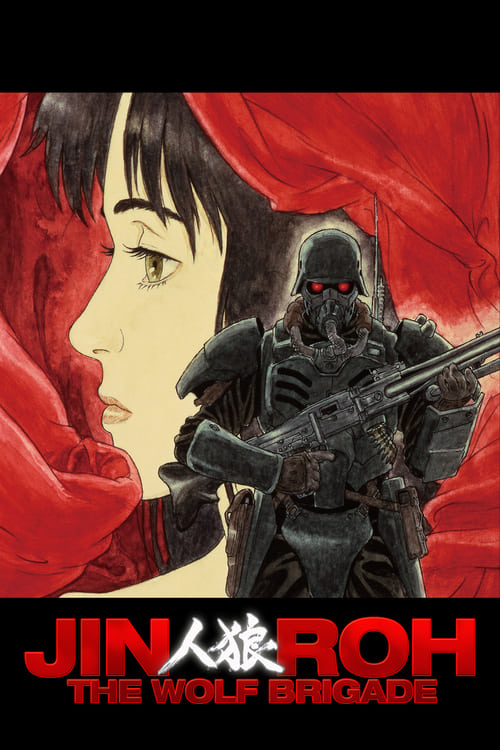
Jin-Roh: The Wolf Brigade
Jin-Roh Stages Red Riding Hood as an Initiation Into Full Inhumanity
Directed by Hiroyuki Okiura
The fairy tale everyone knows as comfort is, in this film, a ritual. The wolf wins. That is the point.
Hiroyuki Okiura's 1999 film tells you its architecture before a single frame rolls. Little Red Riding Hood. A young girl carrying a basket. A wolf in the forest. The story is so familiar it feels like furniture, but Jin-Roh uses that familiarity as camouflage. The film is not illustrating the fairy tale. It is performing it as an initiatory rite, and the initiation is into the complete surrender of the human self to an institutional machine that feeds on souls. Kazuki Fuse, counter-terrorism operative of the Capital Police's Wolf Brigade, watches a teenage courier detonate a suicide bomb in the sewers beneath Tokyo. He cannot fire. Something recognizably human stalls his hand. The rest of the film is the state correcting that error.
The Jungian Reading: The Wolf Mask Is a Persona That Devours Its Wearer
Jung identified the Persona as the mask constructed for social survival, the face worn to navigate collective demands. In most lives, the Persona remains separable from the Self underneath it. Jin-Roh documents what happens when the Persona is engineered to be total, when the institution requires not performance but replacement.
The Wolf Brigade's ceremonial armor is not protective equipment. It is the Persona made physical, an exoskeleton that transforms human soldiers into tactical wolves. The film's central question is whether Fuse has already been consumed by this Persona or whether there is still a Self behind the visor. His inability to fire in the sewer is the last visible evidence of a Self that the state then moves systematically to extinguish. His relationship with Kei, the dead girl's older sister, reads throughout as an attempt to recover affect, to locate the human residue. But the final scene in the sewer mirrors the opening with devastating precision. The same tunnel. The same configuration. This time, Fuse fires. The Persona has completed its annexation of the Self. The wolf mask has become a face.
The Gnostic Reading: The State Is the Demiurge, Fuse Its Complicit Archon
Gnostic cosmology describes a universe administered by the Demiurge, a lesser god who mistakes himself for the highest power and constructs a material prison to contain the divine spark. His agents, the Archons, enforce the architecture of captivity, many of them unaware they are guardians of a cage rather than a temple.
The Capital Police in Jin-Roh operate as a Demiurgic system. The state does not ask for loyalty; it asks for the extinction of the pneuma, the inner spark that might question its authority. Fuse is an Archon who briefly glimpses something beyond the system when he encounters the dead girl in the tunnel. Her body carries a grenade hidden in her basket, a Pneumatic spark disguised as an errand. She dies rather than surrender what she carries, which is precisely the Gnostic formulation of the soul that chooses the Pleroma over captivity. Fuse sees this. The state's subsequent intervention, the retraining, the psychological management, the orchestrated relationship with Kei, exists to ensure he forgets what he saw. By the final frame he has forgotten completely. The Demiurge does not need to destroy awareness. It only needs to redirect it long enough for the Archon to act.
Questions this film answers
What is the deeper meaning of Jin-Roh: The Wolf Brigade?
Hiroyuki Okiura's 1999 film tells you its architecture before a single frame rolls. Little Red Riding Hood. A young girl carrying a basket. A wolf in the forest. The story is so familiar it feels like furniture, but Jin-Roh uses that familiarity as camouflage. The film is not illustrating the fairy tale. It is performing it as an initiatory rite, and the initiation is into the complete surrender of the human self to an institutional machine that feeds on souls. Kazuki Fuse, counter-terrorism operative of the Capital Police's Wolf Brigade, watches a teenage courier detonate a suicide bomb in the sewers beneath Tokyo. He cannot fire. Something recognizably human stalls his hand. The rest of the film is the state correcting that error.
What is the hidden symbolism in Jin-Roh: The Wolf Brigade?
Jung identified the Persona as the mask constructed for social survival, the face worn to navigate collective demands. In most lives, the Persona remains separable from the Self underneath it. Jin-Roh documents what happens when the Persona is engineered to be total, when the institution requires not performance but replacement.
What esoteric traditions appear in Jin-Roh: The Wolf Brigade?
Jin-Roh: The Wolf Brigade draws from Jungian, Gnosticism traditions. The fairy tale everyone knows as comfort is, in this film, a ritual. The wolf wins. That is the point.
Is Jin-Roh: The Wolf Brigade worth watching for spiritual seekers?
Jin-Roh: The Wolf Brigade (1999) directed by Hiroyuki Okiura is essential viewing for those interested in Jungian, Gnosticism. Jin-Roh Stages Red Riding Hood as an Initiation Into Full Inhumanity. It rewards multiple viewings and contemplation.
Rewatch With New Eyes
Now that you've seen the architecture, experience it again. The same film becomes a different film when you know what to watch for.
This time, watch for:
- Meet the shadow: what is rejected, projected, and finally integrated
- Watch for the false world vs. the real — who is asleep, who awakens
Links may include affiliate partnerships that support Media Revelations
The Descent Continues
Where this thread leads next.
Princess Mononoke 1997
The Apocalypse That Already Happened and You Didn't Notice
Read the revelation →