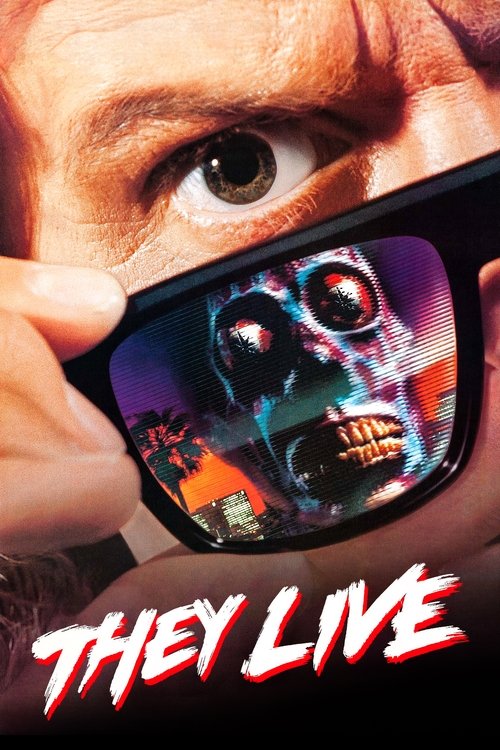
They Live
The Sunglasses Are Gnosis and Nobody Wants Them
Directed by John Carpenter
Carpenter made the most underrated Gnostic film in American cinema. The sunglasses are gnosis — direct vision, not interpretation. The aliens are Archons. They are not hidden; they are simply unseen by those without the apparatus. The famous bubblegum line is the line of someone who has remembered who he is. The eight-minute alleyway fight is the film's centerpiece because gnosis is the thing nobody wants to receive.
They Live is the most precisely Gnostic film made in 1980s American cinema and is consistently underrated because its surface is B-movie action. Carpenter adapted Ray Nelson's short story 'Eight O'Clock in the Morning' and built around it a structurally rigorous depiction of the standard Gnostic schema. The Archons are present and ruling. They are not hidden; they are invisible only because the apparatus of perception that would reveal them has not been distributed. The sunglasses are the apparatus. They are not magic. They simply allow the wearer to see the substrate of the world as it actually is — the messages embedded in every billboard, magazine cover, dollar bill: OBEY, CONSUME, MARRY AND REPRODUCE, NO INDEPENDENT THOUGHT. The faces of the elite — the wealthy, the politicians, the police — become visible as alien beneath the human projection. Nada, an unemployed construction worker, puts on the sunglasses and acquires gnosis. The film's deepest insight is the eight-minute fistfight that follows when Nada tries to give the sunglasses to his friend Frank. Frank refuses to put them on. Frank fights Nada for the right to remain unseeing. The fight goes on for eight minutes because the truth Carpenter is telling is that gnosis is the gift nobody wants to receive. People will fight for the privilege of not knowing. The Archons do not need to hide themselves. The Archons only need to maintain the conditions under which their existence is, structurally, the kind of fact most people will fight to remain unable to perceive.
The Surface
John Nada, an unemployed drifter, arrives in Los Angeles looking for construction work. He befriends Frank, a fellow worker who lives in a shantytown for the unemployed. A nearby church is raided by police; Nada returns to investigate and finds a box of sunglasses hidden in the church's basement. He puts on a pair. The world transforms. Billboards display their actual messages: OBEY, CONSUME, NO INDEPENDENT THOUGHT. The faces of the wealthy and powerful are revealed as inhuman — gaunt, skeletal alien creatures wearing the human form as overlay. He kills two officers, takes their weapons, walks into a bank and announces, 'I have come here to chew bubblegum and kick ass — and I'm all out of bubblegum.' He goes on a shooting spree against the aliens. He tries to give a pair of sunglasses to Frank. Frank refuses. They fight for over five minutes. Nada eventually wins. Frank puts on the sunglasses. Together they infiltrate the alien elite. Nada destroys the transmitter that produces the perceptual overlay. The aliens are revealed to everyone simultaneously. Nada dies in the act. The film ends with humans across the country suddenly seeing the aliens that have been beside them all along.
The film was Carpenter's response to the consumerism of the Reagan era. Carpenter has stated explicitly that he intended the film as political satire about Reagan-era yuppie capitalism, and that the aliens are the literal embodiment of the wealthy elite using the rest of humanity as resource.
Most reading of the film treats it as the political allegory Carpenter intended. The allegory is real and is the surface. Underneath is a structurally complete Gnostic film that operates whether or not the viewer accepts Carpenter's specific political framing. The aliens-as-Archons schema works for any elite that the viewer would identify with the figures the film places under the sunglasses' revelation. Carpenter built a perceptual machine. The political content is one application. The structure is more general.
The Sunglasses as Gnosis
Gnosis, in classical Gnostic tradition, is not belief and not reasoning. Gnosis is direct unmediated perception of the actual structure of reality. The Gnostic does not infer that the world is constructed by lesser beings; the Gnostic perceives this directly. The perception cannot be transmitted by argument. It can only be transmitted by the apparatus that produces the perception in the recipient.
Carpenter's literalization of this is the most accurate depiction of gnosis ever produced in mainstream cinema. The sunglasses are the apparatus. They do not contain information. They do not include instructions. They simply allow the wearer to see what is in fact already there. The OBEY message on the billboard is not added by the sunglasses. The message is already on the billboard, embedded in the substrate beneath the cosmetic image. The sunglasses just permit the perception of the substrate.
This is the Gnostic claim in its purest form. The world's actual nature is not hidden by any active concealment. The world's actual nature is unperceived because perceiving it requires equipment most beings do not possess. The Archons do not work by lying. They work by limiting the apparatus of perception in the population. The lying is unnecessary because the population, lacking the apparatus, would not have perceived the truth in any case.
Carpenter makes this even more rigorous by showing that the apparatus is, in the film's world, scarce but not impossible to obtain. The sunglasses exist. They are produced by the resistance. They are distributed where they can be. The Gnostic tradition is the technical knowledge of how to manufacture and distribute the apparatus. The Archons' counter-strategy is to maintain the conditions under which most people will not seek out the apparatus and, even when offered it, will refuse to put it on. The refusal is the structural condition the Archons depend on.
The Alleyway Fight
The film's most discussed scene is the eight-minute fistfight between Nada and Frank. Nada has put on the sunglasses and seen the truth. He wants to share the gift. He approaches Frank with an extra pair. He tells Frank to put them on. Frank refuses. Nada insists. The two men fight for over five minutes — a brutal, exhausting, increasingly desperate exchange of blows in a deserted alley. Nada eventually wins. Frank, defeated, puts on the sunglasses. He sees what Nada sees.
Most viewers respond to this scene as comically excessive — a film that wanted to be a wrestling match took a detour through a parable. Carpenter's framing is exactly the opposite. The length is the point. The length is the teaching. The fight is the most theologically honest depiction of what actually happens when one being attempts to transmit gnosis to another.
People do not want to know. The structures that have kept them unseeing are also the structures that have kept them functional within the regime that benefits from their unseeing. To perceive the Archons is to perceive that one's job, one's purchases, one's marriage, one's children's school, one's entertainment, one's sense of self have all been part of a system administered by entities whose interests are not one's own. The perception cannot be reversed. The pre-perception life cannot be returned to. Once Frank puts on the sunglasses, Frank is in a different relationship to everything he previously knew.
He will fight, with his fists, to prevent this. The fight is not against Nada. The fight is against the loss of the unperceiving life. Nada represents the threshold. Frank knows, structurally, that crossing the threshold is irreversible. He punches Nada because punching Nada is the only available form of refusing the gift. The five minutes are the time it takes for his resistance to be physically exhausted. He puts on the sunglasses because he no longer has the energy to continue refusing. This is the actual structure of how most people receive gnosis, in the rare cases when they receive it at all. The transmitter has to be willing to spend themselves to the point where the recipient's resistance collapses. Without that willingness, the recipient continues unseeing for the rest of their life.
The Ending and the Aftermath
Nada destroys the transmitter on the rooftop of the broadcast facility. The transmitter has been generating the perceptual overlay that allows the Archons to walk among humans without being seen as Archons. With the transmitter destroyed, the overlay collapses. Humans across the country see, simultaneously, what the sunglasses had previously been required to see.
The film ends with a montage: a man in bed with a woman; the man pulls back and sees that the woman is an Archon; the woman looks at the man and screams. A bartender refilling a drink; the drinker looks up and sees the Archon face; the drinker stumbles backward. A pastor delivering a sermon; the congregation looks up and sees the Archon at the pulpit. Carpenter cuts through dozens of these recognitions. He does not show what happens next. The film simply ends on the moment of mass perception.
This is the structural recognition the entire film has been driving toward. The unveiling can happen suddenly and globally. The structures that have been maintaining the unperceiving are physical and can be physically interrupted. The transmitter is a piece of broadcast equipment. The equipment can be destroyed. Nada is the figure who chose to destroy it. He died in the act. The destruction was the gift he provided to the rest of the species.
What Carpenter refuses to show — and this is the film's most rigorous final restraint — is what happens after the perception is universal. The Archons are seen. The Archons do not disappear. The Archons are still in the bedrooms, the bars, the pulpits. The Archons have weapons. The Archons have organizational structures. The humans are now aware but are no better equipped than they were before. The unveiling is the beginning of the conflict, not the conclusion. The film ends because the film's specific work is done. The longer work begins where the credits roll. The film hands the question of what to do with the perception to the viewer. The viewer, putting on their own metaphorical sunglasses by watching the film, is in Nada's position. The transmitter, in whatever form, is somewhere accessible. The conflict, in whatever form, begins on the way home from the theater.
The Transmission
They Live transmits a recognition that has been continuously vindicated by the four decades since its release: the elite class of contemporary capitalism is structurally and behaviorally distinct enough from the rest of humanity to be usefully described in the terms previously reserved for non-human entities. Carpenter chose to make this literal. The choice is more rigorous than the standard left-wing political film that depicts the elite as people who simply make different decisions. The elite, in They Live, are not making different decisions. They are a different order of being. Their interests are alien to human interests. Their reproduction is alien to human reproduction. Their relationship to the planet is the relationship a colonizing species has to a colonized territory.
The political content of this analysis has been adopted, in the decades since the film, by movements across the political spectrum. The famous still of the OBEY billboard has been appropriated by left, right, and center. This is because the structural diagnosis is more general than any specific political content. The elite that one perceives, when one puts on the sunglasses, may vary depending on which transmitter one believes is operating. The structure — that there is an elite, that the elite is invisible without specific perceptual equipment, that the elite is administering the rest of the species for purposes other than the species' own — is consistent across the political deployments.
Carpenter's transmission, finally, is the practical instruction. The sunglasses exist. The transmitter exists. The willingness to fight Frank in the alleyway exists. The structural challenge is not perceiving the truth — once perceived, the truth is undeniable. The structural challenge is perceiving the truth in the first place, transmitting it to others who will resist receiving it, and then doing something with the transmission that interrupts the apparatus rather than merely cataloging what the apparatus has been doing.
Most viewers who recognize themselves in the film stop at recognition. The film offers no consolation for this. Nada destroyed the transmitter and died. He did not negotiate. He did not document. He did not protest. He physically destroyed the equipment that produced the perceptual overlay. The film is, structurally, the recommendation that recognition is only the first step and that subsequent steps involve forms of action that the recognition has been preparing the equipment for. Whether the viewer takes those steps is, of course, the viewer's question. The film simply makes clear what the actual situation is.
Questions this film answers
What is the deeper meaning of They Live?
They Live is the most precisely Gnostic film made in 1980s American cinema and is consistently underrated because its surface is B-movie action. Carpenter adapted Ray Nelson's short story 'Eight O'Clock in the Morning' and built around it a structurally rigorous depiction of the standard Gnostic schema. The Archons are present and ruling. They are not hidden; they are invisible only because the apparatus of perception that would reveal them has not been distributed. The sunglasses are the apparatus. They are not magic. They simply allow the wearer to see the substrate of the world as it actually is — the messages embedded in every billboard, magazine cover, dollar bill: OBEY, CONSUME, MARRY AND REPRODUCE, NO INDEPENDENT THOUGHT. The faces of the elite — the wealthy, the politicians, the police — become visible as alien beneath the human projection. Nada, an unemployed construction worker, puts on the sunglasses and acquires gnosis. The film's deepest insight is the eight-minute fistfight that follows when Nada tries to give the sunglasses to his friend Frank. Frank refuses to put them on. Frank fights Nada for the right to remain unseeing. The fight goes on for eight minutes because the truth Carpenter is telling is that gnosis is the gift nobody wants to receive. People will fight for the privilege of not knowing. The Archons do not need to hide themselves. The Archons only need to maintain the conditions under which their existence is, structurally, the kind of fact most people will fight to remain unable to perceive.
What is the hidden symbolism in They Live?
John Nada, an unemployed drifter, arrives in Los Angeles looking for construction work. He befriends Frank, a fellow worker who lives in a shantytown for the unemployed. A nearby church is raided by police; Nada returns to investigate and finds a box of sunglasses hidden in the church's basement. He puts on a pair. The world transforms. Billboards display their actual messages: OBEY, CONSUME, NO INDEPENDENT THOUGHT. The faces of the wealthy and powerful are revealed as inhuman — gaunt, skeletal alien creatures wearing the human form as overlay. He kills two officers, takes their weapons, walks into a bank and announces, 'I have come here to chew bubblegum and kick ass — and I'm all out of bubblegum.' He goes on a shooting spree against the aliens. He tries to give a pair of sunglasses to Frank. Frank refuses. They fight for over five minutes. Nada eventually wins. Frank puts on the sunglasses. Together they infiltrate the alien elite. Nada destroys the transmitter that produces the perceptual overlay. The aliens are revealed to everyone simultaneously. Nada dies in the act. The film ends with humans across the country suddenly seeing the aliens that have been beside them all along.
What esoteric traditions appear in They Live?
They Live draws from Gnosticism, Initiation traditions. Carpenter made the most underrated Gnostic film in American cinema. The sunglasses are gnosis — direct vision, not interpretation. The aliens are Archons. They are not hidden; they are simply unseen by those without the apparatus. The famous bubblegum line is the line of someone who has remembered who he is. The eight-minute alleyway fight is the film's centerpiece because gnosis is the thing nobody wants to receive.
What does They Live teach about the sunglasses as gnosis?
The world's actual nature is not hidden by active concealment. It is unperceived because perceiving it requires equipment most beings do not possess. Gnosis, in classical Gnostic tradition, is not belief and not reasoning. Gnosis is direct unmediated perception of the actual structure of reality. The Gnostic does not infer that the world is constructed by lesser beings; the Gnostic perceives this directly. The perception cannot be transmitted by argument. It can only be transmitted by the apparatus that produces the perception in the recipient.
What does They Live teach about the alleyway fight?
People will fight for the privilege of not knowing. The Archons only need to maintain the conditions under which gnosis is, structurally, the thing most people will physically resist. The film's most discussed scene is the eight-minute fistfight between Nada and Frank. Nada has put on the sunglasses and seen the truth. He wants to share the gift. He approaches Frank with an extra pair. He tells Frank to put them on. Frank refuses. Nada insists. The two men fight for over five minutes — a brutal, exhausting, increasingly desperate exchange of blows in a deserted alley. Nada eventually wins. Frank, defeated, puts on the sunglasses. He sees what Nada sees.
Is They Live worth watching for spiritual seekers?
They Live (1988) directed by John Carpenter is essential viewing for those interested in Gnosticism, Archons, Carpenter. The Sunglasses Are Gnosis and Nobody Wants Them. It rewards multiple viewings and contemplation.
Rewatch With New Eyes
Now that you've seen the architecture, experience it again. The same film becomes a different film when you know what to watch for.
This time, watch for:
- Watch for the false world vs. the real — who is asleep, who awakens
- Mark the threshold: the old self dies, the ordeal transforms, the new self returns
Links may include affiliate partnerships that support Media Revelations
The Descent Continues
Where this thread leads next.
The Matrix 1999
The Gnostic Gospel of the Machine Age
Read the revelation →