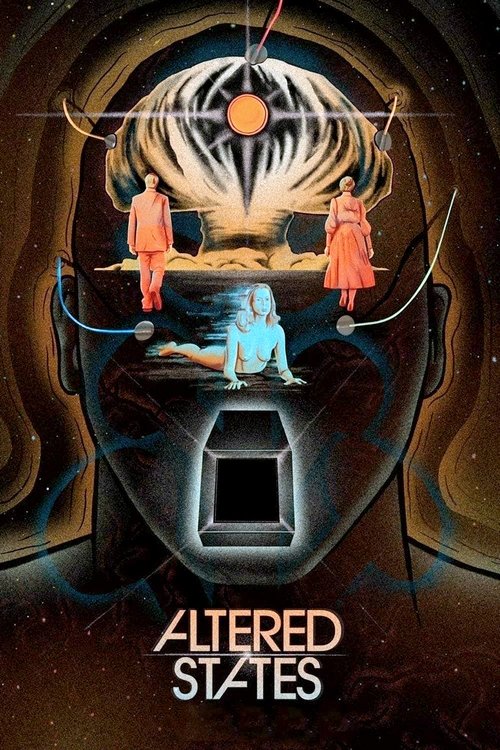
Altered States
The Scientist Who Found God and Kept Going
Directed by Ken Russell
Jessup is not searching for God. He is searching for something before God — the ground beneath all grounds. The isolation tank is his cell. The mushrooms are his sacrament. He achieves gnosis and it devours him. The body devolves because consciousness won't stop ascending. Love is the only tether that works.
Altered States is the only major studio film that treats psychedelic consciousness exploration with genuine theological seriousness — and shows why that exploration can destroy its practitioner. Eddie Jessup is not a recreational drug user. He is a seeker whose search has the intensity of obsession. He wants to know what consciousness is before it becomes personal, before it becomes human, before it becomes anything at all. The film's premise is literal: Jessup's altered states produce altered states. When his consciousness regresses to prehuman forms, his body follows. He devolves into a protohuman, then into something before that. The mind pulls the body backward through evolution. Ken Russell's hallucinatory sequences — exploding crucifixes, boiling lava, fetal visions, seven-eyed angels — are not decoration. They are the content. The film transmits something of what Jessup experiences because Russell refuses to make the visions look tidy or interpretable. They overwhelm. They disturb. They intrude. This is what gnosis feels like when it is actually happening: not peace but cosmic vertigo.
The Surface
Eddie Jessup is a researcher at Harvard studying schizophrenia and the neurological basis of religious experience. He begins experimenting with sensory deprivation tanks, floating in darkness to observe how consciousness changes when input is removed. He reports mystical experiences — visions of primal symbols, contact with something vast.
His search intensifies. He travels to Mexico to participate in indigenous ceremonies involving a powerful hallucinogenic mushroom. The visions become more extreme. He sees crucifixion, genesis, the beginning of matter itself. He returns with samples of the mushroom to combine with his isolation tank experiments.
The combination produces something unprecedented: Jessup's body begins to change. Security cameras capture him transforming into a protohuman — apelike, violent, animal. At first he cannot believe it. Then he seeks it again. He wants to go further back. Before humanity. Before life. To the first moment of consciousness emerging from void.
The Seeker Who Will Not Stop
Jessup is not mad, though everyone around him wonders. He is relentless in the way that genuine seekers are relentless. When he experiences God in the isolation tank, he does not stop. He asks what is behind God. When he experiences the birth of the universe, he asks what is before the universe.
This is the structure of authentic mystical seeking — and its danger. The seeker who encounters the absolute and treats it as another waypoint rather than the destination will keep seeking until there is nothing left to find. And nothing is exactly what Jessup eventually finds: the void before being, the darkness that precedes light.
His wife Emily — herself a researcher — watches him pull away. He cannot explain what he is seeking because he does not know. He only knows that whatever he has found so far is not enough. The experiences themselves push him forward. Having seen behind one curtain, he cannot rest until he has seen behind them all.
This is the shamanic calling in its most dangerous form: the seeker for whom no initiation is final, for whom every death is a doorway to another death, who will not return until there is nowhere further to go.
The Visions
Ken Russell films the altered states as assaults on perception. They are not orderly spiritual revelations. They are overloads — image piled on image, symbol crashing into symbol, no respite allowed.
Jessup sees the crucifixion from inside — he is the body on the cross, feeling the nails. He sees Emily's face superimposed on a mushroom cloud. He sees the creation of the solar system as an orgasm of fire. He sees seven-eyed lambs and bleeding Christs and his own face dissolving into sand.
Russell refuses to make these visions coherent. They are not allegories to be decoded. They are experiences to be endured. The viewer is subjected to them rather than observing them. This is Russell's greatest achievement: the visual language produces disorientation, not understanding. It mimics the state rather than describing it.
Jessup keeps notes on what he sees, trying to build a theory. The notes fail. The visions resist systematization. They are not data. They are encounters with something that does not want to be known — or wants to be known so badly that knowing it destroys the knower.
The Physical Regression
The film's central conceit is that consciousness and body are not separable. When Jessup's consciousness regresses to prehuman states, his body follows. First he becomes more aggressive, more animal. Then, in the tank, he physically transforms into a protohuman creature — small, apelike, violent.
This is the alchemical principle literalized: as above, so below. The transformation of consciousness produces transformation of matter. The vessel (the body) reshapes to match the content (the mind). Jessup is performing an inverted opus, not ascending toward gold but descending toward lead — toward the prima materia before differentiation.
The devolution is not stable. He reverts to human form. But each time he pushes further, the regression goes deeper and lasts longer. He is approaching something — the ground state, the first matter, the void that preceded being. His body is being unmade in pursuit of it.
The scientists around him are terrified. This should not be possible. Bodies do not regress evolutionarily because minds regress psychologically. But Jessup has found something that breaks the rules, and he cannot stop pursuing it.
The Final State
In the climax, Jessup's transformation becomes uncontrollable. He dissolves — not into protohuman but into energy itself. His body becomes a field of light and force, losing form entirely. He has reached the ground state. The thing before things. The consciousness that exists without matter.
And it is not peace. It is not union with the divine. It is annihilation without remainder. Whatever Jessup sought behind all the visions, behind God, behind creation — what he found was nothing. Not a sacred nothing. An absolute nothing that pulls everything into itself.
He is held back from complete dissolution by Emily, who enters the energy field and refuses to let him go. Her body begins to dissolve too. But her refusal — her love, her attachment, the thing Jessup has spent the film trying to transcend — provides enough tether to pull them both back.
They emerge, naked, on the hallway floor. Jessup is human again. But he saw it. He touched the void. He knows now what is at the bottom of everything. And he speaks the film's final line: 'I love you, Emily.' The seeker has found the one thing that can stop the search.
The Transmission
Altered States was based on Paddy Chayefsky's novel, itself based on the work of John Lilly — the neuroscientist who invented the isolation tank and combined it with LSD and ketamine, reporting contact with cosmic intelligences and warnings about human extinction. Lilly went very far. Not everyone who follows him comes back.
The film transmits a specific warning: the search for ultimate truth is real, the experiences are real, and the danger is real. Jessup is not deluded. He is actually experiencing what he reports. The problem is that some truths destroy their knowers.
Russell's visual excess is not mere style. It is the content of the transmission. The film does not describe altered states — it subjects the viewer to them. The disorientation, the overwhelm, the sense that something is happening that cannot be processed — this is what the tank and the mushroom produce. The audience gets a controlled dose of what Jessup is drowning in.
The antidote to infinite regress is finite love. Emily's hand pulling Jessup back from dissolution is the film's answer to the void. There is nothing at the bottom. But there is something at the surface: connection, body, another person's face. The seeker who survives is the one who has something to come back to.
Questions this film answers
What is the deeper meaning of Altered States?
Altered States is the only major studio film that treats psychedelic consciousness exploration with genuine theological seriousness — and shows why that exploration can destroy its practitioner. Eddie Jessup is not a recreational drug user. He is a seeker whose search has the intensity of obsession. He wants to know what consciousness is before it becomes personal, before it becomes human, before it becomes anything at all. The film's premise is literal: Jessup's altered states produce altered states. When his consciousness regresses to prehuman forms, his body follows. He devolves into a protohuman, then into something before that. The mind pulls the body backward through evolution. Ken Russell's hallucinatory sequences — exploding crucifixes, boiling lava, fetal visions, seven-eyed angels — are not decoration. They are the content. The film transmits something of what Jessup experiences because Russell refuses to make the visions look tidy or interpretable. They overwhelm. They disturb. They intrude. This is what gnosis feels like when it is actually happening: not peace but cosmic vertigo.
What is the hidden symbolism in Altered States?
Eddie Jessup is a researcher at Harvard studying schizophrenia and the neurological basis of religious experience. He begins experimenting with sensory deprivation tanks, floating in darkness to observe how consciousness changes when input is removed. He reports mystical experiences — visions of primal symbols, contact with something vast.
What esoteric traditions appear in Altered States?
Altered States draws from Shamanism, Gnosticism, Alchemy traditions. Jessup is not searching for God. He is searching for something before God — the ground beneath all grounds. The isolation tank is his cell. The mushrooms are his sacrament. He achieves gnosis and it devours him. The body devolves because consciousness won't stop ascending. Love is the only tether that works.
What does Altered States teach about the physical regression?
The transformation of consciousness produces transformation of matter. As above, so below. The film's central conceit is that consciousness and body are not separable. When Jessup's consciousness regresses to prehuman states, his body follows. First he becomes more aggressive, more animal. Then, in the tank, he physically transforms into a protohuman creature — small, apelike, violent.
What does Altered States teach about the final state?
What he found at the bottom of everything was not peace. It was annihilation without remainder. In the climax, Jessup's transformation becomes uncontrollable. He dissolves — not into protohuman but into energy itself. His body becomes a field of light and force, losing form entirely. He has reached the ground state. The thing before things. The consciousness that exists without matter.
Is Altered States worth watching for spiritual seekers?
Altered States (1980) directed by Ken Russell is essential viewing for those interested in Shamanism, Gnosis, Devolution. The Scientist Who Found God and Kept Going. It rewards multiple viewings and contemplation.
Rewatch With New Eyes
Now that you've seen the architecture, experience it again. The same film becomes a different film when you know what to watch for.
This time, watch for:
- Follow the descent: what dies, what guides, what returns transformed
- Watch for the false world vs. the real — who is asleep, who awakens
- Track the stages: blackening, whitening, reddening — death before rebirth
Links may include affiliate partnerships that support Media Revelations