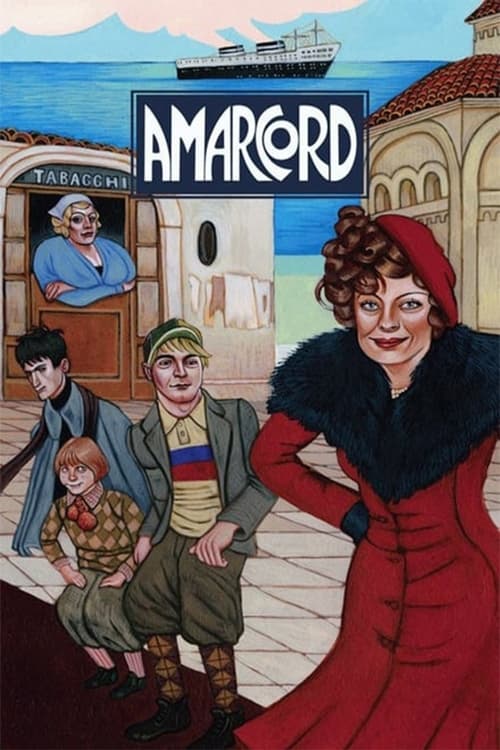
Amarcord
Amarcord Is Fellini Diagnosing Fascism as a Town That Never Grew Up
Directed by Federico Fellini
The title means "I remember" in Romagnol dialect. What Fellini remembers is that the men who cheered for Mussolini were boys who never left the schoolyard.
Amarcord looks like nostalgia and works like an autopsy. A year passes in a seaside town under Fascism: the puffballs of spring drift, the town gathers, boys ogle the tobacconist Gradisca, the family quarrels, winter buries everything in snow, and spring returns. Nothing that resembles a plot occurs. That is the point. The town lives in an eternal adolescence, a perpetual arrested loop, and Fellini shows exactly how a whole population of grown men stuck at the level of the horny schoolboy became the soil that Fascism grew in. This is not a warm memory of youth. It is a study of what happens to a community that refuses to mature: it hands itself, laughing, to the strongman who promises to keep it a child forever.
Jungian Reading: The Mother-Bound Town and the Anima It Cannot Reach
Jung described the puer aeternus, the eternal boy who never descends into real life, forever chasing an idealized woman he can never actually meet. Titta and the town's men are a whole population of puers. Gradisca, the beautiful hairdresser everyone desires, is the collective anima, the soul-image the men project outward and cannot integrate. They watch her, fantasize about her, and remain boys, because the anima met only as fantasy keeps a man immature by design.
The film's most naked image of this is Titta and the enormous tobacconist. She bares her breasts and he suffocates against them, a boy trying to nurse and nearly smothering. The scene is comic and it is a diagnosis: the men of this town want the mother, not the woman, and a man who wants the mother will never become a father, a citizen, a self. Even the erotic pageantry around Gradisca dissolves when she finally marries, and the town simply transfers its longing to the next fantasy. Nothing is integrated. The anima is worshipped from the pavement and never brought home.
Initiatory Reading: The Rites That Fail, and the One That Almost Works
A healthy culture initiates its young: it takes the boy, breaks the childhood self, and returns a man. Amarcord is full of rituals that mimic initiation and deliver nothing. The Fascist rally, with its uniforms and the giant illuminated face of Mussolini conjured for a boy's imagined wedding, is a false initiation: it offers belonging and manhood while actually locking the initiate deeper into obedient boyhood. The school is another failed rite, all mockery and no transmission. The Church hears confession from a boy consumed by lust and offers only the counting of sins.
The single real initiation in the film is death. When Titta's mother Miranda dies, the puffballs drift again, the same drift that opened the film, and for one moment Titta stands at an actual threshold. Grief is the one force in the town that cannot be turned into farce. It is the only teacher that reaches him. Fellini's judgment is quiet and total: a town that will not initiate its young through wisdom will be initiated by loss, or by the Duce, and it chose the Duce. Then Gradisca marries a carabiniere, spring comes back, the puffballs float, and the loop resets for the next generation of boys.
Questions this film answers
What is the deeper meaning of Amarcord?
Amarcord looks like nostalgia and works like an autopsy. A year passes in a seaside town under Fascism: the puffballs of spring drift, the town gathers, boys ogle the tobacconist Gradisca, the family quarrels, winter buries everything in snow, and spring returns. Nothing that resembles a plot occurs. That is the point. The town lives in an eternal adolescence, a perpetual arrested loop, and Fellini shows exactly how a whole population of grown men stuck at the level of the horny schoolboy became the soil that Fascism grew in. This is not a warm memory of youth. It is a study of what happens to a community that refuses to mature: it hands itself, laughing, to the strongman who promises to keep it a child forever.
What is the hidden symbolism in Amarcord?
Jung described the puer aeternus, the eternal boy who never descends into real life, forever chasing an idealized woman he can never actually meet. Titta and the town's men are a whole population of puers. Gradisca, the beautiful hairdresser everyone desires, is the collective anima, the soul-image the men project outward and cannot integrate. They watch her, fantasize about her, and remain boys, because the anima met only as fantasy keeps a man immature by design.
What esoteric traditions appear in Amarcord?
Amarcord draws from Jungian, Initiation traditions. The title means "I remember" in Romagnol dialect. What Fellini remembers is that the men who cheered for Mussolini were boys who never left the schoolyard.
Is Amarcord worth watching for spiritual seekers?
Amarcord (1973) directed by Federico Fellini is essential viewing for those interested in Jungian, Initiation. Amarcord Is Fellini Diagnosing Fascism as a Town That Never Grew Up. It rewards multiple viewings and contemplation.
Rewatch With New Eyes
Now that you've seen the architecture, experience it again. The same film becomes a different film when you know what to watch for.
This time, watch for:
- Meet the shadow: what is rejected, projected, and finally integrated
- Mark the threshold: the old self dies, the ordeal transforms, the new self returns
Links may include affiliate partnerships that support Media Revelations
The Descent Continues
Where this thread leads next.
La Dolce Vita 1960
La Dolce Vita Is Seven Nights of a Man Being Offered Salvation and Choosing the Party
Read the revelation →