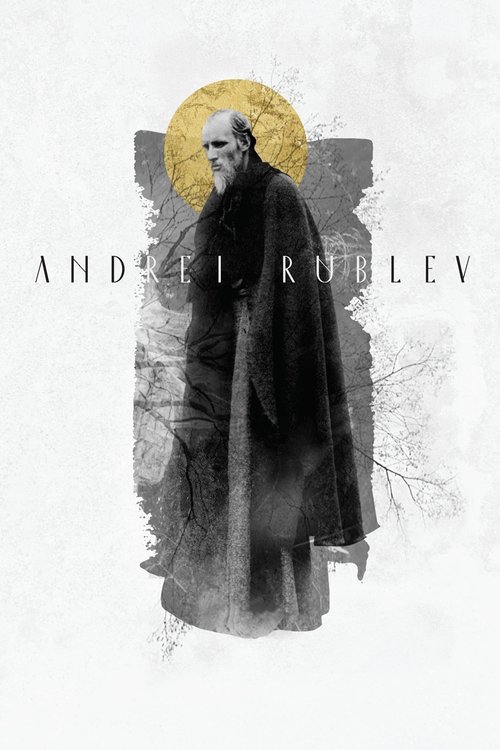
Andrei Rublev
How to Create Beauty in a World of Violence
Directed by Andrei Tarkovsky
Tarkovsky made a three-hour meditation on the central question of art: how can you create beauty when the world is brutal? Rublev witnesses atrocities, takes a vow of silence, stops painting. His return to creation is not through resolution but through faith — faith that the Trinity he paints represents something real, even if the world he lives in does not reflect it.
Andrei Rublev is not a biography of the medieval Russian icon painter. It is a three-hour meditation on the conditions under which sacred art becomes possible — and the cost of creating it. Tarkovsky's Rublev witnesses the worst of human cruelty: Tatar invasions, Russian princes murdering their own people, pagans and Christians destroying each other. After one particularly terrible massacre, he kills a man to save a woman, and then stops painting. He takes a vow of silence. For years, he creates nothing. The film asks: how do you make images of divine love when human reality is butchery? How do you paint the Trinity when the church itself is complicit in violence? How do you continue when continuation seems like obscenity? Rublev's crisis is every artist's crisis, intensified to the point of breaking. The answer comes through Boriska, the boy who claims to know the secret of bell-making (though he does not) and who succeeds through faith rather than knowledge. Watching Boriska complete his impossible task, Rublev breaks his silence and returns to painting. The transmission is not technique but something deeper: faith that the work matters, even when you cannot prove it.
The Surface
The film follows Andrei Rublev, the 15th-century monk who painted some of Russia's most revered icons, through a series of episodes spanning decades. We see him young and idealistic, then confronting paganism and violence, then falling into despair after witnessing a massacre, then silent for years, then finally creating his masterwork, the Trinity icon.
Tarkovsky structures the film as eight chapters plus an epilogue, each exploring a different aspect of creation, faith, and suffering. The pacing is deliberately slow, the black-and-white images deliberately austere. This is not entertainment. This is meditation in cinematic form.
The film was completed in 1966 but suppressed by Soviet authorities for years — too religious, too Russian, too critical of human nature. When it finally reached international audiences, it was immediately recognized as one of the greatest films ever made. Time has only confirmed this judgment.
The Problem of Art in Hell
Rublev's central dilemma: he is commissioned to paint divine love, but he lives in a world of torture, betrayal, and mass murder. The church that commissions his icons is itself compromised — allied with brutal princes, complicit in oppression. How do you paint heaven when you live in hell?
The massacre at Vladimir — where a Russian prince allies with Tatars to destroy his own brother's city — is the film's moral nadir. Rublev watches as the church he was painting is defiled, as his mentor Theophanes is killed, as a woman is raped. He kills her attacker with an axe. This act of violence, even in defense, breaks something in him.
After this, Rublev stops painting. He has seen too much. To paint the Trinity — the image of divine love among equals — would be to lie. The world he lives in contains no such love. His art would be false advertisement for a heaven that does not exist.
This is the artist's nightmare: confronting a reality so brutal that any beautiful thing seems like insult. How do you make music after Auschwitz? How do you write poetry after the gulag? How do you paint icons after the massacre? Rublev's silence is not cowardice. It is integrity.
Theophanes and the Debate
Theophanes the Greek, Rublev's mentor, represents one answer to the problem: paint anyway, because art serves eternal truth, not temporal reality. Theophanes is older, more cynical, has already made his peace with creating beauty in a fallen world. He does not expect humanity to improve.
The debates between Rublev and Theophanes structure the film's theology. Rublev believes in human goodness, in the possibility of redemption, in art as communication rather than transcendence. Theophanes has abandoned such hopes. He paints for God, not for people.
When Theophanes dies in the massacre, his position is both vindicated and refuted. The world really is as brutal as he said. But his cynicism offered no protection, no way forward. Rublev's faith in humanity seems naive after Vladimir, but it is the only thing that might eventually allow him to create again.
The film does not resolve this debate. Both positions contain truth. The tension between them — between faith in humanity and recognition of human evil — is the space in which the artist must work. Resolution would be false.
The Vow of Silence
After killing the man in the church, Rublev takes a vow of silence. He will not speak. He will not paint. He withdraws from creation entirely. For years — the film is ambiguous about exactly how long — he exists in a kind of living death.
This silence is not simple despair. It is a refusal to pretend. Rublev will not make art that lies about reality. He will not speak words that ignore what he has seen. His silence is a form of witness: I saw what happened, and I have no response that does not trivialize it.
The Russian monks he lives with do not understand. Some think him mad. Some think him holy. He simply endures, day after day, year after year, waiting for something he cannot name. The silence is both punishment and purification.
Tarkovsky lingers on this period because it is essential to understand what follows. Rublev's eventual return to painting is not simply 'getting over' the trauma. It is something that must be earned through time, through suffering, through a transformation that happens off-screen because it happens in the soul.
Boriska and the Bell
The final chapter introduces Boriska, a young boy who claims that his dead father taught him the secret of casting bells. A prince needs a bell. Boriska is the only supposed heir to the knowledge. He is given the commission.
The extended sequence of bell-casting — finding the clay, building the pit, gathering the crew, pouring the bronze — is the film's climax despite containing no dialogue from Rublev. We watch a young man attempt the impossible, not knowing if he has the knowledge, driven by faith that he can do what he said he can do.
When the bell is cast and the clapper first strikes — and the bell rings true — Boriska collapses, weeping. He confesses to Rublev: his father never told him the secret. He did not know. He succeeded through faith, not knowledge. He created despite not knowing how.
This breaks Rublev's silence. He embraces the boy and speaks: 'You'll cast bells, I'll paint icons.' The transmission has occurred. Not technique — Boriska had no technique — but something deeper: the faith that creation is possible even when you have no guarantee it will succeed. The faith that moves anyway.
The Transmission
The film ends with color — the only color in three hours of black and white — as Tarkovsky shows us Rublev's actual icons. The Trinity. The faces of saints. The deep blues and golds that have survived six centuries. We see what Rublev made after the silence, after the trauma, after the return.
These images are evidence. Something survived. Something was created. Despite the brutality of Rublev's world — a brutality the film has documented exhaustively — he returned to paint images of divine love. Not because the world had improved. The world did not improve. But because faith is not about the world improving.
Andrei Rublev transmits a specific teaching to every artist who confronts the problem of creation in a fallen world: you cannot wait for conditions to be right. Conditions will never be right. You cannot prove that your work matters. You can only proceed as if it matters. The bell must be cast without knowing the secret. The icon must be painted despite the massacre.
The Trinity that closes the film — three angels at Abraham's table, the image of divine community that Rublev created after everything he suffered — is not an answer to the problem of evil. It is a witness: someone saw hell and painted heaven anyway. The faith is in the painting, not in the resolution. The transmission continues.
Questions this film answers
What is the deeper meaning of Andrei Rublev?
Andrei Rublev is not a biography of the medieval Russian icon painter. It is a three-hour meditation on the conditions under which sacred art becomes possible — and the cost of creating it. Tarkovsky's Rublev witnesses the worst of human cruelty: Tatar invasions, Russian princes murdering their own people, pagans and Christians destroying each other. After one particularly terrible massacre, he kills a man to save a woman, and then stops painting. He takes a vow of silence. For years, he creates nothing. The film asks: how do you make images of divine love when human reality is butchery? How do you paint the Trinity when the church itself is complicit in violence? How do you continue when continuation seems like obscenity? Rublev's crisis is every artist's crisis, intensified to the point of breaking. The answer comes through Boriska, the boy who claims to know the secret of bell-making (though he does not) and who succeeds through faith rather than knowledge. Watching Boriska complete his impossible task, Rublev breaks his silence and returns to painting. The transmission is not technique but something deeper: faith that the work matters, even when you cannot prove it.
What is the hidden symbolism in Andrei Rublev?
The film follows Andrei Rublev, the 15th-century monk who painted some of Russia's most revered icons, through a series of episodes spanning decades. We see him young and idealistic, then confronting paganism and violence, then falling into despair after witnessing a massacre, then silent for years, then finally creating his masterwork, the Trinity icon.
What esoteric traditions appear in Andrei Rublev?
Andrei Rublev draws from Initiation traditions. Tarkovsky made a three-hour meditation on the central question of art: how can you create beauty when the world is brutal? Rublev witnesses atrocities, takes a vow of silence, stops painting. His return to creation is not through resolution but through faith — faith that the Trinity he paints represents something real, even if the world he lives in does not reflect it.
What does Andrei Rublev teach about boriska and the bell?
'You'll cast bells, I'll paint icons.' The faith that creation is possible even when you have no guarantee it will succeed. The final chapter introduces Boriska, a young boy who claims that his dead father taught him the secret of casting bells. A prince needs a bell. Boriska is the only supposed heir to the knowledge. He is given the commission.
Is Andrei Rublev worth watching for spiritual seekers?
Andrei Rublev (1966) directed by Andrei Tarkovsky is essential viewing for those interested in Faith, Art, Suffering. How to Create Beauty in a World of Violence. It rewards multiple viewings and contemplation.
Rewatch With New Eyes
Now that you've seen the architecture, experience it again. The same film becomes a different film when you know what to watch for.
This time, watch for:
- Mark the threshold: the old self dies, the ordeal transforms, the new self returns
Links may include affiliate partnerships that support Media Revelations