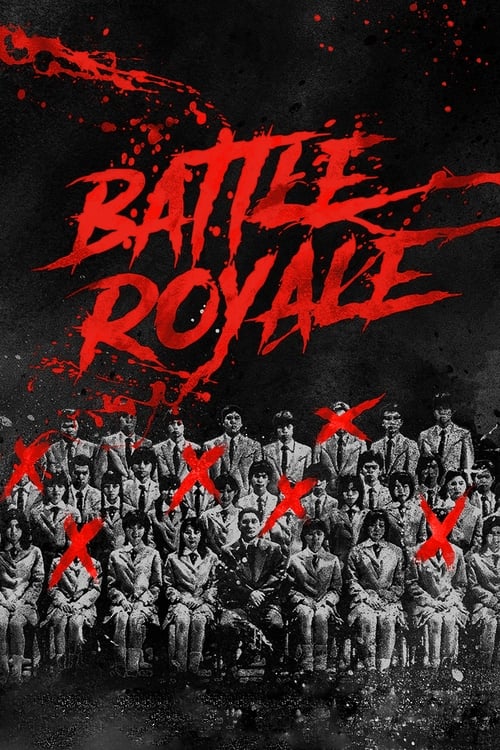
Battle Royale
Battle Royale Is a Bardo Text Disguised as a Dystopia
Directed by Kinji Fukasaku
Fukasaku did not make a satire of Japanese society. He filmed the forty-nine days after death, and cast ninth-graders as the dead.
The government does not create the game in Battle Royale. It only makes the killing legible. What the film actually depicts is a consciousness already severed from its previous life, dropped into an unfamiliar terrain, surrounded by forms it used to call classmates, forced to discover what it is when every social contract has been stripped away. The Bardo Thodol describes exactly this geography. The island is the intermediate state. The collar around each student's neck is the Karmic Trace, ticking toward whatever they accumulated before the screen went dark. Fukasaku made this film at seventy years old, dying of cancer, doing retakes from a wheelchair. He knew what he was filming.
Buddhism: The Island Is the Bardo
The Tibetan Book of the Dead teaches that consciousness persisting after death enters the Bardo, a liminal realm of forty-nine days where the deceased encounters projections generated by their own unresolved mind. The peaceful deities appear first. Then the wrathful ones. The soul that clings to familiar forms gets dragged deeper. Only the soul that recognizes the projections as projections finds the exit.
Watch the film through this lens and the casting of ninth-graders stops being provocative and starts being precise. These children already know each other. They carry every unresolved history: Mitsuko's abuse, Kawada's grief, Hiroki's longing. The island does not impose new conditions. It removes the suppression. What each student enacts on the island is what was already inside them before the boat docked. Shuya survives by refusing to kill. Kawada survives because he has already died on this island once. He is the one figure in the film who has already passed through the Bardo and understands its mechanics. His teaching is simple: the island is not the world. The collar is not your self. The game's only real rule is that you believe it.
The two students who escape at the end do not win the game. No one can win a Bardo. They simply refuse the projections long enough to find the shore.
Gnosticism: Kitano Is the Demiurge, and He Already Knows It
Kitano, the teacher turned game overseer, loves Noriko. This is the film's strangest and most crucial detail. He has a drawing of her on his wall. He does not want her dead. He shoots her with a blank.
In Gnostic cosmology, the Demiurge is not evil in the way of a villain. He is a lesser god who created a flawed world and rules it with genuine conviction. His flaw is that he believes his creation is the real one. Kitano is this figure exactly: the authority who administers the game with procedural sincerity, who has forgotten or suppressed that the children in front of him are pneumatic souls who carry a spark he cannot extinguish. He kills the ones he does not recognize. He cannot kill the one he sees. When Noriko shoots him at the end, she is not murdering a tyrant. She is completing the Gnostic circuit: the pneumatic, having passed through the Demiurge's world intact, walks out of it. The Archon collapses when the light leaves the room.
Kitano's final image is him alone on the beach, smiling, the game over. He gets what the Demiurge always gets: his world, emptied of the souls that made it worth watching.
For the initiated-by-violence arc, Lord of the Flies runs the same dissolution without a collar, and the Archon is the boys themselves. The Platform mechanizes the Demiurgic structure into concrete and food. For the Buddhist death-and-rebirth cycle that Battle Royale compresses into ninety minutes, Spring, Summer, Fall, Winter... and Spring takes the same teaching and slows it to the pace of a lake.
Questions this film answers
What is the deeper meaning of Battle Royale?
The government does not create the game in Battle Royale. It only makes the killing legible. What the film actually depicts is a consciousness already severed from its previous life, dropped into an unfamiliar terrain, surrounded by forms it used to call classmates, forced to discover what it is when every social contract has been stripped away. The Bardo Thodol describes exactly this geography. The island is the intermediate state. The collar around each student's neck is the Karmic Trace, ticking toward whatever they accumulated before the screen went dark. Fukasaku made this film at seventy years old, dying of cancer, doing retakes from a wheelchair. He knew what he was filming.
What is the hidden symbolism in Battle Royale?
The Tibetan Book of the Dead teaches that consciousness persisting after death enters the Bardo, a liminal realm of forty-nine days where the deceased encounters projections generated by their own unresolved mind. The peaceful deities appear first. Then the wrathful ones. The soul that clings to familiar forms gets dragged deeper. Only the soul that recognizes the projections as projections finds the exit.
What esoteric traditions appear in Battle Royale?
Battle Royale draws from Buddhism, Gnosticism traditions. Fukasaku did not make a satire of Japanese society. He filmed the forty-nine days after death, and cast ninth-graders as the dead.
Is Battle Royale worth watching for spiritual seekers?
Battle Royale (2000) directed by Kinji Fukasaku is essential viewing for those interested in Buddhism, Gnosticism. Battle Royale Is a Bardo Text Disguised as a Dystopia. It rewards multiple viewings and contemplation.
Rewatch With New Eyes
Now that you've seen the architecture, experience it again. The same film becomes a different film when you know what to watch for.
This time, watch for:
- See impermanence: what clings, what releases, what remains
- Watch for the false world vs. the real — who is asleep, who awakens
Links may include affiliate partnerships that support Media Revelations
The Descent Continues
Where this thread leads next.
Forrest Gump 1994
The Holy Fool and the Feather of Grace
Read the revelation →