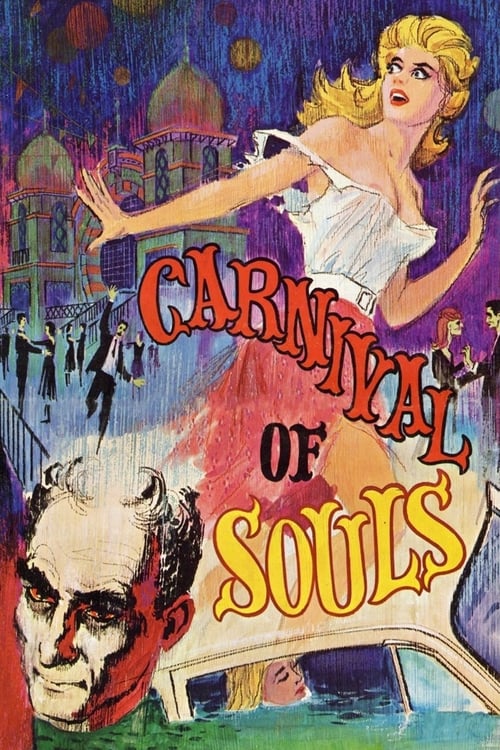
Carnival of Souls
Carnival of Souls Is a Bardo Film Made by People Who Did Not Know They Were Making One
Directed by Herk Harvey
Mary Henry died in the river. Everything after the wreck is the state a consciousness enters when it will not accept that it has already ended.
Herk Harvey shot this in three weeks with industrial-film money, and by accident or grace he made one of the most accurate depictions of the intermediate state ever put on film. A car goes off a bridge into a river. Three women are inside. Only Mary walks out of the water, dripping and dazed, unable to say how she survived. She takes a job as a church organist in Utah and tries to resume a life. But the world keeps refusing her. Sound drops out around her and people cannot see or hear her for minutes at a time. A pale-faced Man appears in windows and reflections, drawing her toward an abandoned lakeside pavilion. The surface reading is that this is a low-budget ghost story with a twist ending. The film is doing something exact: it is tracking a soul that does not know it is dead, and it withholds the diagnosis from her and from us until the divers pull her body from the river in the final minutes. She never left the water. The whole film happened in the moment of drowning.
Buddhist Reading: The Organist Who Cannot Hear She Is Being Sung Toward Death
The Tibetan bardo teachings describe the newly dead as confused, still moving through familiar rooms, still trying to speak to the living, not understanding why no one answers. This is Mary's entire experience after the wreck. The scenes where the diner falls silent and the pedestrians look through her are not surreal flourishes. They are the moments the bardo teachings describe precisely: the dead reaching for the world and finding no purchase in it.
Watch what she does for a living. She plays the organ in a church and feels nothing, and her employer fires her when he catches her playing a wild, unholy piece she cannot stop, her hands moving as if directed. In the bardo, the deceased is drawn toward the circumstances of the next state by the momentum of its own attachments. Mary is being played, not playing. The Man at the pavilion is not a monster. He is the psychopomp, the ferryman, the figure the teachings say comes to lead the confused consciousness to where it must go. Her terror is the terror of a mind clinging to a life that ended at the bottom of a river.
Gnostic Reading: A World That Was Never Real, Only Convincingly Staged
For the Gnostic, the material world is a counterfeit, a stage set built to keep the soul from recognizing its true condition. Mary moves through a town that feels increasingly hollow, an apartment, a job, a landlord, a doctor, all of it thin, none of it holding. The people speak lines but the reality behind them keeps flickering out.
The pavilion is where the veil finally drops. It is empty, decayed, ringed with dark water, and when Mary enters it the dead rise and dance, and she sees herself among them. This is gnosis in its most literal cinematic form: the recognition that the ordinary world was the illusion and the carnival of the dead was the truth underneath it the whole time. The salvation Gnosticism offers is not rescue but recognition. Mary receives the recognition one instant too late to do anything but be claimed by it.
Questions this film answers
What is the deeper meaning of Carnival of Souls?
Herk Harvey shot this in three weeks with industrial-film money, and by accident or grace he made one of the most accurate depictions of the intermediate state ever put on film. A car goes off a bridge into a river. Three women are inside. Only Mary walks out of the water, dripping and dazed, unable to say how she survived. She takes a job as a church organist in Utah and tries to resume a life. But the world keeps refusing her. Sound drops out around her and people cannot see or hear her for minutes at a time. A pale-faced Man appears in windows and reflections, drawing her toward an abandoned lakeside pavilion. The surface reading is that this is a low-budget ghost story with a twist ending. The film is doing something exact: it is tracking a soul that does not know it is dead, and it withholds the diagnosis from her and from us until the divers pull her body from the river in the final minutes. She never left the water. The whole film happened in the moment of drowning.
What is the hidden symbolism in Carnival of Souls?
The Tibetan bardo teachings describe the newly dead as confused, still moving through familiar rooms, still trying to speak to the living, not understanding why no one answers. This is Mary's entire experience after the wreck. The scenes where the diner falls silent and the pedestrians look through her are not surreal flourishes. They are the moments the bardo teachings describe precisely: the dead reaching for the world and finding no purchase in it.
What esoteric traditions appear in Carnival of Souls?
Carnival of Souls draws from Buddhism, Gnosticism traditions. Mary Henry died in the river. Everything after the wreck is the state a consciousness enters when it will not accept that it has already ended.
Is Carnival of Souls worth watching for spiritual seekers?
Carnival of Souls (1962) directed by Herk Harvey is essential viewing for those interested in Buddhism, Gnosticism. Carnival of Souls Is a Bardo Film Made by People Who Did Not Know They Were Making One. It rewards multiple viewings and contemplation.
Rewatch With New Eyes
Now that you've seen the architecture, experience it again. The same film becomes a different film when you know what to watch for.
This time, watch for:
- See impermanence: what clings, what releases, what remains
- Watch for the false world vs. the real — who is asleep, who awakens
Links may include affiliate partnerships that support Media Revelations