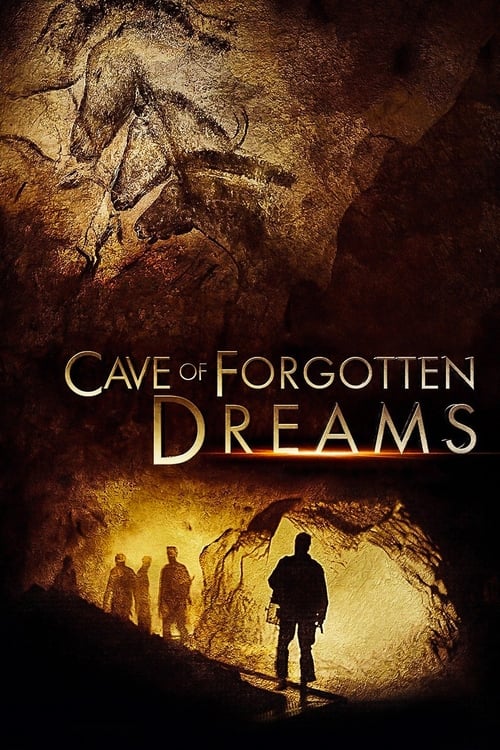
Cave of Forgotten Dreams
Cave of Forgotten Dreams Reveals That the First Art Was Not Decoration. It Was a Doorway.
Directed by Werner Herzog
Herzog filmed inside the Chauvet caves, where humans painted charging lions and galloping horses thirty-two thousand years ago. He does not treat these as primitive scratchings. He treats them as evidence that the first artists were mystics.
Cave of Forgotten Dreams enters a sealed French cave, closed by a rockfall for tens of thousands of years, its walls covered with the oldest known paintings on Earth. Herzog's crew can film only from a narrow metal walkway, in a few stolen hours, breathing bad air. And what they find overturns the schoolbook idea of cave art as crude beginnings. The animals are drawn with a confidence and motion that would not look out of place in a master's sketchbook: a bison with eight legs to suggest running, horses rendered with shading, a lion's hunt caught mid-lunge. Herzog keeps asking what these people believed, what the images were for, and the film's answer is that they were never meant to be looked at as pictures. The cave was not a gallery. It was a threshold, and the paintings were the instruments of passage between this world and another.
Shamanic Reading: The Rock Wall as Membrane Between Worlds
The scholars Herzog interviews point to something the walkway makes visible: the paintings cluster in the deepest, darkest chambers, places you must crawl to reach, lit only by torch, where the flickering flame would make the animals appear to move on the curved rock. This is the shamanic cosmos exactly. The cave is the underworld, entered through a narrow passage that is itself a birth channel in reverse. The shaman goes down into the dark to meet the animal spirits and returns with power and vision. The painters worked where no daylight has ever fallen because the images were never for the surface world.
One handprint recurs across the cave, marked by a crooked little finger, the same hand traveling deep into the rock over what may have been years. Herzog treats this as the trace of a single person returning again and again to the same sacred act. The rock face is not a canvas. It is a membrane, and the animals are half-emerged from it, drawn using the natural bulges of the stone so the horse's shoulder is the cave's own swelling. The artist was not depicting an animal. He was calling one through the wall.
Gnostic Reading: The Spark That Woke Inside the Beast
The film raises a question it cannot resolve: at some point the human became something the other animals are not. A being that buries its dead, paints its gods, and knows it will die. Gnosticism names this the awakening of the divine spark, the moment spirit stirred inside matter and began to recognize itself as a stranger in the material world. The Chauvet paintings are the first surviving record of that stranger looking out.
Herzog closes with a haunting coda about albino crocodiles in a nearby biosphere, mutants born of warmed water, gazing at their own reflections. He wonders whether we, too, are looking at reflections we cannot understand, whether we ever truly see what these ancestors saw. This is the Gnostic condition precisely: the spark awake in the flesh, straining to remember an origin the flesh cannot hold. The paintings are thirty-two thousand years old, and they are already the record of a soul that knew it did not fully belong here.
Questions this film answers
What is the deeper meaning of Cave of Forgotten Dreams?
Cave of Forgotten Dreams enters a sealed French cave, closed by a rockfall for tens of thousands of years, its walls covered with the oldest known paintings on Earth. Herzog's crew can film only from a narrow metal walkway, in a few stolen hours, breathing bad air. And what they find overturns the schoolbook idea of cave art as crude beginnings. The animals are drawn with a confidence and motion that would not look out of place in a master's sketchbook: a bison with eight legs to suggest running, horses rendered with shading, a lion's hunt caught mid-lunge. Herzog keeps asking what these people believed, what the images were for, and the film's answer is that they were never meant to be looked at as pictures. The cave was not a gallery. It was a threshold, and the paintings were the instruments of passage between this world and another.
What is the hidden symbolism in Cave of Forgotten Dreams?
The scholars Herzog interviews point to something the walkway makes visible: the paintings cluster in the deepest, darkest chambers, places you must crawl to reach, lit only by torch, where the flickering flame would make the animals appear to move on the curved rock. This is the shamanic cosmos exactly. The cave is the underworld, entered through a narrow passage that is itself a birth channel in reverse. The shaman goes down into the dark to meet the animal spirits and returns with power and vision. The painters worked where no daylight has ever fallen because the images were never for the surface world.
What esoteric traditions appear in Cave of Forgotten Dreams?
Cave of Forgotten Dreams draws from Shamanism, Gnosticism traditions. Herzog filmed inside the Chauvet caves, where humans painted charging lions and galloping horses thirty-two thousand years ago. He does not treat these as primitive scratchings. He treats them as evidence that the first artists were mystics.
Is Cave of Forgotten Dreams worth watching for spiritual seekers?
Cave of Forgotten Dreams (2010) directed by Werner Herzog is essential viewing for those interested in Shamanism, Gnosticism. Cave of Forgotten Dreams Reveals That the First Art Was Not Decoration. It Was a Doorway.. It rewards multiple viewings and contemplation.
Rewatch With New Eyes
Now that you've seen the architecture, experience it again. The same film becomes a different film when you know what to watch for.
This time, watch for:
- Follow the descent: what dies, what guides, what returns transformed
- Watch for the false world vs. the real — who is asleep, who awakens
Links may include affiliate partnerships that support Media Revelations
The Descent Continues
Where this thread leads next.
Into the Inferno 2016
Into the Inferno Is About the Volcano the Living Use to Talk to the Dead
Read the revelation →