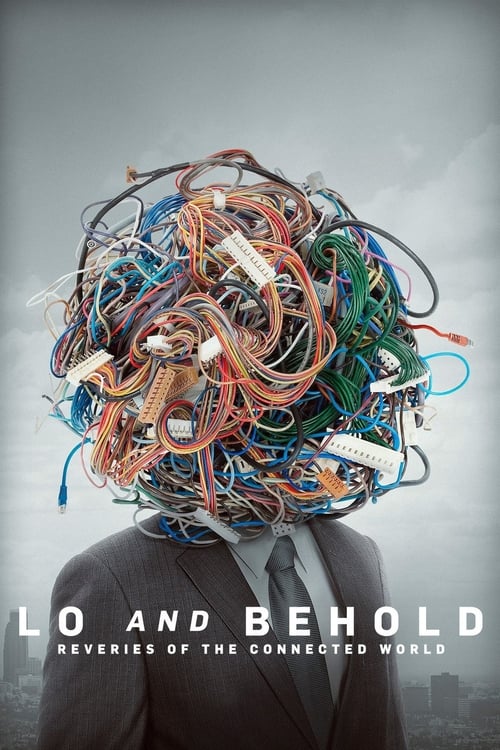
Lo and Behold: Reveries of the Connected World
Lo and Behold Is Herzog Asking Whether the Internet Dreams, and Deciding It Cannot
Directed by Werner Herzog
Herzog walks into the room where the first message was sent and calls the corridor holy. Then he spends the rest of the film proving the holiness stops there.
The film is organized as ten chapters, and most reviewers treated it as a survey of connectivity: origins, dependency, threats, the future. That framing misses the actual argument Herzog is building underneath the segments. He is asking one question in ten forms. Does the network have an inner life, or only an outer one. He interviews the engineers who built ARPANET, the family destroyed by a viral photograph of their dead daughter, the addicts in rehab, the man who lives in a radiation shadow to escape signal. He keeps returning to the same nerve. The internet connects everything and understands nothing. When Herzog asks a roboticist whether the machines will one day dream, the pause before the answer is the whole film. Herzog does not believe the connected world is evil. He believes it is empty in a specific way, and he built the film to locate the exact site of the emptiness.
Gnostic Reading: A Demiurge That Copies Without Knowing
In Gnostic cosmology the Demiurge is the craftsman who builds a convincing world while remaining ignorant of the true light above him. He produces order, replication, and law. He cannot produce gnosis. Herzog's internet is precisely this figure rendered in fiber optic. In the opening chapter he stands in the UCLA room where the first node lived and describes it in the language of scripture, the corridor "repulsive and beautiful at the same time." He is naming a creation event. But watch what the created world does with the Catsouras family, whose daughter died in a crash and whose autopsy photographs were emailed around the world for sport. The network copied the image perfectly and understood nothing of the grief it was propagating. That is the Demiurgic signature. Flawless reproduction, zero comprehension. Herzog's monks who tweet, his hackers, his solar-flare prophets are all responding to the same intuition: the thing that connects us is a lower god, competent and blind, and salvation is not inside it.
Buddhist Reading: Connection Without Contact
Buddhism draws a hard line between proximity and genuine contact, phassa, the meeting that actually conditions experience. You can be surrounded and untouched. Herzog builds an entire chapter around this in the Green Bank quiet zone, where people who claim to be sickened by electromagnetic radiation gather in the one valley where signal is forbidden. They are refugees from connection that never became contact. The network offered them everyone and delivered no one. The internet-addiction rehab sequence makes the same point from the opposite side: young men so saturated with connection that they have lost the capacity to sit with a single unmediated moment, relearning presence like a foreign language. Buddhism would recognize their condition instantly. It is not that they have too little. It is that endless craving-objects have crowded out the still awareness that could actually receive one thing fully. Herzog frames the recovering addict and the quiet-zone exile as the same person seen twice. Both are trying to subtract the network far enough to feel a person again.
Questions this film answers
What is the deeper meaning of Lo and Behold: Reveries of the Connected World?
The film is organized as ten chapters, and most reviewers treated it as a survey of connectivity: origins, dependency, threats, the future. That framing misses the actual argument Herzog is building underneath the segments. He is asking one question in ten forms. Does the network have an inner life, or only an outer one. He interviews the engineers who built ARPANET, the family destroyed by a viral photograph of their dead daughter, the addicts in rehab, the man who lives in a radiation shadow to escape signal. He keeps returning to the same nerve. The internet connects everything and understands nothing. When Herzog asks a roboticist whether the machines will one day dream, the pause before the answer is the whole film. Herzog does not believe the connected world is evil. He believes it is empty in a specific way, and he built the film to locate the exact site of the emptiness.
What is the hidden symbolism in Lo and Behold: Reveries of the Connected World?
In Gnostic cosmology the Demiurge is the craftsman who builds a convincing world while remaining ignorant of the true light above him. He produces order, replication, and law. He cannot produce gnosis. Herzog's internet is precisely this figure rendered in fiber optic. In the opening chapter he stands in the UCLA room where the first node lived and describes it in the language of scripture, the corridor "repulsive and beautiful at the same time." He is naming a creation event. But watch what the created world does with the Catsouras family, whose daughter died in a crash and whose autopsy photographs were emailed around the world for sport. The network copied the image perfectly and understood nothing of the grief it was propagating. That is the Demiurgic signature. Flawless reproduction, zero comprehension. Herzog's monks who tweet, his hackers, his solar-flare prophets are all responding to the same intuition: the thing that connects us is a lower god, competent and blind, and salvation is not inside it.
What esoteric traditions appear in Lo and Behold: Reveries of the Connected World?
Lo and Behold: Reveries of the Connected World draws from Gnosticism, Buddhism traditions. Herzog walks into the room where the first message was sent and calls the corridor holy. Then he spends the rest of the film proving the holiness stops there.
Is Lo and Behold: Reveries of the Connected World worth watching for spiritual seekers?
Lo and Behold: Reveries of the Connected World (2016) directed by Werner Herzog is essential viewing for those interested in Gnosticism, Buddhism. Lo and Behold Is Herzog Asking Whether the Internet Dreams, and Deciding It Cannot. It rewards multiple viewings and contemplation.
Rewatch With New Eyes
Now that you've seen the architecture, experience it again. The same film becomes a different film when you know what to watch for.
This time, watch for:
- Watch for the false world vs. the real — who is asleep, who awakens
- See impermanence: what clings, what releases, what remains
Links may include affiliate partnerships that support Media Revelations