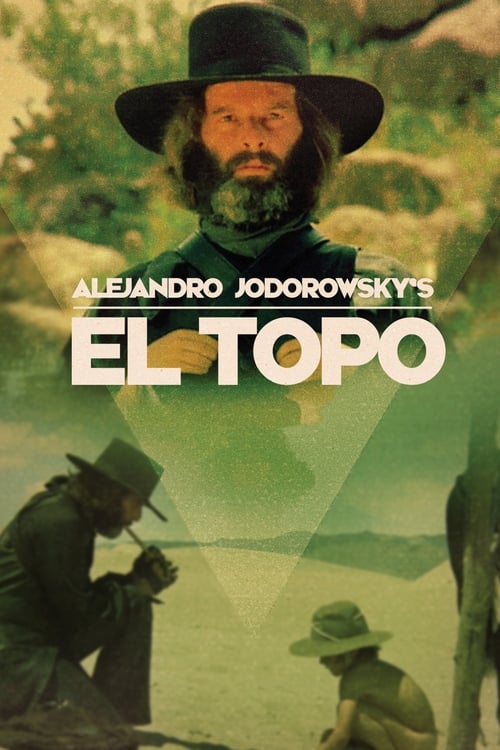
El Topo
The Gunfighter Who Killed All Four Masters and Still Was Not Enlightened
Directed by Alejandro Jodorowsky
Jodorowsky's first major film is a Tarot reading in western costume. El Topo travels the desert killing four masters and discovers that defeating teachers is not the same as becoming one. The cave of underground people is the second life — the bardo of the dead-yet-living, where he must finally do work he could not do on his first body. This is sacred cinema for people who do not yet know they are saints.
El Topo is the first acid western and the only film of its era that is genuinely an initiation manual. Jodorowsky did not make a film about a gunfighter. He made a film about the entire path of spiritual development, structured around the encounter with four teachers, the catastrophic recognition that defeating teachers does not produce mastery, and the rebirth into a second life inside a cave full of the disfigured. The first half of the film is the ego's project of becoming great. The second half is what happens when the project completes and reveals itself as failure. El Topo is not the hero. El Topo is what every seeker becomes if they pursue mastery without grace — capable, lethal, alone, and finally on fire on a desert stone, having understood too late.
The Surface
A black-clad gunfighter rides into the desert with his naked son. He slaughters a band of bandits, takes a woman, abandons his son with the monks. The woman demands he prove himself by defeating the four greatest masters of the desert. He does, with tricks rather than honesty. She leaves him for another woman. He is shot by both women and left for dead. He awakens years later, after being rescued by a community of physically disabled people imprisoned in a cave under a mountain. He vows to free them by digging a tunnel out. He builds a town that exploits them. They escape through his tunnel. The town massacres them. He sets himself on fire on the cave's stone in front of his grown son, who has become a monk.
On surface, El Topo is a deranged Mexican western in psychedelic register. It was the first 'midnight movie,' becoming a cult phenomenon at New York's Elgin Theatre and personally championed by John Lennon. The shock images — the bandits torturing the priest, the rabbit massacre, the deformed cave community — got most of the early attention.
Jodorowsky himself described the film differently. He has said in interviews that he intended it as a complete spiritual autobiography in symbolic form: the ego's pursuit of mastery in part one, the ego's death and reconstruction in part two. Every scene is positioned within that schema. The film does not work as adventure. It works as Tarot, where each image is a station and each station is operating on the viewer's psyche whether or not the viewer is consciously decoding the symbol.
The Four Masters as Initiatory Schema
The structural spine of part one is El Topo's encounters with four desert masters, each representing a different attainment that the seeker would have to genuinely embody to inherit. The first master is master of physical perception — he sees with his hands and ears, having lost his eyes. The second is master of pure technique — his bullets pass through anything. The third is master of devotion — he has reduced himself to caring for rabbits. The fourth is master of total acceptance — he is unbeatable because he has nothing left to defend.
El Topo defeats all four. He does not earn any of their wisdom. He defeats the first by using a mirror to reflect the master's perception. He defeats the second by shooting before the master can finish his philosophical statement. He defeats the third by pulling a hidden gun. He cannot defeat the fourth fairly, so the fourth allows himself to be killed, recognizing that El Topo has not understood anything.
This is the precise diagnosis of what is wrong with most spiritual seeking. The seeker imitates the form of mastery rather than developing the substance. Cheats are available. Tricks work. Teachers can be defeated by the unprepared. The defeat does not transmit the teaching. It only kills the teacher.
Each master El Topo kills represents a quality he then lacks more thoroughly than before. He kills the master of sight and goes more blind. He kills the master of technique and his technique remains a trick. He kills the master of devotion and becomes more incapable of love. He kills the master of acceptance and arrives at his own death without any acceptance available to him. The film stages the inverse of an initiation. The seeker who pursues this path arrives at total alienation.
The Cave and the Second Life
El Topo wakes in a cave under a mountain. He has been kept alive by a community of disabled outcasts who have been imprisoned in the cave for generations by the racist colonial town above them. They have made him their messiah, dressed him in white, shaved his head. He accepts the role. He vows to dig a tunnel that will free them.
This is the shamanic second life. The first life ended on the rocks with the two women. The body that survived is a different body. The consciousness that occupies it has access to capacities the first El Topo never developed — humility, manual labor, sustained intention toward a goal that is not about him. He spends years digging. He earns money in the town as a clown performer with the dwarf woman who saved him, debasing himself for coins that will buy explosives.
Shamanic traditions across cultures describe this pattern. The wounded healer must die first. The new body is sometimes literally different — shamans report scars, missing organs, parallel limbs after their initiatory illness. El Topo's second body is the second body of every shaman: capable of what the first body could not do, in service of those the first body could not even see.
But Jodorowsky is not romantic about this. The second life is not necessarily redemption. El Topo's project to free the cave community is sincere. It is also the source of the final catastrophe. He digs the tunnel. They emerge into the town. The town massacres them. His good intentions, married to insufficient understanding of what the surface world is, lead to the slaughter of the people he loves. The second life can fail too. The film refuses easy resolution.
The Fire and the Son
The final scene is one of the most precise images of alchemical ending in cinema. El Topo sees the bodies of the cave people in the town square. He understands the failure of his project. He goes back to the cave. He pours oil over himself. He lights himself on fire on the stone where he first awakened.
His son — abandoned as a child, raised by monks, now a young man — has returned to the cave to find his father. He arrives in time to watch his father burn. He does not extinguish him. He sits with him. He receives, by witness, what his father could not receive any other way: the recognition that the path completes itself, even when the path has been walked badly.
Self-immolation is the radical version of the rubedo. The body that has carried two lives is finally returned to fire. Nothing remains for the third life. The son is the third life. He carries forward what the father could not. The lineage continues. The mistakes are not redeemed, but they are not the final word either, because the next generation is there, having watched, and now knows.
Jodorowsky frames this not as tragedy but as transmission. El Topo's failure is the son's curriculum. The son will not have to make the same mistakes because he watched them be made and watched the maker burn. This is how spiritual lineage works when it works. The unfinished teacher is finished by the next generation's witness. The fire that consumes him is the fire that lights them.
The Transmission
El Topo is not a film you watch. It is a film you survive. The pacing is hallucinatory. The violence is graphic. The symbolism is unrelenting. Many viewers leave the first time confused or repulsed. The film does not change. They do, when they come back to it years later, having lived enough that the schema begins to make sense.
What it transmits is a precise warning to the seeker: do not pursue mastery without compassion, do not defeat teachers you have not learned from, do not assume your good intentions in the second life will be sufficient. The film is an unusually accurate map of how spiritual pride destroys the person it is trying to elevate. It is also a map of how the destruction is not necessarily final — there is a son, there is a cave, there is fire that lights as well as consumes.
Jodorowsky would refine these themes in The Holy Mountain three years later, in a more controlled and more accessible register. El Topo is the rougher, wilder original. It is the film he made when he had to make it, before he knew how to make it carefully. The carelessness is part of its power. It is sacred cinema at the moment of its first appearance, when nobody yet knew that this was even a genre. The viewer who can sit with it receives an initiation. The viewer who cannot will at least know that initiations exist, somewhere, and that not all of them end well.
Questions this film answers
What is the deeper meaning of El Topo?
El Topo is the first acid western and the only film of its era that is genuinely an initiation manual. Jodorowsky did not make a film about a gunfighter. He made a film about the entire path of spiritual development, structured around the encounter with four teachers, the catastrophic recognition that defeating teachers does not produce mastery, and the rebirth into a second life inside a cave full of the disfigured. The first half of the film is the ego's project of becoming great. The second half is what happens when the project completes and reveals itself as failure. El Topo is not the hero. El Topo is what every seeker becomes if they pursue mastery without grace — capable, lethal, alone, and finally on fire on a desert stone, having understood too late.
What is the hidden symbolism in El Topo?
A black-clad gunfighter rides into the desert with his naked son. He slaughters a band of bandits, takes a woman, abandons his son with the monks. The woman demands he prove himself by defeating the four greatest masters of the desert. He does, with tricks rather than honesty. She leaves him for another woman. He is shot by both women and left for dead. He awakens years later, after being rescued by a community of physically disabled people imprisoned in a cave under a mountain. He vows to free them by digging a tunnel out. He builds a town that exploits them. They escape through his tunnel. The town massacres them. He sets himself on fire on the cave's stone in front of his grown son, who has become a monk.
What esoteric traditions appear in El Topo?
El Topo draws from Initiation, Shamanism, Alchemy traditions. Jodorowsky's first major film is a Tarot reading in western costume. El Topo travels the desert killing four masters and discovers that defeating teachers is not the same as becoming one. The cave of underground people is the second life — the bardo of the dead-yet-living, where he must finally do work he could not do on his first body. This is sacred cinema for people who do not yet know they are saints.
Is El Topo worth watching for spiritual seekers?
El Topo (1970) directed by Alejandro Jodorowsky is essential viewing for those interested in Initiation, Sufism, Jodorowsky. The Gunfighter Who Killed All Four Masters and Still Was Not Enlightened. It rewards multiple viewings and contemplation.
Rewatch With New Eyes
Now that you've seen the architecture, experience it again. The same film becomes a different film when you know what to watch for.
This time, watch for:
- Mark the threshold: the old self dies, the ordeal transforms, the new self returns
- Follow the descent: what dies, what guides, what returns transformed
- Track the stages: blackening, whitening, reddening — death before rebirth
Links may include affiliate partnerships that support Media Revelations
The Descent Continues
Where this thread leads next.
The Holy Mountain 1973
The Tarot as Initiatory Cinema
Read the revelation →