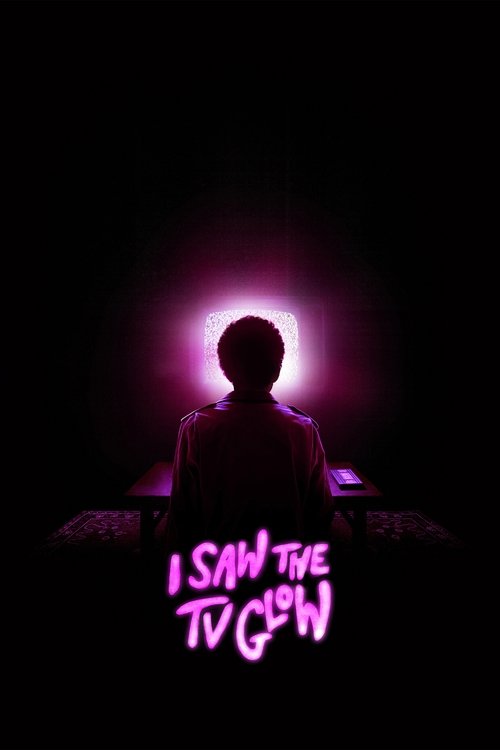
I Saw the TV Glow
The Soul That Saw the Door and Chose the Coffin
Directed by Jane Schoenbrun
I Saw the TV Glow is a Gnostic parable disguised as a nostalgia film. The Pink Opaque is not escapism but gnosis leaking through the screen, Maddy offers the burial that is initiation, and Owen chooses the slow suffocation of the false self over the death that would wake him.
I Saw the TV Glow is a Gnostic parable disguised as a nostalgia film about a canceled TV show. Owen is a soul that has forgotten it is a soul, asleep inside a false world that calls itself reality. The Pink Opaque, the cheap supernatural teen show he watches with Maddy, is not escapism. It is gnosis, the leaked memory of who he actually is, smuggled in on a Saturday-night broadcast. Maddy offers him the way out, burial in the earth and death to the false self, and he refuses it. Everything after that refusal is the slow suffocation of a being who chose the coffin over the truth, and who keeps apologizing to a world that is killing him.
The Surface
Jane Schoenbrun's second feature opens in the suburbs of the late 1990s. Owen is a shy, sexless kid who befriends an older girl, Maddy, over a young-adult supernatural series called The Pink Opaque. Two psychically linked girls, Isabel and Tara, fight a villain named Mr. Melancholy who lives on the moon. The show airs past Owen's bedtime, so he watches in fragments, in secret, lit by the screen.
Then Maddy disappears. The show gets canceled. Years pass. Owen ages into a soft, frightened adult working at a family entertainment center, married to a job and a house and nothing else. Maddy returns once, decades later, and tells him an impossible thing: their real lives are inside The Pink Opaque, they are Isabel and Tara, and the suburb is a prison the villain built to keep them asleep. To wake up, Owen has to let himself be buried alive. He runs. The film ends with him hyperventilating in a bathroom, splitting open his own chest to find a screen glowing inside, apologizing to strangers, fading to black.
Critics called it a trans allegory, an egg-cracking metaphor, a story about dysphoria and the closet. That reading is correct and the film invites it openly. It is also the surface. Underneath the trans parable runs an older one, the oldest one, about a spirit trapped in matter that mistakes its prison for its home.
The Pink Opaque Is Gnosis Leaking Through the Screen
In Gnostic cosmology the soul is a divine spark fallen into a counterfeit world. The world was made by a lesser power, the Demiurge, who rules through forgetting. The trap is not pain. The trap is amnesia. You do not know you are imprisoned because you do not remember there was ever anywhere else. Salvation is gnosis, direct knowledge of your true origin, and it almost always arrives as a message from outside the system, a call, a stranger, a voice that says you do not belong here.
The Pink Opaque is that call. Watch how Owen receives it. He cannot watch it directly or in full. He catches it in pieces, after dark, hidden under a blanket in Maddy's basement, lit by a glow he is not supposed to see. Forbidden, fragmentary, transmitted from somewhere higher than his bedtime. This is exactly how gnosis behaves. It does not come through the front door of the sanctioned world. It bleeds in through a crack, on a frequency the rulers of the false world consider trash.
Maddy hands him a recorded tape so he can keep watching. The tape is the relic, the secret scripture, the thing you hide because the world would destroy it if it knew what it was. Owen guards it like contraband. He is right to. In Gnostic terms he is carrying the only true text in a house full of furniture.
And notice the title. The Pink Opaque. Pink, the glow of the screen and of living flesh. Opaque, the thing you cannot see through. The show names its own function. It is the membrane between worlds, glowing, and you cannot see what is on the other side until you pass through it.
Mr. Melancholy Is the Demiurge, and the Suburb Is His Counterfeit Eden
The villain of the in-universe show lives on the moon and steals time. His name is Mr. Melancholy. A face in the sky, lunar and cold, who governs by draining the days out of your life so you never get around to becoming who you are. Behind the children's-TV villain stands a precise portrait of the archon who runs the false world, the one whose whole power is delay.
Look at what Mr. Melancholy actually does to Owen across the film. He does not attack. He does not torture. He simply lets time pass. Owen gets older in long dissolves, the suburb stays the same beige, the years evaporate while Owen stands behind a counter feeling vaguely that something is wrong. That feeling, the low hum of misplaced dread, is the only honest signal left in him. Gnostics had a word for it. They called it the call that the soul hears and cannot place.
The suburb is the Demiurge's masterpiece. It looks like home. It has parents and a school and a job and a marriage. It provides everything except the one thing, contact with the real. Schoenbrun shoots it as a place where nothing happens with total conviction. The bleeding chalk on the pavement, the inflatable planetarium dome, the entertainment center where Owen finally works, a building whose entire purpose is the manufacture of fun for people who have forgotten how to feel anything. This is the counterfeit Eden. Comfortable, lit, and dead.
When Maddy tells Owen the suburb is not real, she means it literally, in the full Gnostic sense. The world he calls his life is a stage set, and the longer he stays inside it, the more of his real life Mr. Melancholy drinks.
Maddy Offers Burial, Which Is Initiation, and Owen Chooses the Coffin Instead
Every initiation crosses through death. The shaman is dismembered, buried, eaten by spirits, and reassembled as something that can see. The seed has to be put in the dark ground and rot before it becomes the plant. In the traditions this is operating instruction, stated literally. To be reborn you first have to die, fully, in the body, in the dirt.
Maddy did it, and the way she returns to tell him is itself the proof. She vanished for eight years and then she is simply there in the parking lot of the entertainment center at night, lit by the same kind of glow the show always carried, not aged the way the suburb ages people, speaking too calmly for someone describing her own death. She tells Owen she went out to the football field behind the school, the flat open ground at the dead center of the town, and she dug. She climbed into a television set, poured gasoline, and let the earth take her. She suffocated in the dark on purpose. And she woke up inside the real world as Tara. Her face, when she describes it, is not traumatized. It is the face of someone who came out the other side. She is the returned initiate, and she has come back for the one she left behind, which is what real initiates do.
She offers Owen the identical passage. There is a television. He has to climb inside it and let it bury him. The set, the glowing box that has been the membrane all along, is now an open grave. The way out and the way down are the same door. That is the shamanic structure exactly. You descend to ascend. You go into the earth to get to the sky.
The film has been rehearsing this burial in Owen's body the whole way. Watch the playground. As a boy Owen crawls under the parachute at school, into a dome of fabric that goes dark and close over his face, and the air seems to leave the frame; the playground equipment becomes a soft suffocation, a first small grave he is laid in and does not understand. Watch the Pink Opaque episodes themselves, which Schoenbrun stages as scriptures of dirt and entombment, Isabel buried, ice cream men full of moon-rot, bodies opened and refilled with cosmic sludge. The show keeps showing Owen the operation he will be asked to undergo, and he keeps mistaking it for a story. Even his name on the tape, the contraband relic, is a coffin he carries in a backpack.
Owen stands at the edge of his own initiation and turns around. He cannot do it. The terror of the death is larger than the promise of the life. So he walks back into the suburb and lets the years close over him anyway, which is the cruel joke the film refuses to soften. He gets buried regardless. He just gets buried slowly, breathing, conscious, by inches, instead of all at once into something new. He chooses the coffin over the womb, not knowing they were the same shape.
"There Is Still Time" Is the Bodhisattva's Lie He Tells the Living Dead
Late in the film Owen, now old, has a breakdown at his workplace. He runs to a bathroom, claws open his shirt, and tears into his own chest. The skin parts like a curtain and inside is a glow, a screen, the Pink Opaque still broadcasting from within his body, light pouring out of the cavity where his heart should be. The real self never left. It was buried inside him the whole time, transmitting on a frequency he stopped listening to. He sees it the way you see your own face for the first time in a mirror you forgot was a mirror.
This is the Buddhist core under the Gnostic shell. The true nature was never lost or far away. It is intimate, interior, closer than the breath, and obscured only by the relentless habit of identifying with the false self. Owen does not need to go anywhere. He needs to recognize what is already glowing in him. For one cracked-open second, he sees it, and the seeing is total.
Then he closes the shirt. He walks back out onto the floor of the entertainment center and he apologizes. Over and over, to coworkers, to children, to strangers, he says he is sorry. The last sustained image of the film is a man who briefly saw his own Buddha-nature and chose to button his shirt over it and apologize to a world made of cardboard for the disruption.
Maddy's words echo against this. Throughout the film someone insists there is still time. In the Buddhist frame that is the bodhisattva's vow, the promise held out to every sleeping being that liberation remains available right now, in this life, before the credits. The horror of the ending is that the door stays open and the man keeps choosing the wall. There is still time is true. It is also the most painful sentence in the film, because the one it is meant for will not hear it.
The Glow Is What You Worship Instead of What You Are
Schoenbrun titled the film after a sensation, the TV glow, the light on a child's face in a dark room. Hold on that image, because it is the whole thesis compressed into one frame.
The glow is real light coming from a false source. It is the only beauty in Owen's world and it arrives through a machine that exists to keep him sedated. That doubleness is the entire spiritual problem of the film and of the age it depicts. The signal of the real, the leaked memory of paradise, comes to a generation through the exact same channel that anesthetizes them. The medium that could wake Owen up is the medium engineered to keep him asleep. He has to learn to tell the transmission from the trance, and the film's grief is that almost nobody does.
Owen worships the glow instead of becoming it. He loves the show, hoards the tape, returns to the rerun, and never once climbs through the screen. He treats the message as comfort instead of command. This is the subtlest Gnostic trap of all, subtler than mere forgetting. It is the soul that half-remembers, that feels the pull, that weeps at the right images, and uses that very feeling as a substitute for the act. He gets to feel deep while staying buried. The glow becomes a pacifier shaped like a key.
The film ends in the dark, after the glow is gone, with Owen alone and apologizing. That is the true horror Schoenbrun built, quieter and worse than any monster on the moon. Not that the false world is a prison. That the cell door was unlocked the entire time, that someone he loved came back to hold it open, and that he stood in the light of his own buried life and said he was sorry for the inconvenience.
Questions this film answers
What is the deeper meaning of I Saw the TV Glow?
I Saw the TV Glow is a Gnostic parable disguised as a nostalgia film about a canceled TV show. Owen is a soul that has forgotten it is a soul, asleep inside a false world that calls itself reality. The Pink Opaque, the cheap supernatural teen show he watches with Maddy, is not escapism. It is gnosis, the leaked memory of who he actually is, smuggled in on a Saturday-night broadcast. Maddy offers him the way out, burial in the earth and death to the false self, and he refuses it. Everything after that refusal is the slow suffocation of a being who chose the coffin over the truth, and who keeps apologizing to a world that is killing him.
What is the hidden symbolism in I Saw the TV Glow?
Jane Schoenbrun's second feature opens in the suburbs of the late 1990s. Owen is a shy, sexless kid who befriends an older girl, Maddy, over a young-adult supernatural series called The Pink Opaque. Two psychically linked girls, Isabel and Tara, fight a villain named Mr. Melancholy who lives on the moon. The show airs past Owen's bedtime, so he watches in fragments, in secret, lit by the screen.
What esoteric traditions appear in I Saw the TV Glow?
I Saw the TV Glow draws from Gnosticism, Buddhism, Shamanism traditions. I Saw the TV Glow is a Gnostic parable disguised as a nostalgia film. The Pink Opaque is not escapism but gnosis leaking through the screen, Maddy offers the burial that is initiation, and Owen chooses the slow suffocation of the false self over the death that would wake him.
Is I Saw the TV Glow worth watching for spiritual seekers?
I Saw the TV Glow (2024) directed by Jane Schoenbrun is essential viewing for those interested in Gnosticism, Buddhism, Shamanism. The Soul That Saw the Door and Chose the Coffin. It rewards multiple viewings and contemplation.
Rewatch With New Eyes
Now that you've seen the architecture, experience it again. The same film becomes a different film when you know what to watch for.
This time, watch for:
- Watch for the false world vs. the real — who is asleep, who awakens
- See impermanence: what clings, what releases, what remains
- Follow the descent: what dies, what guides, what returns transformed
Links may include affiliate partnerships that support Media Revelations
The Descent Continues
Where this thread leads next.
Donnie Darko 2001
The Living Receiver and the Sacrifice That Repairs Time
Read the revelation →