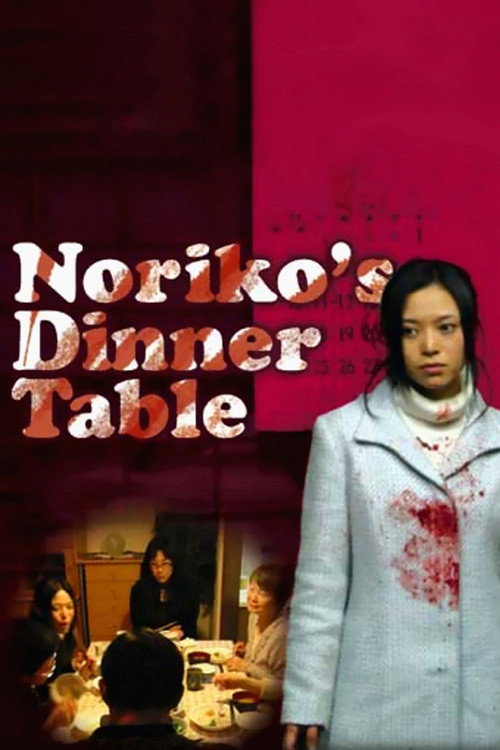
Noriko's Dinner Table
Noriko's Dinner Table Asks Whether You Can Be Connected to Anything If You Never Chose Your Own Self
Directed by Sion Sono
Sono's companion to Suicide Club abandons the mystery of the mass suicides and asks the harder question underneath it: what is a person who was only ever a role, and what happens when she goes looking for a self she can rent.
Noriko is seventeen, suffocating in a provincial family where she is nothing but "the daughter," a function at a dinner table. She runs to Tokyo and finds Kumiko, who runs a website and a business called Family Circle, a service that supplies rented relatives, actors who will be your daughter, your grandmother, your dead sister for a fee. Noriko becomes an employee. She performs other people's family members with total conviction, and finds she is better at being a rented daughter than she ever was at being a real one. Her sister follows her into the same work. Their father, a small-town journalist, tracks them through the same internet threads that dissolved his family, and finally hires his own daughters back, without telling them he knows, to play themselves at a staged dinner. The surface film is a bleak drama about internet alienation. The actual film is a metaphysical interrogation of identity itself. If a self can be performed for money and performed better than it was ever lived, then what exactly was the original self, and did it ever exist, and can such a person be connected to anyone at all.
Buddhist Reading: Anatta Weaponized Into Despair
Buddhism teaches anatta, non-self: there is no fixed unchanging essence inside a person, only a stream of conditioned roles and processes mistaken for a soul. This is meant to be liberating. Sono takes the same insight and shows what it becomes without wisdom, weaponized into despair. Noriko discovers experientially that she has no essential self, that "Noriko the daughter" was a role all along, and instead of freedom she finds a vacuum she fills with rented roles. The teaching that could have freed her instead hollows her out, because she learned that no self is fixed without learning that awareness itself remains. The rented-family business is anatta run as a marketplace: everyone is interchangeable, every relationship is a performance, no role touches a real ground because there is no ground being touched. The horror is not that these people are fake. It is that Sono makes you feel there may be nothing behind anyone's face that is more real than the performance, and that this, without the further teaching, is not enlightenment but annihilation.
Initiatory Reading: A Descent With No One Waiting to Guide It
Every genuine initiation is a descent into dissolution followed by a return in which an elder or a rite reconstitutes the initiate at a higher order. Noriko undertakes the descent perfectly. She dies to her old identity, enters the underworld of Tokyo's rented selves, dissolves completely into other people's names. What she lacks is the second half. There is no elder, no rite, no container to receive her on the far side and hand her back a self she can own. The internet BBS that summoned her is a hollow initiator, a threshold with no temple behind it. The father's staged dinner at the climax is his desperate, doomed attempt to build the missing rite, to become the elder and reconstitute his daughters through a ceremony of pretending to be themselves. It half-works and half-fails, and Sono leaves the outcome deliberately unresolved. The initiation was begun by a culture that no longer possesses the return.
Questions this film answers
What is the deeper meaning of Noriko's Dinner Table?
Noriko is seventeen, suffocating in a provincial family where she is nothing but "the daughter," a function at a dinner table. She runs to Tokyo and finds Kumiko, who runs a website and a business called Family Circle, a service that supplies rented relatives, actors who will be your daughter, your grandmother, your dead sister for a fee. Noriko becomes an employee. She performs other people's family members with total conviction, and finds she is better at being a rented daughter than she ever was at being a real one. Her sister follows her into the same work. Their father, a small-town journalist, tracks them through the same internet threads that dissolved his family, and finally hires his own daughters back, without telling them he knows, to play themselves at a staged dinner. The surface film is a bleak drama about internet alienation. The actual film is a metaphysical interrogation of identity itself. If a self can be performed for money and performed better than it was ever lived, then what exactly was the original self, and did it ever exist, and can such a person be connected to anyone at all.
What is the hidden symbolism in Noriko's Dinner Table?
Buddhism teaches anatta, non-self: there is no fixed unchanging essence inside a person, only a stream of conditioned roles and processes mistaken for a soul. This is meant to be liberating. Sono takes the same insight and shows what it becomes without wisdom, weaponized into despair. Noriko discovers experientially that she has no essential self, that "Noriko the daughter" was a role all along, and instead of freedom she finds a vacuum she fills with rented roles. The teaching that could have freed her instead hollows her out, because she learned that no self is fixed without learning that awareness itself remains. The rented-family business is anatta run as a marketplace: everyone is interchangeable, every relationship is a performance, no role touches a real ground because there is no ground being touched. The horror is not that these people are fake. It is that Sono makes you feel there may be nothing behind anyone's face that is more real than the performance, and that this, without the further teaching, is not enlightenment but annihilation.
What esoteric traditions appear in Noriko's Dinner Table?
Noriko's Dinner Table draws from Buddhism, Initiation traditions. Sono's companion to Suicide Club abandons the mystery of the mass suicides and asks the harder question underneath it: what is a person who was only ever a role, and what happens when she goes looking for a self she can rent.
Is Noriko's Dinner Table worth watching for spiritual seekers?
Noriko's Dinner Table (2005) directed by Sion Sono is essential viewing for those interested in Buddhism, Initiation. Noriko's Dinner Table Asks Whether You Can Be Connected to Anything If You Never Chose Your Own Self. It rewards multiple viewings and contemplation.
Rewatch With New Eyes
Now that you've seen the architecture, experience it again. The same film becomes a different film when you know what to watch for.
This time, watch for:
- See impermanence: what clings, what releases, what remains
- Mark the threshold: the old self dies, the ordeal transforms, the new self returns
Links may include affiliate partnerships that support Media Revelations
The Descent Continues
Where this thread leads next.

Suicide Club 2001
Suicide Club Asks If You Are Connected to Yourself, and Most of Japan Fails the Test
Read the revelation →