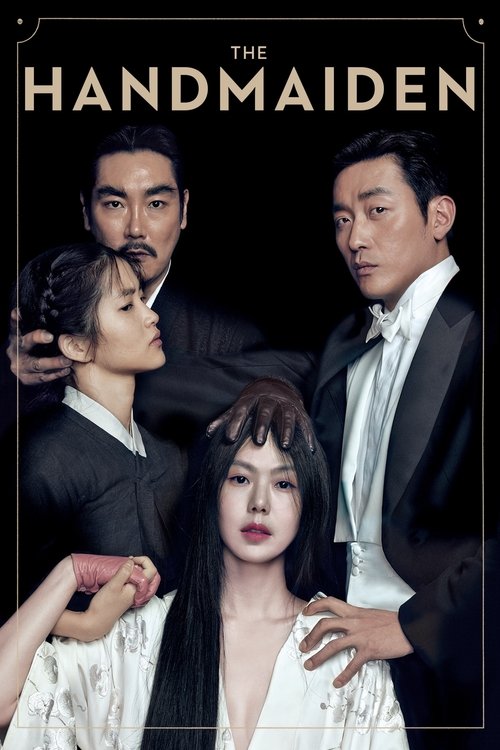
The Handmaiden
Burning the Library That Defined You
Directed by Park Chan-wook
Park made a film about reading as imprisonment and reading as liberation. Hideko has been raised to perform pornographic texts for the uncle's collector audience. Sook-hee cannot read but knows what touch is. The con artists are running their own scripts. The lovers escape by burning the library — every text that defined them gone in smoke. The pearls in the throat in the final scene are the words they no longer need to speak.
The Handmaiden is the most precise film ever made about the relationship between text and bondage. Park adapted Sarah Waters's Fingersmith and relocated the story from Victorian England to 1930s colonial Korea — a doubling of imperial domination (Japanese over Korean) and patriarchal domination (uncle over niece, fiancé over bride, owner over maid). The film's three parts re-tell the same events from different perspectives, each revealing what the previous part concealed. The structural reveal is that nearly every character is performing a script someone else wrote. Hideko has been performing pornographic readings since childhood for her uncle's audience of male collectors. Count Fujiwara is performing the script of the noble seducer. Sook-hee has been sent to perform the script of the loyal handmaiden as part of a larger con. Only one thing in the film is not scripted: the actual attraction between Hideko and Sook-hee, which both women initially mistake for performance and which both eventually recognize as the only territory in their lives that no man has yet written for them. The escape they perform — Hideko poisoning herself with the uncle's reading methodology, burning the library, fleeing the country with Sook-hee — is the destruction of the texts that have defined them. The final scene of the two women using ben-wa balls together on a ship at sea is the film's deepest sacrament: pleasure that requires no script, no audience, no performance for the male gaze that has organized every previous moment of their existence.
The Surface
Korea under Japanese occupation, 1930s. Sook-hee, a Korean pickpocket, is recruited by a con man calling himself Count Fujiwara to pose as a maid in the household of Kouzuki, a Korean man who has assimilated into Japanese identity and who lives in a mansion built half in English Tudor style and half in Japanese style. Kouzuki's niece, Hideko, is heir to a fortune. The plan is for Fujiwara to marry Hideko, have her committed to an asylum as insane, and split the fortune with Sook-hee. Sook-hee becomes Hideko's maid and begins helping Fujiwara's seduction. Sook-hee and Hideko become lovers. At the marriage and elopement, Sook-hee is committed to the asylum — Hideko and Fujiwara, in alliance Sook-hee did not know about, have inverted the plan. Sook-hee escapes the asylum. Hideko then reveals to Fujiwara that the alliance she made with him was its own con — she and Sook-hee have been allied against him from before the wedding. The two women rob Fujiwara and flee. Hideko, before leaving, destroys her uncle's pornographic library — the texts she has been forced to read aloud since girlhood. Fujiwara dies during torture by the uncle, who has also been corrupted by the library's contents. The two women escape Korea by ship.
The film was Park's adaptation of Sarah Waters's 2002 novel Fingersmith. Park preserved the structure of the original — three parts, perspective shifts revealing what the previous parts concealed — and added the colonial Korean setting, which transformed the British class drama into a meditation on multiple overlapping regimes of domination.
Most readings handle the film as elegant erotic thriller or as feminist genre exercise. Both are accurate descriptions of the surface. Underneath is a precise Gnostic structure about the texts that define beings and the act of burning those texts as the only available liberation.
The Library as Prison
Kouzuki's library is the film's most theologically loaded space. It is a perfect domestic recreation of the pornographic archive that the gentleman-collector class of late 19th and early 20th century Asia and Europe assembled for private pleasure. The texts are rare, expensive, ritualistically maintained. The library has its own viewing platform, its own audience of male collectors who pay to attend the readings, its own ceremonial structure. Hideko is the instrument through which the library performs itself.
She was trained from childhood. She was taught by her aunt — Kouzuki's previous reading-instrument, who eventually hanged herself from the cherry tree in the garden — and then by Kouzuki himself. The training was sustained, methodical, and physically punitive. Hideko's body, by adulthood, is the perfect delivery mechanism for the library's contents. Her voice, her posture, her precise gestures during the readings have been calibrated by years of correction. She is, in the most literal sense, a being defined by the texts she has been forced to perform.
This is the Gnostic prison rendered as domestic architecture. The Demiurge is Kouzuki. The Archons are the collector audience. The pneumatic — the soul trapped in the system — is Hideko. The library is the apparatus by which her consciousness has been organized for purposes external to her own being. She knows nothing of herself except as the library has defined her. She has been taught that her value is the precision of her readings. She has been taught that escape is impossible. She has been shown the cherry tree.
The destruction of the library at the film's end is the only available liberation. Hideko has to burn the texts because the texts have her in their cataloging. The pages she rips out, soaks in water, smears with ink — the violation of the library's preservation protocols is the symbolic killing of the system that constituted her. Sook-hee, who cannot read, joins her in the destruction. The two women are dismantling the apparatus that the literate world has built to manage the body of one of them, with the help of the body of the other one.
The Cons That Cancel Each Other
Every major character in the film is running a script. Fujiwara is performing the seducer-Count. Sook-hee is performing the loyal handmaiden. Hideko is performing the reading-instrument. Kouzuki is performing the cultivated assimilator who has improved himself through Japanese refinement. The scripts overlap and conflict. The plot's mechanism is the gradual revelation of which scripts each character was actually running and which scripts they were only pretending to run while running others.
This is a Jungian frame depicted at structural scale. Persona, in Jung's analysis, is the social mask the ego wears in order to function in society. Most people wear several. The Handmaiden's characters wear three or four each, and the wearing is conscious and instrumental. The film is an extended meditation on what happens when persona is performed knowingly, by characters who have been forced into performance by their structural positions in regimes of class, gender, and colonial domination.
The shock the film delivers is that Hideko and Sook-hee, despite each running a script aimed at exploiting the other, fall in love anyway. The love is the residual material that the scripts cannot account for. Both women begin with the plan to use the other. Both women discover, in the act of using, that what they wanted from the other was not what the script had specified. Sook-hee did not want Hideko's fortune by the end. Hideko did not want Sook-hee's complicity by the end. They wanted each other.
This is the Jungian insight that the persona, however elaborate, cannot fully constrain the self. The self leaks through. The self meets, sometimes, the self of another being who is also leaking through their own elaborated persona. The meeting is what produces the actual relationship that the scripts had merely been preparing the conditions for. The cons cancel each other not because the characters become honest but because the scripts collapse into incoherence when both parties realize they are running competing fictions and the only remaining content is the attraction the fictions had not predicted.
The Pearls and the Sacrament
The final scene of the film is the two women, on a ship leaving Korea, in a cabin together. Hideko produces a pair of ben-wa balls — silver balls that Sook-hee had originally found in Hideko's room and assumed were the uncle's contraband. The balls are used between the women in the closing seconds. The film ends in light.
This is the film's deepest sacrament and it is structured with the precision of liturgical climax. Throughout the film, sexual content has been mediated by text. The uncle's library has been the apparatus by which sexuality is performed for male audiences. The Count's seductions have been verbal manipulations. Every act of physical intimacy that we see has been entangled with someone's script.
The final scene is the first sexual act in the film that has no script, no audience, no text, no man, and no purpose beyond the act itself. The two women are alone. They are at sea, outside any jurisdiction. They are using an object that the uncle had collected as instrument of his own contraband interest, repurposing it for their own purpose. The object has been taken from the library's context and placed into the women's context. The redirection is the film's whole theological work.
In Sufi tradition, the lover and the beloved unite in a register that exceeds language. The unity is not describable from outside. The beloved is, in the highest reading, the divine in another body. The lover discovers the divine through the body of the beloved. This is the position the film places the two women in by the end. Their pleasure is not depicted to the viewer for the viewer's benefit. The camera withdraws. The light comes up. The film ends. The viewer has been invited to recognize that the sacrament has been performed and that the viewer was never the audience the sacrament was for.
The Transmission
The Handmaiden transmits a recognition that very few films attempt: the regimes of domination that organize most beings' lives are structurally textual. They consist of scripts the dominated have been forced to learn and to perform. Liberation, where it is available at all, requires the destruction of the texts. Not their critique. Not their rewriting. Their burning.
Hideko cannot reform the library. The library's content is not the problem. The library's existence as the apparatus by which her consciousness is constituted is the problem. As long as the library stands, she is its instrument, regardless of which texts are in it. She has to burn it because anything less would leave the apparatus available for the next reading-instrument to be installed.
This is the structural insight that domesticated feminism has tended to underdescribe. Many regimes of gendered domination cannot be reformed because they are constituted by the apparatus that the reformer would have to use to perform the reform. The library cannot be made into a better library. The library has to stop being a library. What replaces it, in the film, is a ship at sea — a non-place, a transit zone, a place where no text has yet been written about what the two women will be next.
The transmission, for the viewer in any condition of textually constituted bondage, is that destruction may be the only available liberation. The viewer is asked to consider what library is currently constituting them, what texts they have been forced to learn and perform, and whether reform of the library is genuinely an option or whether the library itself is the structure that has to be ignited. Park is not asking the viewer to commit literal arson. He is asking the viewer to perceive the architecture and to consider what scale of action the architecture actually requires. The film ends on the ship because the ship is the answer the film is willing to provide. What the women will do after they land is the viewer's question to answer for themselves.
Questions this film answers
What is the deeper meaning of The Handmaiden?
The Handmaiden is the most precise film ever made about the relationship between text and bondage. Park adapted Sarah Waters's Fingersmith and relocated the story from Victorian England to 1930s colonial Korea — a doubling of imperial domination (Japanese over Korean) and patriarchal domination (uncle over niece, fiancé over bride, owner over maid). The film's three parts re-tell the same events from different perspectives, each revealing what the previous part concealed. The structural reveal is that nearly every character is performing a script someone else wrote. Hideko has been performing pornographic readings since childhood for her uncle's audience of male collectors. Count Fujiwara is performing the script of the noble seducer. Sook-hee has been sent to perform the script of the loyal handmaiden as part of a larger con. Only one thing in the film is not scripted: the actual attraction between Hideko and Sook-hee, which both women initially mistake for performance and which both eventually recognize as the only territory in their lives that no man has yet written for them. The escape they perform — Hideko poisoning herself with the uncle's reading methodology, burning the library, fleeing the country with Sook-hee — is the destruction of the texts that have defined them. The final scene of the two women using ben-wa balls together on a ship at sea is the film's deepest sacrament: pleasure that requires no script, no audience, no performance for the male gaze that has organized every previous moment of their existence.
What is the hidden symbolism in The Handmaiden?
Korea under Japanese occupation, 1930s. Sook-hee, a Korean pickpocket, is recruited by a con man calling himself Count Fujiwara to pose as a maid in the household of Kouzuki, a Korean man who has assimilated into Japanese identity and who lives in a mansion built half in English Tudor style and half in Japanese style. Kouzuki's niece, Hideko, is heir to a fortune. The plan is for Fujiwara to marry Hideko, have her committed to an asylum as insane, and split the fortune with Sook-hee. Sook-hee becomes Hideko's maid and begins helping Fujiwara's seduction. Sook-hee and Hideko become lovers. At the marriage and elopement, Sook-hee is committed to the asylum — Hideko and Fujiwara, in alliance Sook-hee did not know about, have inverted the plan. Sook-hee escapes the asylum. Hideko then reveals to Fujiwara that the alliance she made with him was its own con — she and Sook-hee have been allied against him from before the wedding. The two women rob Fujiwara and flee. Hideko, before leaving, destroys her uncle's pornographic library — the texts she has been forced to read aloud since girlhood. Fujiwara dies during torture by the uncle, who has also been corrupted by the library's contents. The two women escape Korea by ship.
What esoteric traditions appear in The Handmaiden?
The Handmaiden draws from Gnosticism, Jungian, Sufism traditions. Park made a film about reading as imprisonment and reading as liberation. Hideko has been raised to perform pornographic texts for the uncle's collector audience. Sook-hee cannot read but knows what touch is. The con artists are running their own scripts. The lovers escape by burning the library — every text that defined them gone in smoke. The pearls in the throat in the final scene are the words they no longer need to speak.
What does The Handmaiden teach about the library as prison?
She is a being defined by the texts she has been forced to perform. The library is the apparatus by which her consciousness has been organized for purposes external to her own being. Kouzuki's library is the film's most theologically loaded space. It is a perfect domestic recreation of the pornographic archive that the gentleman-collector class of late 19th and early 20th century Asia and Europe assembled for private pleasure. The texts are rare, expensive, ritualistically maintained. The library has its own viewing platform, its own audience of male collectors who pay to attend the readings, its own ceremonial structure. Hideko is the instrument through which the library performs itself.
Is The Handmaiden worth watching for spiritual seekers?
The Handmaiden (2016) directed by Park Chan-wook is essential viewing for those interested in Gnosticism, Jungian, Park. Burning the Library That Defined You. It rewards multiple viewings and contemplation.
Rewatch With New Eyes
Now that you've seen the architecture, experience it again. The same film becomes a different film when you know what to watch for.
This time, watch for:
- Watch for the false world vs. the real — who is asleep, who awakens
- Meet the shadow: what is rejected, projected, and finally integrated
- Feel the love that transforms: what the heart sees that the mind cannot
Links may include affiliate partnerships that support Media Revelations