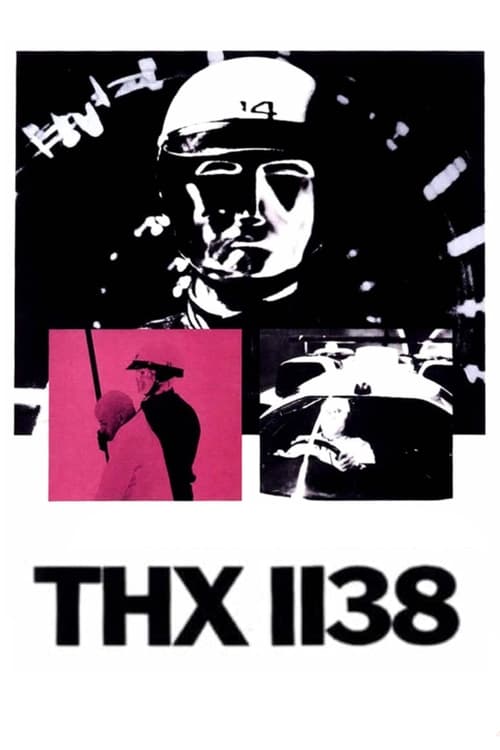
THX 1138
THX 1138 Is About Escaping a Prison That Has No Walls, Only a Budget
Directed by George Lucas
The police stop chasing THX not because they cannot catch him, but because the pursuit exceeds its allotted cost. Freedom arrives as a line item.
George Lucas's first feature is a white void inhabited by drugged, shaven, identically named humans who live underground, work in radiation-laden factories, confess to a mechanical Jesus called OMM, and consume state-mandated sedatives that suppress all feeling. THX 1138 stops taking his drugs, falls in love with his roommate LUH, is arrested for the crime of emotion, and eventually flees toward the surface. The film is usually filed as a dystopia in the register of Orwell and Huxley. That reading misses its most radical stroke. This society does not imprison THX with walls. It imprisons him with sedation, with consumption, with a religion that absorbs his despair, and finally, when he runs, it releases him not out of mercy but because the android police calculate that recapturing him would go over budget. The prison has no bars. It has an accounting department.
Gnostic Reading: The Pneumatic Who Wakes From the Drug of the World
Gnosticism describes the human condition as sleep: the divine spark drugged into forgetfulness, lulled by the material world, needing to be woken to remember what it is. THX 1138 literalizes the drug. The population is chemically maintained in a state of flattened contentment, and the first act of gnosis in the film is refusal: LUH secretly reduces THX's medication, and feeling floods back into a body that had been anesthetized against its own life. Awakening here is not enlightenment as bliss. It is the return of pain, fear, and love all at once, which is exactly how the Gnostic waking is described.
The confession booth is the film's sharpest theological image. THX kneels before a glowing portrait of a haloed Christ and speaks his troubles, and a soothing recorded voice answers "yes, yes, I understand, let us be thankful we have commerce, buy more, buy more now." The religion is a component of the machine, a sedative wearing the face of the sacred, an archon impersonating God to keep the spark asleep. When THX finally climbs the ladder out of the underground city and emerges into the blinding red light of an actual sunset, silhouetted against a sky he has never seen, the Gnostic image is complete: the pneumatic ascends out of the false world into the real one, alone, with nothing but the fact of being awake.
Buddhist Reading: The Sedated Self and the Suffering That Frees
Buddhism holds that craving and aversion are managed by most beings through distraction, and that awakening begins precisely when the numbing fails and suffering is felt clearly. The state in THX's world runs on the opposite principle: consume the sedative, feel nothing, remain. The mandatory drug is a technology for keeping dukkha, the fundamental unsatisfactoriness of existence, permanently out of view. As long as no one feels the ache of their condition, no one seeks a way out.
THX's liberation begins the moment the numbness ends and the ache arrives. His grief when LUH is taken, his terror in the white limbo of the detention void where prisoners simply sit because there is nowhere to go, his desperation in the flight upward, are the raw material of an awakening. The white prison is the film's most Buddhist frame: an endless featureless space with no walls, and the prisoners do not leave because they cannot conceive that leaving is possible. The door was always open. What kept them was the belief that there was nothing beyond the emptiness, and the drug that kept them from wanting to find out.
Other awakenings out of an engineered sleep: Logan's Run (the sealed city and the run for the surface), Fahrenheit 451 (the sedated wife and the man who starts to feel), Brazil (bureaucracy as the machinery of unfreedom).
Questions this film answers
What is the deeper meaning of THX 1138?
George Lucas's first feature is a white void inhabited by drugged, shaven, identically named humans who live underground, work in radiation-laden factories, confess to a mechanical Jesus called OMM, and consume state-mandated sedatives that suppress all feeling. THX 1138 stops taking his drugs, falls in love with his roommate LUH, is arrested for the crime of emotion, and eventually flees toward the surface. The film is usually filed as a dystopia in the register of Orwell and Huxley. That reading misses its most radical stroke. This society does not imprison THX with walls. It imprisons him with sedation, with consumption, with a religion that absorbs his despair, and finally, when he runs, it releases him not out of mercy but because the android police calculate that recapturing him would go over budget. The prison has no bars. It has an accounting department.
What is the hidden symbolism in THX 1138?
Gnosticism describes the human condition as sleep: the divine spark drugged into forgetfulness, lulled by the material world, needing to be woken to remember what it is. THX 1138 literalizes the drug. The population is chemically maintained in a state of flattened contentment, and the first act of gnosis in the film is refusal: LUH secretly reduces THX's medication, and feeling floods back into a body that had been anesthetized against its own life. Awakening here is not enlightenment as bliss. It is the return of pain, fear, and love all at once, which is exactly how the Gnostic waking is described.
What esoteric traditions appear in THX 1138?
THX 1138 draws from Gnosticism, Buddhism traditions. The police stop chasing THX not because they cannot catch him, but because the pursuit exceeds its allotted cost. Freedom arrives as a line item.
Is THX 1138 worth watching for spiritual seekers?
THX 1138 (1971) directed by George Lucas is essential viewing for those interested in Gnosticism, Buddhism. THX 1138 Is About Escaping a Prison That Has No Walls, Only a Budget. It rewards multiple viewings and contemplation.
Rewatch With New Eyes
Now that you've seen the architecture, experience it again. The same film becomes a different film when you know what to watch for.
This time, watch for:
- Watch for the false world vs. the real — who is asleep, who awakens
- See impermanence: what clings, what releases, what remains
Links may include affiliate partnerships that support Media Revelations