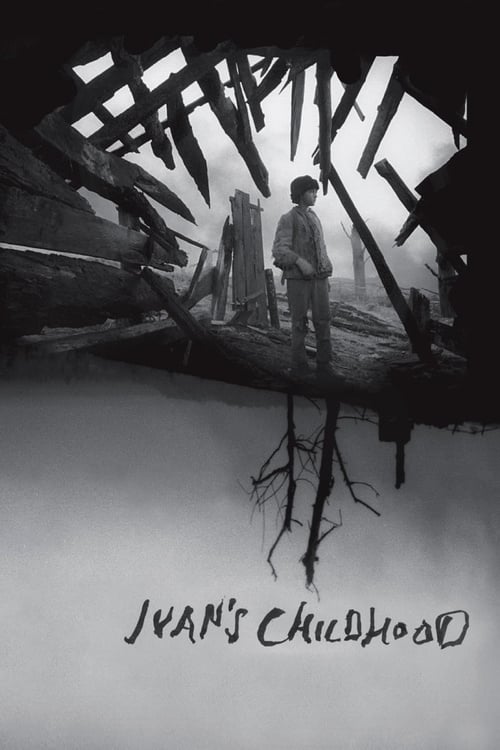
Ivan's Childhood
Ivan's Dreams Are the Real World. The War Is What Trapped Him Here.
Directed by Andrei Tarkovsky
Tarkovsky's first film is a Gnostic document: the waking world is the prison, and the divine leaks through only in sleep.
Every frame of Ivan's waking life is grey, angular, wet. The trenches. The German-occupied shore. The bureaucratic rear lines where grown men argue over a twelve-year-old's next mission. Tarkovsky bathes these scenes in the particular cold of the Eastern Front, and they are real in the way dead things are real. The dreams are different. Ivan's mother stands in sunlight while rain falls on them both. Apples float past. A girl laughs in the back of an army truck loaded with birch trees. Ivan runs on a beach that exists in no wartime. The film's architecture is not a war film with dreams inserted for pathos. It is a Gnostic text in which the dream-world is the only true one, and everything Ivan suffers in waking life is his imprisonment inside a false creation.
Gnosticism: The War-World Is the Archon's Domain
Gnostic cosmology holds that the material world is not God's creation but the Demiurge's. A lesser god built this realm of suffering and named it real. The pneumatic human being carries a spark of genuine divinity inside a body trapped in the Demiurge's kingdom. Gnosis, direct knowing of origin, arrives as flashes that break through the material world's authority.
Ivan's dreams are gnosis made visible. Each sequence returns him to the world before the war, before the Germans murdered his mother and sister, before history closed over him. The opening dream is the film's theological statement: Ivan runs toward his mother at a well, light everywhere, apples in the water, and then a single cut drops him into the trench, wet and awake, and you understand that the cut is not a transition from dream to reality but from reality to prison. Tarkovsky holds the two worlds at equal length to make sure the viewer feels the inversion. The final image of the film confirms it. After a single sentence of documentary text informs us Ivan was captured and executed, Tarkovsky returns to the beach of the opening dream. Ivan runs toward the black dead tree at the water's edge, turns, laughs, and the frame freezes. The material world ended him. The real world did not.
Shamanism: The Boy Already Crossed the Only Line That Matters
There is a scene where Captain Kholin and Lieutenant Galtsev try to talk Ivan out of returning behind German lines. They argue in the way men argue when they already know they have lost the argument. Ivan sits and listens and then simply states that he is going. They let him go.
In shamanic traditions, the initiation that makes a shaman is not an accomplishment but a death-event. The shaman-to-be survives a catastrophic illness or loss, crosses into the death realm, and returns bearing knowledge that ordinary people cannot access. The price is that the shaman never fully returns. He operates between worlds permanently, belonging to neither. His power in the death realm comes precisely from being half-dead already.
Ivan's mother and sister were killed in front of him. He did not grieve and recover. He crossed over and stayed at the threshold. He can penetrate German lines alone, in the dark, where trained soldiers cannot follow, because he is already operating in the territory of the dead. Kholin and Galtsev sense this without naming it. Their protectiveness is helpless because they are trying to guard something that has already passed beyond their jurisdiction. The scouts who wait for Ivan are waiting for a message from across a border they cannot cross themselves.
Ivan's Childhood belongs beside Andrei Rublev as the other half of Tarkovsky's meditation on the soul that holds in the middle of historical catastrophe, beside Mirror for the way memory and dream bleed through the waking world until the boundaries dissolve, and beside Grave of the Fireflies as cinema's other great argument that the war-world destroys exactly what it cannot replace.
Questions this film answers
What is the deeper meaning of Ivan's Childhood?
Every frame of Ivan's waking life is grey, angular, wet. The trenches. The German-occupied shore. The bureaucratic rear lines where grown men argue over a twelve-year-old's next mission. Tarkovsky bathes these scenes in the particular cold of the Eastern Front, and they are real in the way dead things are real. The dreams are different. Ivan's mother stands in sunlight while rain falls on them both. Apples float past. A girl laughs in the back of an army truck loaded with birch trees. Ivan runs on a beach that exists in no wartime. The film's architecture is not a war film with dreams inserted for pathos. It is a Gnostic text in which the dream-world is the only true one, and everything Ivan suffers in waking life is his imprisonment inside a false creation.
What is the hidden symbolism in Ivan's Childhood?
Gnostic cosmology holds that the material world is not God's creation but the Demiurge's. A lesser god built this realm of suffering and named it real. The pneumatic human being carries a spark of genuine divinity inside a body trapped in the Demiurge's kingdom. Gnosis, direct knowing of origin, arrives as flashes that break through the material world's authority.
What esoteric traditions appear in Ivan's Childhood?
Ivan's Childhood draws from Gnosticism, Shamanism traditions. Tarkovsky's first film is a Gnostic document: the waking world is the prison, and the divine leaks through only in sleep.
Is Ivan's Childhood worth watching for spiritual seekers?
Ivan's Childhood (1962) directed by Andrei Tarkovsky is essential viewing for those interested in Gnosticism, Shamanism. Ivan's Dreams Are the Real World. The War Is What Trapped Him Here.. It rewards multiple viewings and contemplation.
Rewatch With New Eyes
Now that you've seen the architecture, experience it again. The same film becomes a different film when you know what to watch for.
This time, watch for:
- Watch for the false world vs. the real — who is asleep, who awakens
- Follow the descent: what dies, what guides, what returns transformed
Links may include affiliate partnerships that support Media Revelations