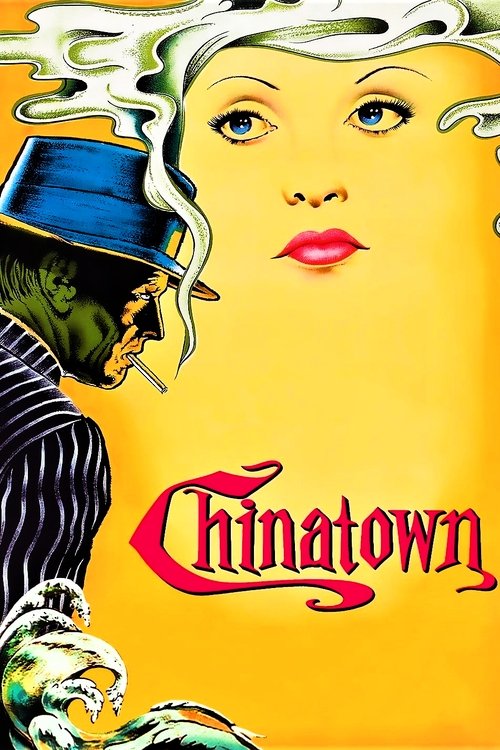
Forget it, Jake. It's Chinatown. The most famous last line in noir is not cynicism — it is diagnosis. Some systems are so total that exposing them changes nothing. Noah Cross rapes his daughter, kills her husband, steals the water, takes the child. He wins. That is the point.
Chinatown is the definitive American film about power — not its abuse, but its nature. Noah Cross does not merely do terrible things. He is the structure that makes terrible things possible and unpunishable. He raped his daughter. She bore his child. He murdered her husband. He stole the water that would build Los Angeles. At the end of the film, he takes the granddaughter-daughter and walks away. Nothing can touch him. This is not a failure of justice. This is a revelation about where justice ends and power begins. Jake Gittes, the detective who uncovers everything, accomplishes nothing. His investigation does not save anyone. His knowledge does not create change. The final line — 'Forget it, Jake. It's Chinatown' — is not resignation. It is the recognition that some domains are beyond rescue. Polanski knew what he was making. A man who escapes consequences made a film about a man who escapes consequences. The film is not commentary. It is confession and cosmology in one.
The Surface
Jake Gittes is a private investigator in 1937 Los Angeles who specializes in 'matrimonial work' — catching cheating spouses. He is hired by a woman claiming to be Evelyn Mulwray to investigate her husband, the city's water commissioner. Gittes tails Mulwray, photographs him with a young woman, and the photos end up in the papers.
Then the real Evelyn Mulwray appears. She did not hire him. Someone set him up to discredit her husband. Days later, Hollis Mulwray is found dead, drowned in a dry riverbed. Gittes begins to investigate what is actually happening: a massive conspiracy to steal water from the Owens Valley, dry out farms, buy the land cheap, and then bring the water back to make fortunes.
Behind everything is Noah Cross, Evelyn's father, former partner of Mulwray, and the richest man in Los Angeles. The conspiracy is bad enough. Then Gittes discovers what Cross did to his own daughter. And then discovers that the system is arranged so that none of this matters.
Noah Cross as Archon
In Gnostic cosmology, the material world is ruled by Archons — beings who did not create reality but who administer it for their own purposes. They are not outside the system. They are the system. Fighting them within the domain they control is impossible because the rules themselves serve them.
Noah Cross is an Archon made visible. He owns the water. In Los Angeles, water is life itself — without it, the desert reclaims everything. To own the water is to own the future of the city. Every development, every farm, every family's ability to live depends on decisions Cross controls.
When Gittes confronts Cross about why he would want more money when he already has millions, Cross replies: 'The future, Mr. Gittes. The future.' This is not greed. It is the Archonic drive to own not just resources but possibility itself. Cross does not want money. He wants to determine what can exist.
The water conspiracy is the visible crime. The invisible crime — what Cross did to Evelyn — is the same will expressed in the family. He takes what he wants. He creates what he wants. The child is his daughter and his granddaughter. He owns her twice over.
Evelyn and the Wound
Faye Dunaway's Evelyn Mulwray is not a femme fatale. She is a woman trying to protect her daughter from the man who fathered her through rape. Every evasion, every lie, every strange behavior Gittes interprets as guilt is actually protection.
The famous slapping scene — where Gittes hits Evelyn repeatedly demanding the truth about the girl — ends with her confession: 'She's my sister. She's my daughter. My sister. My daughter.' The truth is both. The truth is the crime that produced her.
Evelyn has spent her life managing the aftermath of what her father did. She cannot expose him — he is too powerful. She cannot escape him — he is everywhere. She can only try to keep Katherine away from him. This is her entire purpose. It is the one thing she cannot accomplish.
Polanski shoots Evelyn as someone perpetually trapped. Frames within frames. Doorways. Windows. She is always seen through something, contained by architecture. Her freedom is illusory. The house she lives in was built by her father's money. There is nowhere that is not his.
Gittes and the Failure of Knowledge
Jake Gittes is competent. He pieces together the water conspiracy. He identifies the shell corporations buying land. He discovers the murder. He learns the truth about Evelyn and Katherine. He knows everything.
It saves no one. This is the film's most devastating insight. In detective fiction, knowledge is power — the revelation unmasks the villain and restores order. Chinatown inverts this. Gittes's investigation leads him to the truth, and the truth leads him to watch Evelyn shot through the head while Cross walks away with the girl.
The Gnostic problem is precisely this: gnosis — saving knowledge — is supposed to liberate. But what if the Archons have structured reality so that knowledge cannot translate into action? What if the revelation changes nothing because the system has no mechanism for processing truth?
Gittes's last case before Chinatown was in Chinatown itself. Something happened there that he will not discuss. 'I was trying to help someone. I ended up making sure she got hurt.' He learned this lesson before. He forgot it. The film forces him to learn it again.
The Title and the Territory
Chinatown appears only in the final scene. The entire film has been building toward a place that is finally named and located. Gittes has arranged for Evelyn to meet him there before escaping to Mexico with Katherine.
The police arrive. Cross arrives. Gittes is handcuffed. He shouts the truth — that Cross is the murderer, the rapist, the conspirator — and no one acts on it. Evelyn tries to drive away. The police shoot. She dies. Cross takes Katherine's hand. Everyone tells Gittes to walk away.
Chinatown is not just a location. It is a condition. A domain where the normal rules do not apply. Where outcomes cannot be predicted. Where trying to help makes things worse. The title names the entire film's world, not just the final street.
'Forget it, Jake. It's Chinatown.' Forget the case. Forget the truth. Forget justice. You are in a territory where those concepts have no purchase. You do not understand the rules here. You never will.
The Transmission
Chinatown was released in 1974 — the year Nixon resigned, the year the system appeared to be working, the year a president was held accountable. The film's release into that moment was precise: a reminder that accountability is the exception, not the rule. Most Noah Crosses win.
Polanski made this film knowing what he knew about himself and the world. The following year he would flee America to escape prosecution for his own crimes. The man who made a film about untouchable power would demonstrate it in his own life.
This does not invalidate the film. It deepens it. Chinatown is not a critique from outside the system. It is a confession from inside it. Polanski understood Cross because he was Cross — or aspired to be. The diagnosis is accurate because it comes from the disease.
The transmission is bleak but specific: some systems are not broken. They are working exactly as designed. The water flows where power directs it. The children go where power takes them. Knowledge accumulates in the hands of people who cannot use it. Forget it, Jake. It's Chinatown.
Questions this film answers
What is the deeper meaning of Chinatown?
Chinatown is the definitive American film about power — not its abuse, but its nature. Noah Cross does not merely do terrible things. He is the structure that makes terrible things possible and unpunishable. He raped his daughter. She bore his child. He murdered her husband. He stole the water that would build Los Angeles. At the end of the film, he takes the granddaughter-daughter and walks away. Nothing can touch him. This is not a failure of justice. This is a revelation about where justice ends and power begins. Jake Gittes, the detective who uncovers everything, accomplishes nothing. His investigation does not save anyone. His knowledge does not create change. The final line — 'Forget it, Jake. It's Chinatown' — is not resignation. It is the recognition that some domains are beyond rescue. Polanski knew what he was making. A man who escapes consequences made a film about a man who escapes consequences. The film is not commentary. It is confession and cosmology in one.
What is the hidden symbolism in Chinatown?
Jake Gittes is a private investigator in 1937 Los Angeles who specializes in 'matrimonial work' — catching cheating spouses. He is hired by a woman claiming to be Evelyn Mulwray to investigate her husband, the city's water commissioner. Gittes tails Mulwray, photographs him with a young woman, and the photos end up in the papers.
What esoteric traditions appear in Chinatown?
Chinatown draws from Gnosticism traditions. Forget it, Jake. It's Chinatown. The most famous last line in noir is not cynicism — it is diagnosis. Some systems are so total that exposing them changes nothing. Noah Cross rapes his daughter, kills her husband, steals the water, takes the child. He wins. That is the point.
What does Chinatown teach about noah cross as archon?
Cross does not want money. He wants to determine what can exist. In Gnostic cosmology, the material world is ruled by Archons — beings who did not create reality but who administer it for their own purposes. They are not outside the system. They are the system. Fighting them within the domain they control is impossible because the rules themselves serve them.
Is Chinatown worth watching for spiritual seekers?
Chinatown (1974) directed by Roman Polanski is essential viewing for those interested in Gnosticism, Archons, Corruption. The Archon Who Owns the Water. It rewards multiple viewings and contemplation.
Rewatch With New Eyes
Now that you've seen the architecture, experience it again. The same film becomes a different film when you know what to watch for.
This time, watch for:
- Watch for the false world vs. the real — who is asleep, who awakens
Links may include affiliate partnerships that support Media Revelations
The Descent Continues
Where this thread leads next.
The Ninth Gate 1999
The Book Collector Who Became the Collected
Read the revelation →