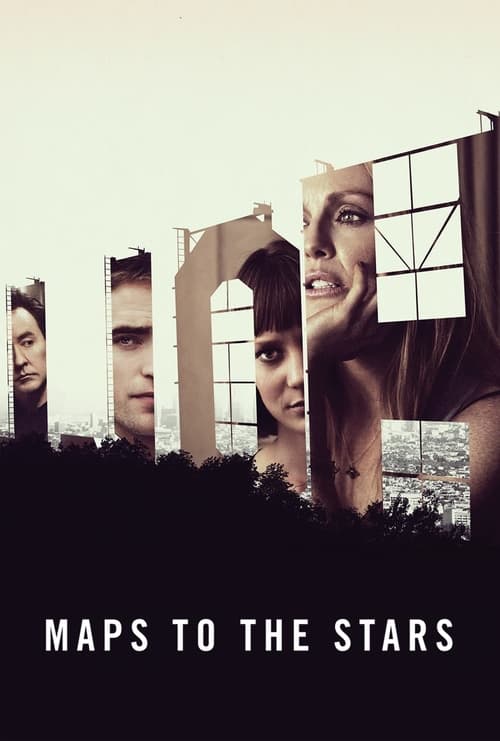
Maps to the Stars
Maps to the Stars Is Hollywood as a Haunted House Nobody Will Admit Is Burning
Directed by David Cronenberg
Cronenberg's ghosts recite poetry and no one hears them. The whole industry is a family refusing to bury its dead.
Everyone in this film is haunted, literally, and everyone treats it as a symptom to be medicated. Havana Segrand, an aging actress, is stalked by the ghost of her abusive movie-star mother whose role she now wants to play. The child star Benjie is visited by a dead girl. Agatha, the burned daughter exiled from the incestuous marriage that produced her, returns to a family determined to pretend she never existed. Paul Éluard's poem "Liberté" runs through the film like a spell nobody understands, spoken by the very ghosts everyone ignores. This is not a satire of Hollywood vanity. It is a portrait of a civilization that has lost every ritual for tending the dead, so the dead never leave, and the living perform wellness while the house they share quietly fills with fire.
Jungian Reading: The Return of the Repressed as Literal Ghost
Jung insisted that what a family will not consciously face descends into the unconscious and returns autonomously, often across generations, as the ancestor who will not rest. The Weiss family is a machine for repression. The parents are secretly brother and sister, the incest hidden beneath a New Age therapy empire, and their entire fortune is built on selling other people techniques for the very self-knowledge they cannot survive applying to themselves. The ghosts are the repressed made visible, the unlived, unmourned truth demanding acknowledgment.
Agatha is the returning shadow of the whole system, the child who carries the family's original sin on her scarred skin. She comes back not to destroy them but to be seen, and their refusal to see her is what turns her into the agent of their ruin. The murders that end the film are not random madness. They are the psyche's correction, the repressed content forcing its way to the surface with lethal pressure because every gentler door was bolted shut. When you will not integrate the shadow, Jung warned, it arrives as fate. Here it arrives with a candelabra and a match.
Gnostic Reading: A Demiurge World Where the Sacred Is Sold Back as Product
The Gnostics called this world the counterfeit kingdom, a realm run by a false god who mistakes his own creation for the whole of reality and keeps souls entranced by images. Cronenberg's Hollywood is that counterfeit kingdom rendered with clinical precision. It is a place where the deepest human material, grief, love, the longing for liberation, has been strip-mined and resold as therapy sessions, as film roles, as the self-help patter Dr. Weiss dispenses on television. The sacred is not absent. It has been captured and monetized, which is worse.
The children are the pneumatic sparks trapped in this system, and they are being consumed by it. Benjie, barely a teenager, is already an addict and a killer, formed entirely by the machine. Agatha, the burned one, is the Gnostic figure of the wounded knower, the one whose scars are the mark of having touched a truth the smooth people cannot bear. Éluard's poem is the call to freedom that the archon-world drowns out with its noise. Her fire at the end is a terrible gnosis, the burning away of the counterfeit, an escape available only through the immolation of the whole false structure. There is no gentle exit from the demiurge's set.
Questions this film answers
What is the deeper meaning of Maps to the Stars?
Everyone in this film is haunted, literally, and everyone treats it as a symptom to be medicated. Havana Segrand, an aging actress, is stalked by the ghost of her abusive movie-star mother whose role she now wants to play. The child star Benjie is visited by a dead girl. Agatha, the burned daughter exiled from the incestuous marriage that produced her, returns to a family determined to pretend she never existed. Paul Éluard's poem "Liberté" runs through the film like a spell nobody understands, spoken by the very ghosts everyone ignores. This is not a satire of Hollywood vanity. It is a portrait of a civilization that has lost every ritual for tending the dead, so the dead never leave, and the living perform wellness while the house they share quietly fills with fire.
What is the hidden symbolism in Maps to the Stars?
Jung insisted that what a family will not consciously face descends into the unconscious and returns autonomously, often across generations, as the ancestor who will not rest. The Weiss family is a machine for repression. The parents are secretly brother and sister, the incest hidden beneath a New Age therapy empire, and their entire fortune is built on selling other people techniques for the very self-knowledge they cannot survive applying to themselves. The ghosts are the repressed made visible, the unlived, unmourned truth demanding acknowledgment.
What esoteric traditions appear in Maps to the Stars?
Maps to the Stars draws from Jungian, Gnosticism traditions. Cronenberg's ghosts recite poetry and no one hears them. The whole industry is a family refusing to bury its dead.
Is Maps to the Stars worth watching for spiritual seekers?
Maps to the Stars (2014) directed by David Cronenberg is essential viewing for those interested in Jungian, Gnosticism. Maps to the Stars Is Hollywood as a Haunted House Nobody Will Admit Is Burning. It rewards multiple viewings and contemplation.
Rewatch With New Eyes
Now that you've seen the architecture, experience it again. The same film becomes a different film when you know what to watch for.
This time, watch for:
- Meet the shadow: what is rejected, projected, and finally integrated
- Watch for the false world vs. the real — who is asleep, who awakens
Links may include affiliate partnerships that support Media Revelations
The Descent Continues
Where this thread leads next.
Mulholland Drive 2001
The Blue Key and the Dissolution of Identity
Read the revelation →