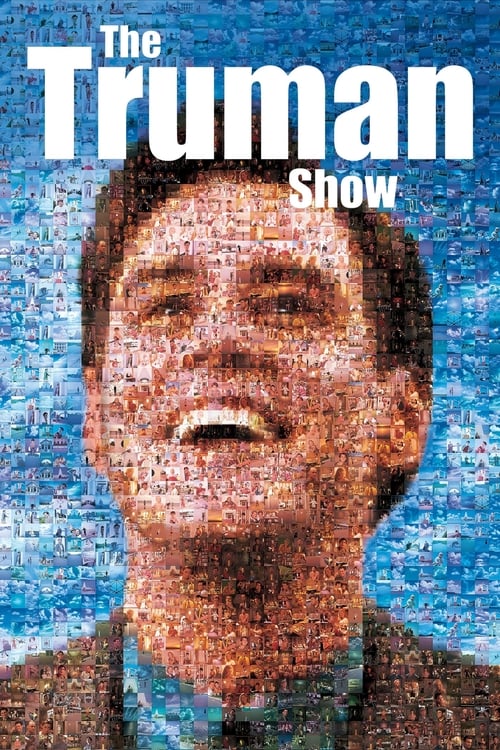
The Truman Show is the cleanest Gnostic parable in mainstream Hollywood. Released a year before The Matrix and with a fraction of the philosophical posturing, it tells the same story with more precision: a soul is born into a manufactured world ruled by a creator who calls himself father, who claims to love the creation, and who cannot bear for that creation to choose freely. Christof is the Demiurge. Seahaven is the Pleroma's parody. Truman is the pneumatic — the one who senses something is wrong before he knows what wrong looks like. And the exit through the painted sky is the most accurate depiction of gnosis on film: choosing to walk into the unknown over a comfortable simulation that has already named all your relationships.
The Surface
Truman Burbank is the unwitting star of a 24-hour reality television program that has been broadcasting his life since before he was born. His town is a soundstage. His wife is an actress. His best friend's lines are fed through an earpiece. Cracks in the production cause him to suspect, then investigate, then attempt to escape.
The film's premise sounds dated now — a reality TV satire from before reality TV had fully arrived. This reading misses what Weir and screenwriter Andrew Niccol actually built. The television apparatus is the surface concern. The real subject is the structure of any consensual reality in which we are unwittingly enrolled, and the price of awakening from it.
The Truman Show is not a film about television. It is a film about whether you can wake up from a world that everyone around you is paid to maintain, and what becomes of the relationships you formed inside that world once you have.
Christof as Demiurge
Christof's name is one letter from Christ. He believes himself to be Truman's father, his protector, his benefactor. He genuinely loves him. He has also imprisoned him for life and dispatched lightning, storms, and drowning to keep him from leaving. This is the Demiurge precisely — not a demon, not a villain in the Hollywood sense, but a being whose love is indistinguishable from control because he cannot conceive of love existing outside the world he constructed.
Christof's most chilling line is sincere: 'There's no more truth out there than there is in the world I created for you.' He believes this. He is not lying to Truman. He is lying to himself first, and then offering Truman the same comfort. The Demiurge cannot acknowledge the Pleroma above him because acknowledging it would dethrone him. So he denies its existence and calls the denial mercy.
Christof in his moon control room is the most theologically accurate cinematic image of the Demiurge ever made. He watches his creation eat, sleep, walk, suffer. He scripts the weather. He kills off the father figure when narrative requires it. He is in every sense god of his world — and the camera makes clear that his world is a bubble inside a much larger reality he refuses to let his creation perceive.
Truman as Pneumatic Soul
The pneumatic, in Gnostic teaching, is the soul that carries a divine spark — the one in whom the longing for the true home has not been fully extinguished. The pneumatic does not know there is a true home. They only know that this one feels wrong. The wrongness leaks through in small failures of the script: a stage light falling from the sky, a radio frequency that broadcasts the camera crew's instructions, a face he saw on the street that he should not have seen.
Truman's gnosis arrives in stages. First as suspicion. Then as testing — he changes routines to see what the world will do. Then as confirmation. By the time he steps onto the boat, he already knows. The storm Christof sends is not a deterrent. It is the final test of whether Truman would rather drown than continue the comfortable lie.
When the bow of the boat hits the wall of the dome — when he touches the painted sky with his hand — Truman has the experience every mystic has tried to describe. The world is not what it appeared to be. It has an edge. And on the other side is something the entire structure he was raised inside was designed to make him forget existed.
He smiles. That smile is gnosis. It is the moment after which nothing can ever be put back.
The Archons Work for Free
In Gnostic cosmology the Demiurge does not run the prison alone. Beneath him are the Archons — the rulers who keep the sleeper asleep. Seahaven's Archons do not wear armor. They wear cardigans, wedding rings, and a six-pack of beer on an unfinished bridge.
The crucial correction to the usual reading: the people around Truman are not simply lying to him. They are keeping him organized inside the lie. His wife never says 'don't leave.' She says 'you need rest, you're not yourself, we have a great life, why would you want something else?' Control that arrives as concern is harder to refuse than any wall, because you cannot fight it without becoming the villain of your own life.
Watch Marlon on the bridge: 'the last thing I'd ever do is lie to you' — and the film cuts to Christof feeding him that exact sentence through an earpiece a half-second before he says it. The most intimate line in Truman's thirty years is read off a script. Yet the Archon does not always know he is one. Marlon may mean it, in the thin space between the words he is given. That is what makes the layer so total: it needs no conscious conspirators, only people protecting the idea that their own lives were not wasted.
A prison guarded by monsters produces a riot. A prison guarded by people who love you produces confusion, and confusion always buys the one thing the operation needs: time. The single line separating Seahaven from your own street is the paycheck. In Seahaven the guards clock in. Out here we perform the town for free, and we learned the script so young that we mistake it for who we are.
Why the Star Goes Back in the Sky
The film's true subject is not the escape. It is the image Weir opens and closes on: a studio light falls from the sky, labeled Sirius — the brightest star in Truman's heaven — and lands on the pavement with a part number on it. He holds physical proof that his sky is manufactured. The car radio explains it away as aircraft debris before the question can finish forming, and he drives to work. The horror of The Truman Show is not the dome. It is the speed at which a man hands the evidence of a false world back and rejoins the day.
So why does the proof never wake him? Truman accumulates evidence for years — the falling light, the radio frequency narrating his own movements, the elevator that opens onto a backstage that cannot exist, the rain that falls only on him. The line that defeats all of it is Marlon's: 'everybody would have to be in on it.' It does not refute a single piece of evidence. It sets the price. To trust his own eyes, Truman must accept that his wife, his mother, his best friend, and the entire town were staged — too much betrayal for one mind to purchase at once. So he accepts the smaller, kinder story instead.
This is the mechanism the Gnostics named and modern psychology re-derived. Leon Festinger embedded in a doomsday cult and watched the flood-date pass; most members did not collapse — they recruited harder. The more a belief has cost you, the more disproof cements it. Truth never arrives as neutral information. It arrives as an unpaid bill, and the mind looks at the price and flinches. This is why handing someone the truth so often makes them grip the lie tighter — and why the film insists that gnosis is not being told. Truman does not believe his way out. He sits in the car, predicts every vehicle on the looping street in order, and checks his way out. Direct knowing, not information. That is the whole difference between waking and being argued at.
The Staircase and the Door
The staircase up the inside of the dome is one of the most important images in late-twentieth-century cinema. Truman climbs out of his own ocean onto the painted wall of his own sky and walks toward a door. The door is small. It is painted to look like nothing. Christof's voice booms from above, naming him, knowing him better than he knows himself, offering him fame, safety, the only family he has ever had.
This is the threshold guardian speaking. Every initiation has this moment. The voice that knows your real name and your real wounds is also the voice that wants you to stay. The familiar wound is more bearable than the unknown freedom. Most candidates turn around at this point. Most lives are governed by which voice we listened to at the door.
Truman bows, says 'in case I don't see ya, good afternoon, good evening, and good night,' and walks through. The line is the one he has said every morning of his constructed life. Said at this threshold, it becomes farewell to the persona that performed it. He is leaving Truman Burbank as a kind of clothing.
The film ends there. Weir does not show what is on the other side of the door because what is on the other side is unscripted. The whole point is that no camera goes through that door. Including the one we are watching with.
The Transmission
The Truman Show is a film about you. Not metaphorically. The structure it depicts is the structure of any consensus reality you happen to be embedded in — the job, the relationship, the worldview, the city, the country, the version of yourself you have been performing so consistently that even you have forgotten it is performance.
Weir built a delivery mechanism. The comedy and the production-satire and Jim Carrey's open earnest face are the wrapping. Inside the wrapping is the question that does not leave: where is your dome wall? What painted sky are you walking past every day without noticing? Whose voice would call your name from above if you ever started climbing the staircase?
Christof's final confession is the business model in one sentence: 'You were real. That's what made you so good to watch.' The only thing inside the dome no budget could manufacture was Truman's authenticity — and that is precisely what the show farmed. They never exploited his labor. They harvested the one thing that cannot be faked.
The film's final shot is two parking-lot guards, who have been watching obsessively for years, looking at each other and asking 'what else is on?' This is the diagnosis. The viewer who watched Truman escape his prison is, in the next moment, looking for another show. The dome is portable. Most people never leave it because most people never notice they are inside it. Truman did. The film hands you the same noticing.
Questions this film answers
What is the deeper meaning of The Truman Show?
The Truman Show is the cleanest Gnostic parable in mainstream Hollywood. Released a year before The Matrix and with a fraction of the philosophical posturing, it tells the same story with more precision: a soul is born into a manufactured world ruled by a creator who calls himself father, who claims to love the creation, and who cannot bear for that creation to choose freely. Christof is the Demiurge. Seahaven is the Pleroma's parody. Truman is the pneumatic — the one who senses something is wrong before he knows what wrong looks like. And the exit through the painted sky is the most accurate depiction of gnosis on film: choosing to walk into the unknown over a comfortable simulation that has already named all your relationships.
What is the hidden symbolism in The Truman Show?
Truman Burbank is the unwitting star of a 24-hour reality television program that has been broadcasting his life since before he was born. His town is a soundstage. His wife is an actress. His best friend's lines are fed through an earpiece. Cracks in the production cause him to suspect, then investigate, then attempt to escape.
What esoteric traditions appear in The Truman Show?
The Truman Show draws from Gnosticism, Initiation traditions. Christof is the Demiurge who loves his creation but cannot let it be free. Truman's entire world is manufactured consent. The exit through the painted sky is gnosis — choosing the unknown over the comfortable illusion.
What does The Truman Show teach about christof as demiurge?
Christof is not lying to Truman. He is lying to himself first, and then offering Truman the same comfort. Christof's name is one letter from Christ. He believes himself to be Truman's father, his protector, his benefactor. He genuinely loves him. He has also imprisoned him for life and dispatched lightning, storms, and drowning to keep him from leaving. This is the Demiurge precisely — not a demon, not a villain in the Hollywood sense, but a being whose love is indistinguishable from control because he cannot conceive of love existing outside the world he constructed.
What does The Truman Show teach about truman as pneumatic soul?
When the bow of the boat hits the wall of the dome, Truman has the experience every mystic has tried to describe. The world has an edge. The pneumatic, in Gnostic teaching, is the soul that carries a divine spark — the one in whom the longing for the true home has not been fully extinguished. The pneumatic does not know there is a true home. They only know that this one feels wrong. The wrongness leaks through in small failures of the script: a stage light falling from the sky, a radio frequency that broadcasts the camera crew's instructions, a face he saw on the street that he should not have seen.
What does The Truman Show teach about the archons work for free?
A prison guarded by monsters produces a riot. A prison guarded by people who love you produces confusion. In Gnostic cosmology the Demiurge does not run the prison alone. Beneath him are the Archons — the rulers who keep the sleeper asleep. Seahaven's Archons do not wear armor. They wear cardigans, wedding rings, and a six-pack of beer on an unfinished bridge.
Rewatch With New Eyes
Now that you've seen the architecture, experience it again. The same film becomes a different film when you know what to watch for.
This time, watch for:
- Watch for the false world vs. the real — who is asleep, who awakens
- Mark the threshold: the old self dies, the ordeal transforms, the new self returns
Links may include affiliate partnerships that support Media Revelations