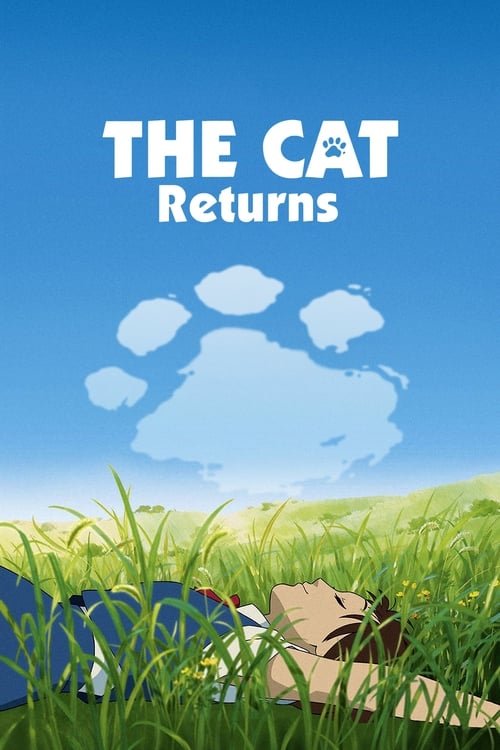
The Cat Returns
The Cat Returns Is About What Happens When You Say Yes to Everyone Until You Disappear
Directed by Hiroyuki Morita
A girl with no spine of her own gets rescued into a kingdom that will marry her off out of gratitude. The threat is not the cats. The threat is her own inability to refuse.
Haru saves a cat from traffic and the Cat Kingdom decides to reward her by marrying her to the Prince, whether she wants it or not. As she is dragged toward the palace she begins to sprout whiskers, paws, fur. She is turning into a cat. The surface reading is a light Ghibli lark, a spin-off charm about a talking Baron and a fat cat named Muta. The film underneath is unusually sharp about a specific failure. Haru's transformation is not a curse cast on her from outside. It is the visible form of her defining trait, established in the opening minutes: she cannot say no. She agrees to things to avoid friction, she lets other people decide who she is, and the Cat Kingdom is simply a world that takes her passivity to its logical end. Stay long enough in a place that decides everything for you, and you become the thing it wants.
Initiatory Reading: The Descent That Punishes the Undefined Self
Every initiation begins with a descent into another world, and the descent tests one thing: does the initiate have a self solid enough to return with. Haru's journey into the Cat Kingdom is a textbook underworld passage, entered through a hidden portal, governed by different laws, escapable only before dawn. But the classic initiatory danger appears in its purest form here. The longer she stays, the more she forgets who she was and the more feline she becomes.
This is the underworld's oldest rule, the one Persephone learned. Do not eat the food, do not accept the gifts, do not let the other world make its claim on you. The Cat Kingdom offers Haru endless catnip, endless ease, a life where nothing is required. The Baron's line is the whole teaching: she must believe in herself, because the kingdom can only hold someone who has not decided to leave. Her transformation reverses the instant she chooses her own way out. The initiation was never about escaping cats. It was about acquiring the one thing she arrived without, which is a will of her own.
Jungian Reading: The Baron as Animus, the Refusal as Individuation
Baron Humbert is not a love interest in the ordinary sense. He is Haru's animus, the inner masculine principle Jung described as the carrier of decisiveness, focus, and the capacity to stand for something. He is a figurine who comes alive precisely when Haru needs the qualities she has never developed, and he embodies exactly what she lacks: elegance under pressure, refusal without cruelty, a self that does not bend.
Notice that the Baron never rescues Haru by removing the danger. He accompanies her through it and insists she act. This is individuation rendered as adventure. The passive girl integrates the inner figure of agency, and by the film's end she can decline what she does not want without apology. The Cat Kingdom recedes because it has nothing left to grip. Haru walks back into her ordinary morning changed in the only way that matters, carrying a self that is now hers to spend.
Questions this film answers
What is the deeper meaning of The Cat Returns?
Haru saves a cat from traffic and the Cat Kingdom decides to reward her by marrying her to the Prince, whether she wants it or not. As she is dragged toward the palace she begins to sprout whiskers, paws, fur. She is turning into a cat. The surface reading is a light Ghibli lark, a spin-off charm about a talking Baron and a fat cat named Muta. The film underneath is unusually sharp about a specific failure. Haru's transformation is not a curse cast on her from outside. It is the visible form of her defining trait, established in the opening minutes: she cannot say no. She agrees to things to avoid friction, she lets other people decide who she is, and the Cat Kingdom is simply a world that takes her passivity to its logical end. Stay long enough in a place that decides everything for you, and you become the thing it wants.
What is the hidden symbolism in The Cat Returns?
Every initiation begins with a descent into another world, and the descent tests one thing: does the initiate have a self solid enough to return with. Haru's journey into the Cat Kingdom is a textbook underworld passage, entered through a hidden portal, governed by different laws, escapable only before dawn. But the classic initiatory danger appears in its purest form here. The longer she stays, the more she forgets who she was and the more feline she becomes.
What esoteric traditions appear in The Cat Returns?
The Cat Returns draws from Initiation, Jungian traditions. A girl with no spine of her own gets rescued into a kingdom that will marry her off out of gratitude. The threat is not the cats. The threat is her own inability to refuse.
Is The Cat Returns worth watching for spiritual seekers?
The Cat Returns (2002) directed by Hiroyuki Morita is essential viewing for those interested in Initiation, Jungian. The Cat Returns Is About What Happens When You Say Yes to Everyone Until You Disappear. It rewards multiple viewings and contemplation.
Rewatch With New Eyes
Now that you've seen the architecture, experience it again. The same film becomes a different film when you know what to watch for.
This time, watch for:
- Mark the threshold: the old self dies, the ordeal transforms, the new self returns
- Meet the shadow: what is rejected, projected, and finally integrated
Links may include affiliate partnerships that support Media Revelations
The Descent Continues
Where this thread leads next.
Spirited Away 2001
The Shamanic Descent of the Child Soul
Read the revelation →