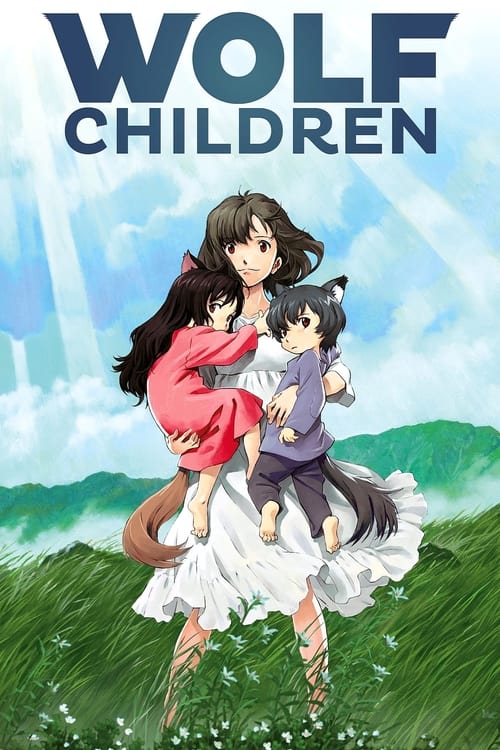
Wolf Children
Wolf Children Is About the Moment a Mother's Job Becomes to Let Her Children Choose What They Are
Directed by Mamoru Hosoda
Hosoda made a film about raising two children who are literally half-wild, and it turns out to be the truest film about parenting ever animated: your love builds the container, then your love has to open its hands.
Wolf Children is not a fantasy about werewolves. The wolf is the mechanism that makes visible what is normally invisible: every child carries a dual nature, a socialized human self and a wild instinctual self, and the entire task of raising them is to protect both long enough that the child can eventually choose the balance between them. Hana raises Yuki and Ame alone after their wolf-man father dies in a storm drain, mistaken for a stray. She moves to the mountains so her children can be wolf or human without anyone forcing the choice. The film's real subject is the hardest truth of parenthood: you give everything to keep them safe, and then the safety you built must be released so they can become themselves rather than yours.
Jungian Reading: Yuki and Ame as the Two Halves of the Instinctual Self, Splitting
Yuki and Ame begin as one thing, wolf-children, and slowly polarize into opposites. Yuki, wild and loud as a toddler, chooses the human world: she starts school, hides her tail, falls for a boy, decides to belong. Ame, timid and clinging as a child, chooses the wolf: he stops attending school, apprentices himself to an old fox on the mountain, and walks into the forest to become its guardian. This is the psyche's instinctual nature dividing into its two legitimate expressions, the drive to belong and the drive to be free, neither wrong.
Hosoda gives the split a precise hinge. In the storm sequence, Yuki fights her way to the school to reach the boy who has seen her tail, choosing connection at the cost of exposure. In the same storm, Ame runs the other direction, into the mountain, answering the wild that has been calling him. A mother learns which child she gets to keep by watching which way each one runs in the rain. The Jungian teaching is exact: the self individuates by choosing, and the parent's grief is that individuation looks identical to leaving.
Initiatory Reading: The Mountain as the Threshold Hana Cannot Cross for Him
Ame's arc is a clean initiation, and its power is that his initiator is not his mother. The old fox on the mountain is the true guide, the one who can teach him what Hana, being human, never could. Every initiation requires a mentor of the same nature as the thing being awakened, and the wound of Wolf Children is that Hana, who gave her whole life to her son, is structurally unable to be that mentor. She can raise the boy. She cannot induct the wolf.
The final ascent is the initiatory departure rendered without ceremony. Ame, now grown into his wolf form, leads Hana partway up the mountain and then stops. He will not come home. She calls after him the way a mother calls, and then, in the film's bravest gesture, she stops calling and says only that she wants him to live well. That is the initiate crossing the threshold and the guardian, this time the mother, releasing him to the world he was made for. She hears his howl from the peak. She does not follow it. The initiation is complete precisely because she lets it be his and not hers.
Questions this film answers
What is the deeper meaning of Wolf Children?
Wolf Children is not a fantasy about werewolves. The wolf is the mechanism that makes visible what is normally invisible: every child carries a dual nature, a socialized human self and a wild instinctual self, and the entire task of raising them is to protect both long enough that the child can eventually choose the balance between them. Hana raises Yuki and Ame alone after their wolf-man father dies in a storm drain, mistaken for a stray. She moves to the mountains so her children can be wolf or human without anyone forcing the choice. The film's real subject is the hardest truth of parenthood: you give everything to keep them safe, and then the safety you built must be released so they can become themselves rather than yours.
What is the hidden symbolism in Wolf Children?
Yuki and Ame begin as one thing, wolf-children, and slowly polarize into opposites. Yuki, wild and loud as a toddler, chooses the human world: she starts school, hides her tail, falls for a boy, decides to belong. Ame, timid and clinging as a child, chooses the wolf: he stops attending school, apprentices himself to an old fox on the mountain, and walks into the forest to become its guardian. This is the psyche's instinctual nature dividing into its two legitimate expressions, the drive to belong and the drive to be free, neither wrong.
What esoteric traditions appear in Wolf Children?
Wolf Children draws from Jungian, Initiation traditions. Hosoda made a film about raising two children who are literally half-wild, and it turns out to be the truest film about parenting ever animated: your love builds the container, then your love has to open its hands.
Is Wolf Children worth watching for spiritual seekers?
Wolf Children (2012) directed by Mamoru Hosoda is essential viewing for those interested in Jungian, Initiation. Wolf Children Is About the Moment a Mother's Job Becomes to Let Her Children Choose What They Are. It rewards multiple viewings and contemplation.
Rewatch With New Eyes
Now that you've seen the architecture, experience it again. The same film becomes a different film when you know what to watch for.
This time, watch for:
- Meet the shadow: what is rejected, projected, and finally integrated
- Mark the threshold: the old self dies, the ordeal transforms, the new self returns
Links may include affiliate partnerships that support Media Revelations
The Descent Continues
Where this thread leads next.
Only Yesterday 1991
Only Yesterday Is About the Child Who Waits Inside You Until You Finally Choose the Life She Wanted
Read the revelation →