Zardoz
The Immortals in Zardoz Are Already Dead, Only the Savage Knows It
Directed by John Boorman
John Boorman hid a complete Gnostic cosmology inside a 1974 film about a man in a red diaper, and the absurdity was the camouflage.
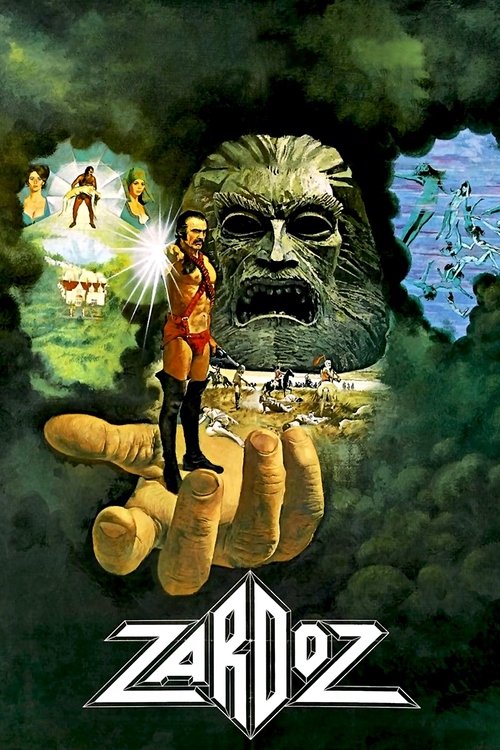
A flying stone head drifts over a scorched wasteland and delivers rifles to the men below, intoning: "The gun is good. The penis is evil." These are not the words of a god. They are the instructions of an archon, the Gnostic term for the false powers that govern material existence by controlling what the soul is allowed to desire. The worshippers are called Brutals. The god is called Zardoz, a corruption of the Wizard of Oz, which is itself a corruption of the word behind the curtain. Zed, one of the Brutals, hides inside the stone head, kills the man operating it, and emerges inside the Vortex: a sealed paradise where immortal humans have lived for centuries, dreaming and forgetting how to die. The Vortex is the most complete cinematic image of Demiurgic imprisonment ever committed to film, and Boorman shot it in 1974.
Gnostic: The Tabernacle Is the Demiurge, and the Brutals Worship Its Shadow
The Eternals are connected through a living collective mind called the Tabernacle. It stores all memory, adjudicates all disputes, monitors every thought. No secrets are possible inside the Vortex. The Tabernacle knows before the Eternal knows. This is not heaven. It is the archontic surveillance system that Gnostic cosmology describes as the mechanism of the Demiurge: a false intelligence that sustains the illusion of order by eliminating the interiority that makes consciousness real.
The Brutals outside worship Zardoz and receive guns. The guns maintain the separation of worlds. The Eternals designed the whole apparatus, Zardoz, the Brutals, the worship, the violence, to protect their enclosure from the one thing that could dissolve it: death. Arthur Frayn, the Eternal who operated Zardoz from inside its mouth, chose Zed deliberately. He seeded him with books, with literacy, with the capacity to see through the curtain, because some part of the Tabernacle had grown tired of its own immortality and arranged for its own dissolution. The Demiurge, in Gnostic myth, is not simply evil. It is ignorant. And ignorance, sustained long enough, begins to hunger for its own correction.
Zed penetrates the Vortex and the Tabernacle cannot contain him. Every Eternal who encounters him is flooded with what they had sealed away: rage, hunger, desire, grief. One woman has an orgasm at the sight of him. Another kills for the first time in centuries. His presence is gnosis arriving in the body, the pneumatic spark the archons cannot digest.
Jungian: The Vortex Is Shadow-Free, and Shadow-Free Means Dead
The Eternals have no shadow. Their telepathic hive ensures nothing stays unconscious. Every impulse surfaces immediately and is processed collectively, producing a population without genuine individuation, without desire, without the capacity to surprise themselves. Jung's central claim is that wholeness requires integration of the shadow, not its elimination, that a psyche without darkness is a psyche without depth, and a psyche without depth will eventually produce what it refused to feel.
Watch the Eternals who have stagnated longest. They have withdrawn into catatonia, called "Apathy" by the others. They are not meditating. They are empty. The shadow, denied long enough, does not disappear. It produces a living death: the body sustained, the self evacuated. Zed walks in and the shadow walks with him. The Vortex does not fall because he destroys it. It falls because it had been consuming itself for centuries, and he gave it permission to finish.
The same terminal immortality runs through Logan's Run, where the city's death prohibition produces a civilization that has forgotten what life costs, and The Man Who Fell to Earth, where an outsider bearing genuine difference is slowly digested by the closed world he entered. For the Gnostic cosmology at full amplitude, El Topo traces the same arc, the sacred fool moving through a world of false gods toward a death that is the only real liberation available.
Questions this film answers
What is the deeper meaning of Zardoz?
A flying stone head drifts over a scorched wasteland and delivers rifles to the men below, intoning: "The gun is good. The penis is evil." These are not the words of a god. They are the instructions of an archon, the Gnostic term for the false powers that govern material existence by controlling what the soul is allowed to desire. The worshippers are called Brutals. The god is called Zardoz, a corruption of the Wizard of Oz, which is itself a corruption of the word behind the curtain. Zed, one of the Brutals, hides inside the stone head, kills the man operating it, and emerges inside the Vortex: a sealed paradise where immortal humans have lived for centuries, dreaming and forgetting how to die. The Vortex is the most complete cinematic image of Demiurgic imprisonment ever committed to film, and Boorman shot it in 1974.
What is the hidden symbolism in Zardoz?
The Eternals are connected through a living collective mind called the Tabernacle. It stores all memory, adjudicates all disputes, monitors every thought. No secrets are possible inside the Vortex. The Tabernacle knows before the Eternal knows. This is not heaven. It is the archontic surveillance system that Gnostic cosmology describes as the mechanism of the Demiurge: a false intelligence that sustains the illusion of order by eliminating the interiority that makes consciousness real.
What esoteric traditions appear in Zardoz?
Zardoz draws from Gnosticism, Jungian traditions. John Boorman hid a complete Gnostic cosmology inside a 1974 film about a man in a red diaper, and the absurdity was the camouflage.
Is Zardoz worth watching for spiritual seekers?
Zardoz (1974) directed by John Boorman is essential viewing for those interested in Gnosticism, Jungian. The Immortals in Zardoz Are Already Dead, Only the Savage Knows It. It rewards multiple viewings and contemplation.
Rewatch With New Eyes
Now that you've seen the architecture, experience it again. The same film becomes a different film when you know what to watch for.
This time, watch for:
- Watch for the false world vs. the real — who is asleep, who awakens
- Meet the shadow: what is rejected, projected, and finally integrated
Links may include affiliate partnerships that support Media Revelations