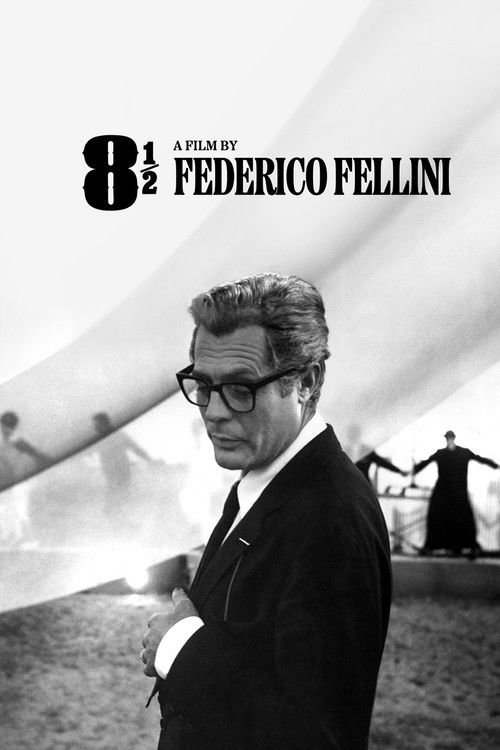
8½
8½ Is a Director Who Can Only Finish His Film by Admitting He Will Never Finish Himself
Directed by Federico Fellini
Fellini made a film about being unable to make a film, and solved the block by putting the block on screen. The confession was the cure.
Guido Anselmi is a celebrated director with a vast science-fiction set already built, a rocket-launch tower rising over the lot, and no film to shoot. He is creatively dead, hiding at a spa, fending off his producer, his writer, his mistress, and his wife, while everyone demands to know what the picture is about. He does not know. The film moves without warning between his present, his memories, his fantasies, and his dreams, and Fellini refuses to label the seams, so childhood, adultery, and hallucination arrive in one continuous flow. Guido is not gathering material. He is drowning in it. The famous ending, where every person from his life joins hands and circles in a ring while Guido finally picks up a megaphone and directs them, is not a plot resolution. It is a man ceasing to fight his own contents and choosing instead to conduct them.
Jungian Reading: The Ring of the Whole Cast Is Guido Meeting His Own Psyche
Jung's process of individuation is the slow work of integrating every disowned figure of the psyche into a conscious whole, presided over by a self that no longer flees its own complexity. Guido spends the film running from figures who are all facets of himself: the anima appears split across the pure Claudia, the earthy Carla, the reproachful Luisa, and the buried Saraghina of his childhood, the monstrous peasant woman who first showed him the body. His critic, forever pronouncing his ideas dead, is his own censoring intellect made flesh, and Fellini has him literally hanged in a fantasy, then restored, because the inner critic cannot actually be killed.
The Saraghina memory is the hinge. The boy Guido is dragged before the priests for watching her dance and is shamed for it, and the adult director has been split ever since between the sacred woman and the profane one, unable to hold both. Individuation is not choosing one figure over the others. It is standing in the center while all of them circle. The closing ring is that image exactly. Guido stops selecting and rejecting, takes up the megaphone, and directs the whole procession of wives, lovers, parents, and clowns as a single dance. The self assumes command not by conquering the psyche but by orchestrating it.
Alchemical Reading: The Spa Waters and the Descent That Precedes the Gold
The alchemical work opens in the nigredo, the blackening, a putrefaction and near-suicide of the operator before anything can be reborn, and it is often bracketed by water, the solutio that dissolves the fixed self so it can be recast. Fellini opens 8½ underwater and in traffic, Guido suffocating in his car, then floating up, then yanked down by a rope, the dream of a man being dissolved. The spa itself, where the film's present unfolds, is a place of healing waters, the vessel of solutio where the rigid director is meant to come apart and be reconstituted.
The lowest point is literal: a fantasy of the film's press conference where Guido crawls under a table and shoots himself, the ego's death that the work requires. Only after that death does the rebirth arrive, and Fellini stages it as pure white, the albedo, the whitening that follows the black, the whole cast in white beneath white lights joining the circle. The gold Guido produces is not the abandoned space epic. It is the film we are watching, made from the very confession of failure, base lead admitted openly and turned, by that admission, into the work.
Questions this film answers
What is the deeper meaning of 8½?
Guido Anselmi is a celebrated director with a vast science-fiction set already built, a rocket-launch tower rising over the lot, and no film to shoot. He is creatively dead, hiding at a spa, fending off his producer, his writer, his mistress, and his wife, while everyone demands to know what the picture is about. He does not know. The film moves without warning between his present, his memories, his fantasies, and his dreams, and Fellini refuses to label the seams, so childhood, adultery, and hallucination arrive in one continuous flow. Guido is not gathering material. He is drowning in it. The famous ending, where every person from his life joins hands and circles in a ring while Guido finally picks up a megaphone and directs them, is not a plot resolution. It is a man ceasing to fight his own contents and choosing instead to conduct them.
What is the hidden symbolism in 8½?
Jung's process of individuation is the slow work of integrating every disowned figure of the psyche into a conscious whole, presided over by a self that no longer flees its own complexity. Guido spends the film running from figures who are all facets of himself: the anima appears split across the pure Claudia, the earthy Carla, the reproachful Luisa, and the buried Saraghina of his childhood, the monstrous peasant woman who first showed him the body. His critic, forever pronouncing his ideas dead, is his own censoring intellect made flesh, and Fellini has him literally hanged in a fantasy, then restored, because the inner critic cannot actually be killed.
What esoteric traditions appear in 8½?
8½ draws from Jungian, Alchemy traditions. Fellini made a film about being unable to make a film, and solved the block by putting the block on screen. The confession was the cure.
Is 8½ worth watching for spiritual seekers?
8½ (1963) directed by Federico Fellini is essential viewing for those interested in Jungian, Alchemy. 8½ Is a Director Who Can Only Finish His Film by Admitting He Will Never Finish Himself. It rewards multiple viewings and contemplation.
Rewatch With New Eyes
Now that you've seen the architecture, experience it again. The same film becomes a different film when you know what to watch for.
This time, watch for:
- Meet the shadow: what is rejected, projected, and finally integrated
- Track the stages: blackening, whitening, reddening — death before rebirth
Links may include affiliate partnerships that support Media Revelations
The Descent Continues
Where this thread leads next.
The Blood of a Poet 1932
The Blood of a Poet Is What Happens When an Artist Follows His Own Image Through the Glass
Read the revelation →