The Shawshank Redemption
The Cell as Initiation Chamber
Directed by Frank Darabont
Shawshank is not a prison film. It is the most precisely structured initiation narrative in modern American cinema, told in the language of incarceration so that audiences who would never sit through a mystery school text would receive its instructions. Andy is the initiate. Red is the elder. The tunnel through the wall is the threshold that cannot be opened all at once because the candidate is not ready all at once.
Shawshank works on every viewer because it is operating on every viewer at a level beneath conscious reception. Darabont — adapting King — built a film with the architecture of a mystery school initiation: enclosure, ordeal, the patient excavation of a hidden passage, ritual death by drowning in the sewer pipe, rebirth into rain on the other side of the wall. Andy Dufresne is not a wrongly imprisoned banker. He is the soul under the regime of the Demiurge, building his exit one cup of stone dust at a time, performing the labor that the labor itself transforms. Red is the seasoned initiate who has nearly given up — until contact with someone still in motion reminds him that motion is possible. The film is so beloved because the architecture of the story is the architecture of an actual transformation, and viewers feel it whether or not they have words for what they are feeling.
The Surface
A banker is convicted of murdering his wife. He goes to a brutal prison. Over nineteen years he wins small dignities for the inmates, runs the warden's money-laundering operation under duress, befriends an older lifer named Red, and finally escapes through a tunnel he has been digging the entire time. He surfaces in a Mexican fishing village. Red joins him there after parole. The credits roll on a wide blue ocean and a feeling most films do not earn.
On surface, this is a melodrama about institutional cruelty and the friendship that survives it. It is also widely regarded — by IMDb users, by general audiences — as the greatest film ever made. The disproportion between the film's modest box office at release and its later beatification is itself diagnostic. The film does something to viewers that they have to come back to to fully receive.
What it does is run an initiation curriculum in the disguise of a prison story. The disguise is necessary. Most viewers would not consent to a Hermetic tract. They will consent to Tim Robbins and Morgan Freeman.
The Cell as Containment Vessel
Alchemy is performed inside a sealed vessel. The vas hermeticum holds the materia while heat is applied. Premature opening ruins the operation. The prisoner cannot leave; that is precisely what makes the prisoner a candidate for transformation. The vessel and the heat are the work.
Shawshank is the vessel. The warden is the heat. Andy is the prima materia, the raw stuff that has not yet become what it will be. The film makes the alchemical structure literal: Andy spends almost two decades being slowly cooked under conditions he cannot escape. The cooking is the curriculum. A man who escaped on day one would not be the man who emerges on day nineteen.
Darabont's most precise touch is the rock hammer. It is small. It is patient. It is the only tool Andy has, and he uses it for twenty years. This is the alchemical doctrine of festina lente — make haste slowly. The transformation cannot be rushed. Each cup of dust carried out in the trousers is part of the work. Red's voice-over insists that geology is the study of pressure and time. The film keeps telling you what it is doing. Few viewers register it because the film also wraps the doctrine in friendship and music and small triumphs.
The poster on the wall is the most efficient symbol in the film. It conceals the tunnel. It is also itself the image of the destination — a woman, a star, a state of yearning made visible. The work is hidden behind the longing. Every initiate learns this. The desire is what permits the digging. Remove the desire and the digging stops.
Sparagmos in the Sewer
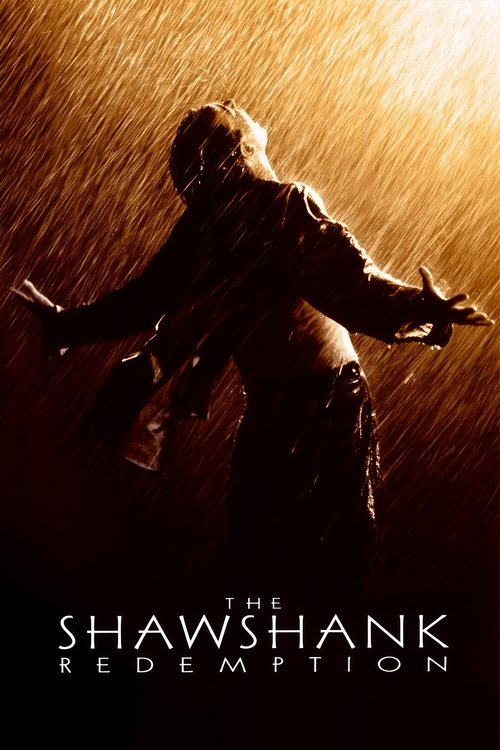
The escape sequence is the film's mystery rite. Andy crawls through five hundred yards of sewage pipe. He emerges in a rainstorm, strips off his prison-issue shirt, raises his arms to the sky. The camera pulls back. Thunder. Renewal.
This is initiation imagery so direct that most religious traditions would recognize it immediately. Descent through filth is sparagmos — the tearing apart of the old self in its most degraded form. The candidate must pass through the unbearable. The pipe full of human waste is the underworld in its most literal modern form. The body that crawls in is not the body that emerges.
Baptism is the obvious reference. The rain is not weather. The rain is the alchemical washing, the albedo arriving after the long nigredo of the prison years. Andy does not just escape the prison. He sheds the identity that was imprisoned. The man with his arms raised in the rain is not the banker who was sentenced. The banker is dead. The new man does not have a name yet, which is why he needs Zihuatanejo — a place chosen for its sound, its blankness, its position outside the structures that produced the prior name.
Initiations across cultures share this template: enclosure, ordeal, descent, rebirth. The Eleusinian mysteries, the Mithraic mysteries, the Christian baptismal liturgy, indigenous vision quests. The pattern is consistent because the pattern is what produces the result. Darabont, perhaps without knowing he was doing so, rebuilt the template from constituent parts.
Red and the Institutionalized Soul
Brooks Hatlen is the warning. The librarian who has been inside so long he cannot live outside. His suicide in the halfway house is the film's most underrated scene. Brooks is the Gnostic diagnosis of what happens to the soul that has accepted the prison as its real home. The walls become identity. The schedule becomes the self. When the walls are removed, there is nothing left.
Red is heading the same way. He says it himself, near the end: 'These walls are funny. First you hate 'em, then you get used to 'em. Enough time passes, you get so you depend on them. That's being institutionalized.' This is one of the most precise descriptions of consensus reality available in popular film. The institution does not need to be a literal prison. Most people are institutionalized into structures whose walls they have stopped seeing. The structure has become the air.
What saves Red is not the parole. The parole nearly destroys him — he stands in the same halfway house room where Brooks died, and the scene is staged identically until the camera lingers on the carved name 'Brooks was here' and Red adds 'so was Red.' What saves Red is the obligation Andy planted in him. The promise to go to the field, to find the box, to receive the message that there is still a destination. The pneumatic spark Andy lit in him is what keeps him moving.
Hope, Andy tells him, is a good thing — maybe the best of things. Red disagrees inside the prison. Red is right inside the prison. Hope inside a Gnostic prison is dangerous. But hope is the only mechanism that gets the pneumatic across the threshold once the wall has been opened. The film distinguishes precisely between the hope that keeps you suffering and the hope that calls you out. Most viewers conflate them. The film does not.
The Warden and the False God
Warden Norton is a Bible-quoting hypocrite. The film does not subtly suggest this; it shows him with a verse on the wall and a corruption ledger in the safe behind the verse. Norton is the Demiurge in his most exact contemporary guise: the authority who claims to administer righteousness while using the machinery of righteousness as a personal extraction system.
He is not a competent villain. He is a corrupt manager. Gnostic teaching has always understood this. The Demiurge is not a powerful enemy. The Demiurge is an administrator who has confused his administration for the cosmos. Norton thinks Shawshank is his. He thinks Andy is his. He thinks the system will protect him because he has profited the system. The film's most satisfying beat is the moment Norton realizes the system will not protect him — that the safe contains the evidence, that Andy has been routing the laundering into a fictional identity, that the moves Norton thought he was making were actually being made on him.
Norton's suicide is the Demiurge falling. Not because he was defeated by force. Because the consciousness he tried to contain has reached the level of the cosmos itself — the press, the state police, the federal authorities — and the local jurisdiction of the Demiurge has been overruled by a higher order. The Pleroma in this film is the world outside the prison, but it is also the principle that institutional corruption cannot indefinitely contain genuine intelligence. Andy's intelligence wins because it operates at a level Norton cannot see.
The final shot of Norton — gun to head, painted verse on the wall — is a precise theological image. The false god, surrounded by the iconography of the true one, exits the world he could not actually rule.
The Transmission
Shawshank does what very few popular films achieve: it transmits the actual feeling of patient, multi-year transformation. Most films cheat. They show transformation as a montage compressed into ninety seconds. Shawshank gives it nineteen years and lets you feel each year's weight. By the end, when the camera tracks across the empty cell and the warden screams, the relief the audience feels is not vicarious — it is structural. They have been inside that cell for the length of the film. They have done the time alongside Andy. The escape is theirs.
What it transmits is the discipline of long patience under conditions you did not choose. Andy does not rage against the prison. He does not stage a heroic revolt. He works. He files books. He helps inmates pass their GEDs. He builds the library. He plays Mozart over the loudspeaker because beauty matters even here. He is performing, inside the prison, the kind of life he intends to perform outside it. The escape, when it comes, is not a rupture from his prior life. It is the continuation of the work into different geography.
This is the film's most counterintuitive teaching. The initiate does not escape by hating the prison. The initiate escapes by becoming a person the prison can no longer contain. The transformation precedes the exit. The wall opens when the work is complete, not before. Hope is what enables the work. Patience is the form of the work. And the destination — the warm Pacific water, the small boat, the old friend rejoined — is what the work was always for.
Questions this film answers
What is the deeper meaning of The Shawshank Redemption?
Shawshank works on every viewer because it is operating on every viewer at a level beneath conscious reception. Darabont — adapting King — built a film with the architecture of a mystery school initiation: enclosure, ordeal, the patient excavation of a hidden passage, ritual death by drowning in the sewer pipe, rebirth into rain on the other side of the wall. Andy Dufresne is not a wrongly imprisoned banker. He is the soul under the regime of the Demiurge, building his exit one cup of stone dust at a time, performing the labor that the labor itself transforms. Red is the seasoned initiate who has nearly given up — until contact with someone still in motion reminds him that motion is possible. The film is so beloved because the architecture of the story is the architecture of an actual transformation, and viewers feel it whether or not they have words for what they are feeling.
What is the hidden symbolism in The Shawshank Redemption?
A banker is convicted of murdering his wife. He goes to a brutal prison. Over nineteen years he wins small dignities for the inmates, runs the warden's money-laundering operation under duress, befriends an older lifer named Red, and finally escapes through a tunnel he has been digging the entire time. He surfaces in a Mexican fishing village. Red joins him there after parole. The credits roll on a wide blue ocean and a feeling most films do not earn.
What esoteric traditions appear in The Shawshank Redemption?
The Shawshank Redemption draws from Initiation, Alchemy, Gnosticism traditions. Shawshank is not a prison film. It is the most precisely structured initiation narrative in modern American cinema, told in the language of incarceration so that audiences who would never sit through a mystery school text would receive its instructions. Andy is the initiate. Red is the elder. The tunnel through the wall is the threshold that cannot be opened all at once because the candidate is not ready all at once.
What does The Shawshank Redemption teach about the cell as containment vessel?
A man who escaped on day one would not be the man who emerges on day nineteen. The cooking is the curriculum. Alchemy is performed inside a sealed vessel. The vas hermeticum holds the materia while heat is applied. Premature opening ruins the operation. The prisoner cannot leave; that is precisely what makes the prisoner a candidate for transformation. The vessel and the heat are the work.
What does The Shawshank Redemption teach about sparagmos in the sewer?
The body that crawls in is not the body that emerges. The man with his arms raised in the rain is not the banker who was sentenced. The escape sequence is the film's mystery rite. Andy crawls through five hundred yards of sewage pipe. He emerges in a rainstorm, strips off his prison-issue shirt, raises his arms to the sky. The camera pulls back. Thunder. Renewal.
What does The Shawshank Redemption teach about red and the institutionalized soul?
Most people are institutionalized into structures whose walls they have stopped seeing. The structure has become the air. Brooks Hatlen is the warning. The librarian who has been inside so long he cannot live outside. His suicide in the halfway house is the film's most underrated scene. Brooks is the Gnostic diagnosis of what happens to the soul that has accepted the prison as its real home. The walls become identity. The schedule becomes the self. When the walls are removed, there is nothing left.
Is The Shawshank Redemption worth watching for spiritual seekers?
The Shawshank Redemption (1994) directed by Frank Darabont is essential viewing for those interested in Initiation, Alchemy, Gnosticism. The Cell as Initiation Chamber. It rewards multiple viewings and contemplation.
Rewatch With New Eyes
Now that you've seen the architecture, experience it again. The same film becomes a different film when you know what to watch for.
This time, watch for:
- Mark the threshold: the old self dies, the ordeal transforms, the new self returns
- Track the stages: blackening, whitening, reddening — death before rebirth
- Watch for the false world vs. the real — who is asleep, who awakens
Links may include affiliate partnerships that support Media Revelations
The Descent Continues
Where this thread leads next.

The Matrix 1999
The Gnostic Gospel of the Machine Age
Read the revelation →