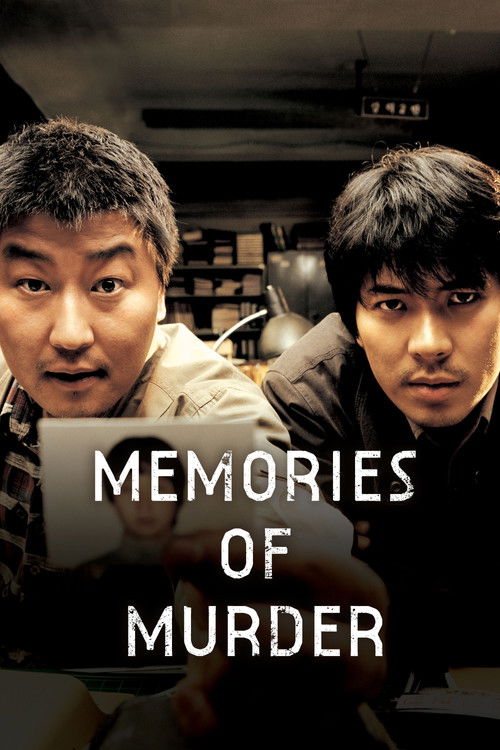
Memories of Murder
Memories of Murder Is About a Face You Are Never Allowed to See
Directed by Bong Joon Ho
Bong Joon Ho took the real, unsolved Hwaseong killings and built a film that ends by looking straight at you. The detective who could not find the answer is now asking whether you are it.
Two detectives hunt a serial murderer across the rice fields of 1986 South Korea. Detective Park works by intuition, staring into suspects' eyes because he believes a guilty man reveals himself through the face. Detective Seo works by evidence, files, patience. Both fail. The murders stop not because the case is solved but because the killer simply stops. The surface reading calls this a procedural about incompetence under a military dictatorship. What Bong actually made is a film about a specific spiritual injury: the discovery that the world does not owe you a knowable culprit, that evil can be a vacancy rather than a person, and that the human need for a face to blame is itself a form of blindness. Park's method assumes the truth is legible in a countenance. The film spends two hours proving that assumption is a religion, and then it destroys the temple.
Gnostic Reading: The World Is Governed by an Absence That Wears No Face
Gnostic cosmology holds that the visible world is misruled, that the powers ordering it are blind and cannot be petitioned. The Hwaseong killer functions in the film exactly as the Gnostic archon functions: he acts through the whole apparatus of the world, on rainy nights, near the radio song he requests before each kill, yet he cannot be located because he was never a discrete object to begin with. He is the malice of the order itself. Notice how the state mirrors him. The police torture the wrong men into false confessions, the military is busy suppressing protests and cannot spare the manpower to guard the fields, the one piece of physical evidence must be mailed to America because Korea has no lab to read it. Every institution that should reveal the truth instead conceals it. This is the Demiurge's world: a system that generates the appearance of investigation while structurally guaranteeing that gnosis never arrives. The killer is not hiding in the world. He is the world's own principle, and the detectives are pneumatics trapped inside a machine built to keep them from waking.
Shamanic Reading: Park's Eyes Are a Broken Diagnostic Organ
The shaman's oldest claim is that certain people can see the unseen cause, can look at a sick body or a cursed village and perceive the spirit responsible. Detective Park believes he is this kind of seer. His entire method is ocular: he stares into faces, convinced that guilt radiates from the eyes, that a shaman-detective can simply behold the culprit and know. Early in the film this looks like folk wisdom, and Bong lets us half-believe it. Then comes the diagnostic failure. The lab report from America clears the prime suspect, the young factory worker whose face Park had read as guilty. Park's response is the film's spiritual climax: he grabs the man's face and stares into it, still trying to see, and sees nothing. The sight-organ that was supposed to reveal the spirit is dead. The film's final shot completes the collapse. Decades later, Park, now a civilian, looks directly into the camera after a girl tells him the killer looked ordinary. He is staring at every face in the audience, the seer whose vision returns nothing but the ordinary. The gift was never real, or the world stopped answering to it.
Questions this film answers
What is the deeper meaning of Memories of Murder?
Two detectives hunt a serial murderer across the rice fields of 1986 South Korea. Detective Park works by intuition, staring into suspects' eyes because he believes a guilty man reveals himself through the face. Detective Seo works by evidence, files, patience. Both fail. The murders stop not because the case is solved but because the killer simply stops. The surface reading calls this a procedural about incompetence under a military dictatorship. What Bong actually made is a film about a specific spiritual injury: the discovery that the world does not owe you a knowable culprit, that evil can be a vacancy rather than a person, and that the human need for a face to blame is itself a form of blindness. Park's method assumes the truth is legible in a countenance. The film spends two hours proving that assumption is a religion, and then it destroys the temple.
What is the hidden symbolism in Memories of Murder?
Gnostic cosmology holds that the visible world is misruled, that the powers ordering it are blind and cannot be petitioned. The Hwaseong killer functions in the film exactly as the Gnostic archon functions: he acts through the whole apparatus of the world, on rainy nights, near the radio song he requests before each kill, yet he cannot be located because he was never a discrete object to begin with. He is the malice of the order itself. Notice how the state mirrors him. The police torture the wrong men into false confessions, the military is busy suppressing protests and cannot spare the manpower to guard the fields, the one piece of physical evidence must be mailed to America because Korea has no lab to read it. Every institution that should reveal the truth instead conceals it. This is the Demiurge's world: a system that generates the appearance of investigation while structurally guaranteeing that gnosis never arrives. The killer is not hiding in the world. He is the world's own principle, and the detectives are pneumatics trapped inside a machine built to keep them from waking.
What esoteric traditions appear in Memories of Murder?
Memories of Murder draws from Gnosticism, Shamanism traditions. Bong Joon Ho took the real, unsolved Hwaseong killings and built a film that ends by looking straight at you. The detective who could not find the answer is now asking whether you are it.
Is Memories of Murder worth watching for spiritual seekers?
Memories of Murder (2003) directed by Bong Joon Ho is essential viewing for those interested in Gnosticism, Shamanism. Memories of Murder Is About a Face You Are Never Allowed to See. It rewards multiple viewings and contemplation.
Rewatch With New Eyes
Now that you've seen the architecture, experience it again. The same film becomes a different film when you know what to watch for.
This time, watch for:
- Watch for the false world vs. the real — who is asleep, who awakens
- Follow the descent: what dies, what guides, what returns transformed
Links may include affiliate partnerships that support Media Revelations
The Descent Continues
Where this thread leads next.
Zodiac 2007
Zodiac Is About the Damnation of Men Who Need the Answer More Than They Need Their Lives
Read the revelation →